
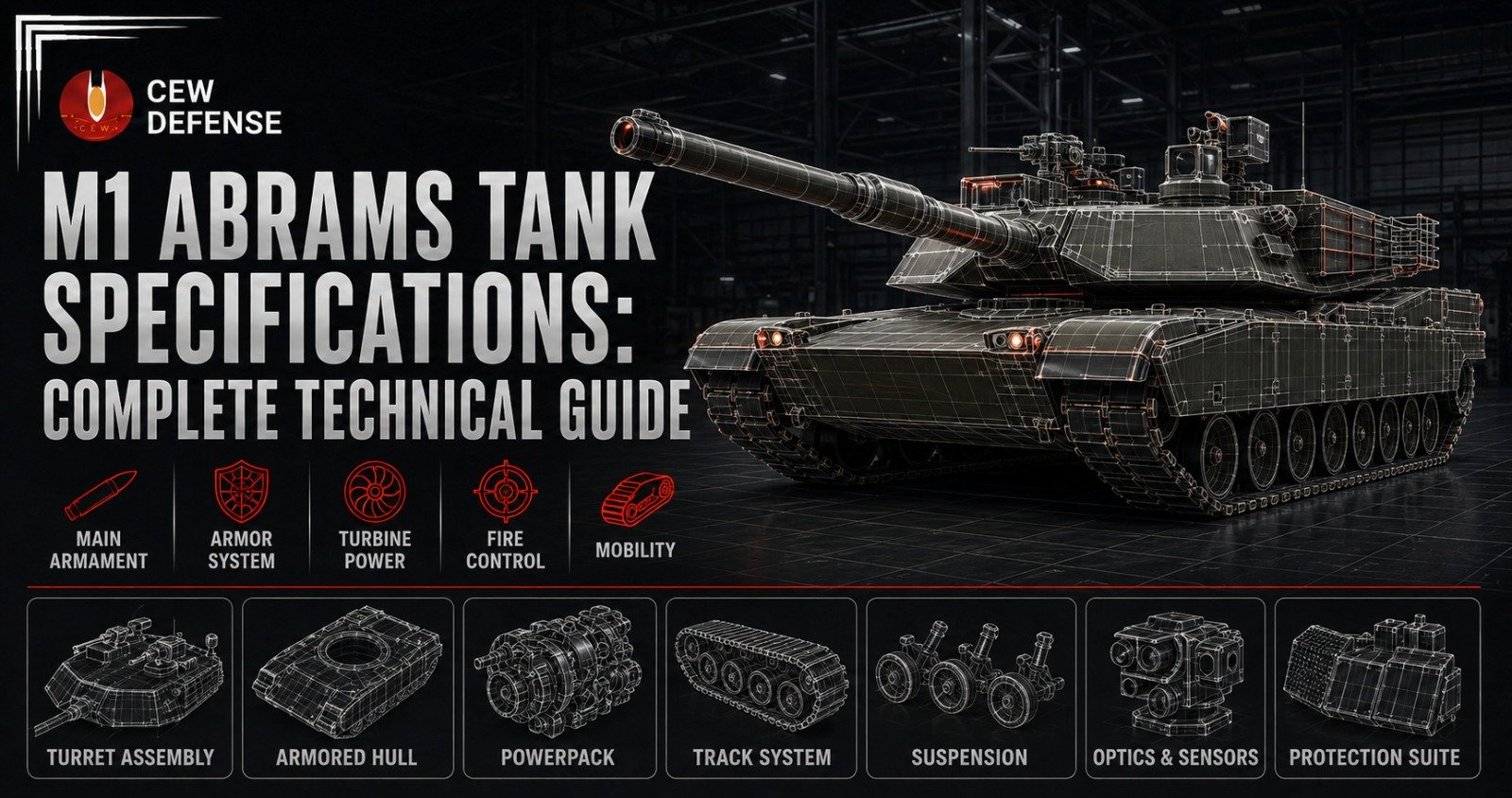
If you study modern ground combat, one vehicle commands serious respect from observers. This American main battle tank combines raw power with advanced physical protection. First rolling off the assembly line in the early nineteen eighties, it evolved constantly. Every new version improves combat abilities while keeping its original mission completely intact.
It is built to outmatch, outmaneuver, and outlast any enemy force on the field. To truly grasp why armies rely on it, you must look much closer. The M1 Abrams tank specifications reveal exactly how it maintains its legendary status now.
The Evolution of M1 Abrams Tank Specifications
The M1 Abrams tank specifications did not emerge overnight; they required serious engineering effort. They are the result of decades of combat experience and steady technological innovation. Originally developed by Chrysler Defense, the first M1 Abrams tank rolled off the line in 1980. It replaced the aging M60 Patton series with highly advanced operational features. Early models weighed around sixty short tons and mounted a 105mm M68 rifled gun.
This setup proved highly effective against Cold War-era Soviet armor on the battlefield. However, as threats evolved, the tank design had to adapt very quickly. The M1A1 variant entered active service in 1985 with a major firepower upgrade. It swapped the older gun for a far more potent 120mm M256 smoothbore cannon. This shift marked a significant leap in direct firepower and effective engagement range. Each subsequent upgrade has significantly enhanced survivability and networked warfare capabilities.
Core M1 Abrams Tank Specifications Across Variants
Understanding the M1 Abrams tank specifications requires examining key parameters across generations. The fundamental layout remains consistent with four crew members and a rear-mounted engine. However, the technical details have changed significantly over the years of active service. Below is a clear comparison of the major variants in service currently.
The table above highlights the steady weight gain from sixty tons to nearly 73.6 tons. This increase stems primarily from additional armor layers and advanced electronic combat suites. Yet remarkably, the top speed remains consistent across all modern variants of this vehicle. This is thanks to the Honeywell AGT-1500 gas turbine engine, delivering 1,500 horsepower.
This powerful engine allows the tank to accelerate from zero to twenty mph quickly. It maintains speeds up to forty-two miles per hour on paved roads with ease. Despite its massive weight, the Abrams retains excellent cross-country mobility in rough terrain. Its operational range stands at approximately 265 miles on internal fuel alone during operations.
Firepower and Lethality on the Battlefield
At the heart of the M1 Abrams tank specifications lies its serious battlefield firepower. The Abrams was engineered to destroy enemy armor before being seen or targeted directly. This doctrine is made possible by its main gun and advanced fire control system. The original M1 used the 105mm M68, a proven NATO-standard weapon for its time. It fired armor-piercing and high-explosive anti-tank rounds with deadly accuracy under pressure. By the mid-nineteen eighties, intelligence suggested newer enemy tanks would outclass this older gun.
Thus, the M1A1 adopted the 120mm M256 smoothbore gun for superior armor penetration. This cannon fires depleted uranium penetrators, offering exceptional armor penetration capabilities in combat. Each round weighs roughly forty pounds, and the tank carries forty rounds total. These are stored in blast-resistant compartments to minimize catastrophic explosion risks during combat.
Complementing the main gun are three essential machine guns for layered defensive coverage:
-
A 7.62mm M240 coaxial machine gun aligned directly with the main gun barrel.
-
A .50 caliber M2HB heavy machine gun mounted securely on the commander’s cupola.
-
Another 7.62mm M240 machine gun is positioned safely at the loader’s top hatch.
These weapons provide reliable defense against infantry and light vehicles in urban areas. In the latest M1A2 SEPv3 model, the heavy machine gun is often remote-controlled. This allows the commander to engage targets safely from inside the armored hull.
Armor and Protection Systems
Few aspects of the M1 Abrams tank specifications are as closely guarded as its armor. Officially described as composite or Chobham-type armor, the exact makeup remains closely guarded. Open-source analysis suggests a mix of ceramics, steel, and non-metallic protective layers. This design defeats both kinetic energy penetrators and chemical energy warheads effectively.
Later variants added depleted uranium mesh within the turret armor structure itself. This significantly boosted protection against armor-piercing rounds during active ground combat operations for crews. The newest models incorporate even denser composites and modular add-on survival kits for emerging threats.
Beyond passive armor, modern Abrams tanks feature several critical survival systems:
-
Automatic fire suppression systems in both crew and ammunition compartments activate instantly.
-
NBC overpressure protection guards against nuclear, biological, and chemical threats in the air.
-
Improved thermal sights provide clear vision during night and adverse weather operations.
-
Blue Force Tracking offers instant friendly force identification on the digital map.
The latest variant includes an under-armor auxiliary power unit for silent operations. This allows the tank to run electronics without idling the main engine loudly. It reduces thermal and acoustic signatures during stealth operations significantly and effectively.
Crew Roles and Responsibilities Inside the Tank
A successful tank relies heavily on the four highly trained individuals inside it. The commander oversees the entire vehicle and makes critical tactical decisions for the team. He utilizes advanced optics to scan the battlefield for potential threats and targets. The gunner is responsible for aiming and firing the main weapon system accurately.
He must track moving targets accurately while the vehicle is in rapid motion. The loader handles the heavy ammunition and assists with vehicle maintenance on a regular basis. He ensures the main gun is ready to fire at a moment's notice during intense combat. The driver navigates the massive vehicle through complex and dangerous terrain safely and very quickly. He relies on thermal sights to see clearly in total darkness and heavy battlefield smoke. Teamwork among these four members is absolutely essential for survival in active combat zones. Their coordinated efforts turn this massive machine into real, effective combat power for the army.
Mobility and Powertrain Details
One might assume a seventy-three-ton behemoth would be sluggish on the move during combat. However, the M1 Abrams tank specifications completely defy that common assumption. Powered by the AGT-1500 gas turbine, it achieves a strong power-to-weight ratio for heavy armor. Though less fuel-efficient than diesel engines, the turbine offers instant torque delivery for quick acceleration. It also provides multi-fuel capability, running on jet fuel, diesel, or gasoline for flexibility.
This flexibility is crucial for logistics in remote combat zones for maintaining steady supply lines. The suspension uses seven road wheels per side with heavy torsion bars for maximum stability. This enables stable gunnery even at high speeds over rough and uneven terrain conditions. Ground clearance exceeds eighteen inches, allowing easy traversal of trenches and heavy battlefield rubble. For logistical context, the tank’s overall width fits within standard rail transport limits easily. Its height allows safe operation under most bridges and forest canopies without any major issues.
Electronics and Situational Awareness
The leap from the base M1 to the M1A2 was a significant technological shift. The M1A2 introduced the Inter-Vehicular Information System for real-time data sharing across units. This enabled instant communication between tanks, command posts, and aircraft overhead for coordination. It transformed the Abrams from a standalone weapon into a networked combat node. The System Enhancement Package upgrades amplified this digital capability further over time for crews.
These modern upgrades include several key technological improvements for the crew inside the turret:
-
Color digital displays replace older, hard-to-read monochrome screens entirely for better visibility.
-
Thermal imaging works for the driver, gunner, and commander simultaneously at all times.
-
GPS integration and detailed digital mapping provide precise navigation in any terrain.
-
Enhanced processors allow for much faster target acquisition and tracking under pressure.
In the newest variant, these systems are hardened against electromagnetic pulse and cyber intrusion. The gunner’s primary sight now includes a second-generation forward-looking infrared sensor for night vision. This dramatically improves target detection at night or in heavy battlefield smoke for gunners. Such advancements mean crews can identify and engage threats faster than ever before. This sensor-to-shooter speed is as critical as raw armor in modern warfare scenarios.
Engineering Excellence Beyond the Battlefield
The precision engineering behind the M1 Abrams tank specifications mirrors specialized industrial applications. Just as defense contractors rely on high-integrity fabrication for armored vehicles, other sectors demand similar rigor. For instance, a stainless steel tank fabricator must ensure structural integrity and exact dimensional tolerances. These qualities are equally vital in military hardware, where failure is never an option.
Operational Legacy and Impact
Since its combat debut in Operation Desert Storm, the Abrams has proven its worth. It has performed reliably across deserts, cities, and mountainous regions alike for many years. During the Gulf War, these tanks destroyed hundreds of enemy vehicles with minimal losses. This showcased the lethality of superior optics, armor, and crew training combined in battle. Later deployments tested its adaptability in counterinsurgency roles and dense urban environments for troops.
The Abrams serves not only the United States military but also allied nations. Countries like Australia, Egypt, Iraq, Kuwait, Poland, and Saudi Arabia operate it regularly. Each operator tailors configurations to their specific regional needs and emerging threats carefully. The recent delivery of upgraded tanks to Ukraine underscores the platform’s continued relevance. These tanks arrive with updated communications and enhanced optics for modern conflicts abroad. This proves the design’s adaptability decades after its initial inception and first deployment.
Final Thought
The M1 Abrams tank specifications represent more than a simple list of numbers. They embody a clear philosophy of battlefield overmatch and crew survival in combat. Every ton of armor and every horsepower exists to ensure mission success for troops. Understanding these details provides a clear window into modern military engineering practices and design. It shows how strategy, technology, and human courage converge on the active battlefield. The Abrams remains the backbone of armored might, constantly upgraded and relentlessly tested.