
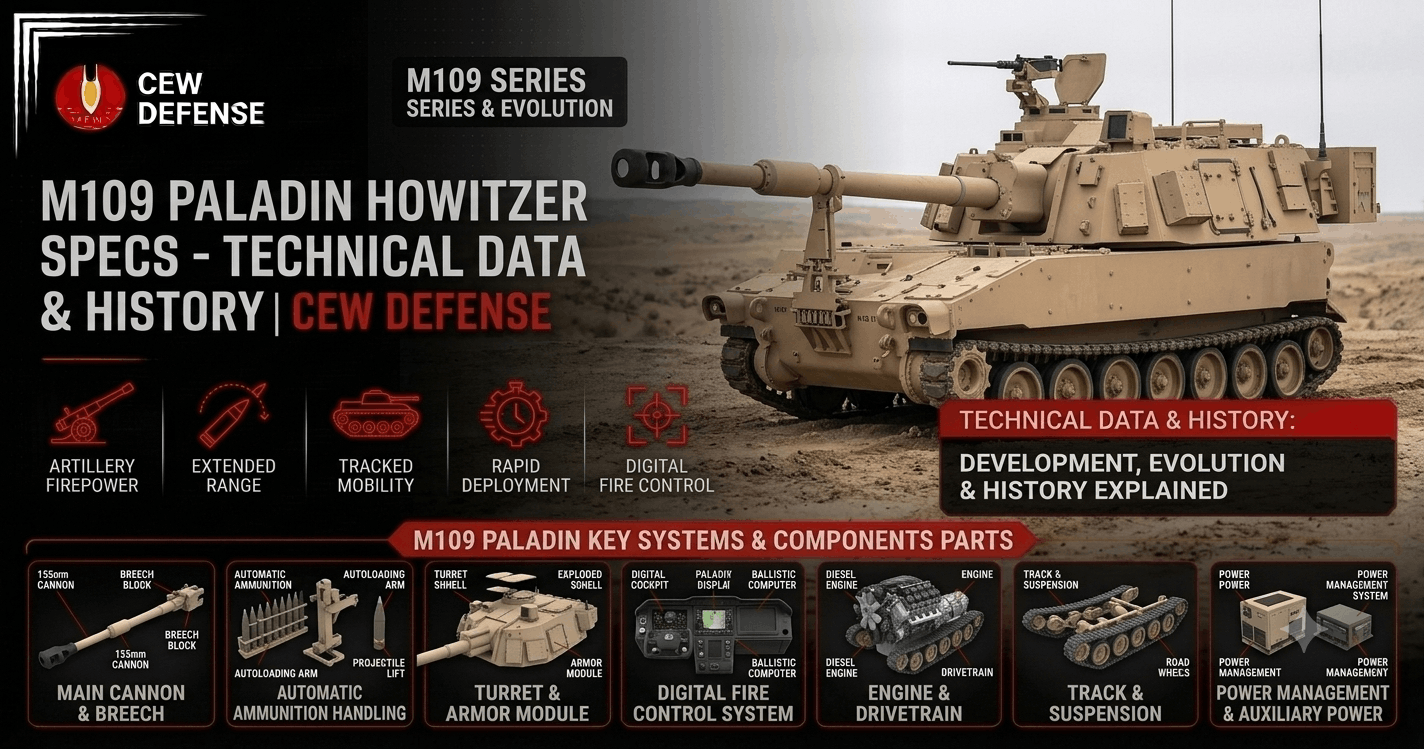
In this era modern battlefield dynamics demand robust platforms that seamlessly blend heavy ordnance with agile movement. The M109 Paladin howitzer stands as a premier tracked weapon system, providing mechanized divisions with immediate, devastating fire support. To guarantee maximum operational reliability under extreme stress, the production and maintenance of its critical defense components strictly adhere to ISO 9001:2015 quality management standards, frequently validated through comprehensive audits by certification bodies like TÜV Austria. Engineered to maneuver alongside main battle tanks, this formidable artillery piece delivers unparalleled tactical flexibility across diverse combat theaters.
Overview of the M109 Paladin howitzer
As a premier self-propelled artillery piece, this tracked fortress bridges the gap between raw explosive power and battlefield survivability. Its footprint allows it to traverse hostile environments while maintaining a low profile. The architecture of the unit prioritizes both personnel safety and rapid engagement, making it an indispensable asset for commanders seeking dominance over the horizon.
- Mission Role
The primary objective of this armored cannon is to deliver close, continuous, and counter-battery fire. It neutralizes enemy infantry, dismantles fortified bunkers, and intercepts opposing artillery batteries. By operating from concealed positions, the detachment can strike high-value targets deep behind enemy lines, disrupting supply chains and command nodes without exposing themselves to direct retaliation.
- Development History
When engineers first conceptualized the M109 Paladin howitzer, they aimed to replace older towed models with a highly mobile alternative. Tracing its lineage back to the early 1960s, the chassis evolved from the baseline through successive upgrades. Each generation integrated better metallurgy, advanced hydraulics, and sophisticated targeting arrays, culminating in the highly automated variants seen today.
- Key Variants
Over the decades, several distinct models have emerged. Early iterations featured rudimentary analog systems, while the A6 variant introduced digital automated controls. The latest A7 model shares critical components with modern infantry fighting vehicles. Export configurations also exist, tailored to the specific climatic and tactical requirements of allied nations worldwide.
Combat Design and Firepower
- 155mm Main Gun
The core firepower of the M109 Paladin howitzer relies on its massive 39-caliber (or longer in upgraded versions) cannon. This enormous barrel accommodates powerful propellant charges, enabling projectiles to reach distant coordinates. Advanced muzzle brakes and robust recoil mechanisms absorb the immense kinetic energy generated during firing, ensuring the hull remains stable on uneven terrain.
- Ammunition Compatibility
The breech is engineered to handle a diverse array of ordnance. Crews can load standard high-explosive shells, rocket-assisted projectiles for extended reach, and precision-guided munitions like the Excalibur. Furthermore, specialized rounds such as smoke screens, illumination flares, and dual-purpose improved conventional munitions provide tailored solutions for any tactical scenario.
- Fire Control System
Gone are the days of manual calculations. The modernized cabin features ruggedized displays, inertial navigation systems, and automated laying mechanisms. When target data streams in from forward observers, the onboard computers instantly calculate the necessary elevation and deflection. This seamless integration drastically reduces the time between receiving a mission and launching the first round.
Mobility and Vehicle Performance
- Powertrain
Propelling a machine of this magnitude requires a robust engine. Older models utilized heavy-duty diesel powerplants coupled with cross-drive transmissions. The latest iterations feature upgraded motors that deliver superior horsepower while consuming less fuel. This mechanical synergy ensures smooth acceleration and seamless gear shifts, even when fully loaded with ordnance.
- Cross-Country Mobility
Equipped with wide steel tracks and an advanced torsion bar suspension, the undercarriage glides over mud, snow, and rocky landscapes. The low ground pressure prevents the unit from sinking into soft soil, allowing it to maintain pace with main battle tanks. Such agility is crucial for executing rapid maneuvers during dynamic engagements.
- Operational Range
Fuel capacity and engine efficiency dictate how far the detachment can travel without logistical support. With internal tanks holding hundreds of gallons, the platform can cover substantial distances on a single fill-up. This endurance ensures that battalions can keep up with advancing armored columns without constantly halting for refueling.
Protection and Crew Systems
- Armor Protection
The hull is primarily constructed from welded aluminum to keep the overall weight manageable, while steel applique panels are bolted on for additional defense. This composite shielding guards the interior against small arms fire, shrapnel, and heavy machine-gun rounds. Reactive or slat armor upgrades can be fitted to counter shaped-charge threats.
- Crew Configuration
Operating such a complex machine requires a coordinated team. A typical detachment includes a driver, commander, gunner, and several ammunition handlers. The spacious turret and hull provide enough room for these personnel to work efficiently, with designated stations for loading, aiming, and navigating the vehicle safely under stress.
- Survivability Features
To endure harsh environments, the interior incorporates spall liners that catch fragments if the exterior is penetrated. A fully enclosed Nuclear, Biological, and Chemical (NBC) filtration system ensures the personnel can breathe safely in contaminated zones. Additionally, automatic fire suppression systems instantly extinguish engine or compartment blazes, preventing catastrophic explosions.
Operational Capabilities
- Rapid Deployment
A key tactical advantage of the M109 Paladin howitzer is its ability to execute "shoot-and-scoot" maneuvers. After launching a volley, the vehicle can immediately pack up and relocate before enemy radar pinpoints its location. This swift evasion protects the personnel from devastating counter-battery strikes, preserving the unit's combat effectiveness.
- High-Volume Fire Support
During intense engagements, the battery can unleash a barrage of shells within minutes. The automated loading aids and well-drilled personnel enable a high rate of sustained fire, saturating target grids with explosive fury. This overwhelming volume suppresses enemy movements and shatters defensive formations.
- Network-Centric Operations
Contemporary battlefields rely on interconnected data. This platform seamlessly integrates into broader tactical networks, receiving encrypted targeting packets from drones, satellites, and forward units. As highlighted by tactical reviews from C2W Defense, when operating alongside modern logistical and transport vehicles like the JLTV Oshkosh truck, the artillery battery ensures secure communication lines and rapid resupply, forming a cohesive, networked fighting force.
M109A7 Paladin Upgrades
- Enhanced Chassis
The transition to the A7 variant brought significant structural improvements. By adopting the powertrain and suspension of the Bradley Fighting Vehicle, engineers standardized parts across the fleet. This commonality simplifies maintenance, reduces spare parts inventory, and vastly improves the ride quality for the operators inside.
- Digital Systems
The cabin received a complete technological overhaul. Analog dials were replaced with high-resolution digital screens and an automotive-style steering wheel, eliminating the old control levers. Advanced diagnostic software alerts mechanics to potential faults before they cause breakdowns, keeping the fleet mission-ready at all times.
- Improved Reliability
The integration of a high-output generator provides ample electrical power for future energy-hungry systems. The continuous refinement of these mechanical and digital subsystems ensures that the platform can withstand the grueling demands of prolonged deployments without suffering critical failures.
Global Military Service
- U.S. Army Operations
American forces have relied on this tracked weapon since the Vietnam era, but it truly proved its worth during Desert Storm. It provided devastating preparatory barrages and continuous cover for advancing armor in Iraq and Afghanistan. Today, it remains the premier indirect fire solution for U.S. Armored Brigade Combat Teams.
- International Operators
Market analyses published by CEW Defense indicate that dozens of allied nations field this robust platform beyond the United States. Countries across the Middle East, Europe, and Asia have purchased various models to bolster their territorial defense. The widespread adoption highlights its reputation as a dependable, battle-tested machine.
- Combat Effectiveness
In modern combat, the M109 Paladin howitzer has repeatedly validated its design through real-world engagements. Its ability to deliver precision strikes from concealed locations demoralizes adversaries and destroys critical infrastructure. The psychological impact of incoming heavy ordnance often breaks enemy resolve before ground forces even make contact.
- Technical Specifications and Fleet Comparison
Future of the M109 Paladin howitzer
- Ongoing Modernization
Military planners are constantly seeking ways to extend the service life of this venerable system. Upgrades focus on integrating extended-range cannons, which push the maximum firing distance well beyond traditional limits. These enhancements ensure the platform remains lethal against increasingly sophisticated adversaries.
- Advanced Artillery Integration
Tomorrow's battlespace will feature autonomous loading mechanisms and hypersonic projectiles. Engineers are testing automated resupply vehicles that drive alongside the cannon, transferring shells without human intervention. This synergy will drastically increase the rate of fire while reducing crew fatigue.
- Long-Term Battlefield Role
Despite the emergence of wheeled and truck-mounted guns, the tracked configuration remains vital for heavily contested zones. The armor protection and off-road agility guarantee that this system will continue to dominate the artillery landscape for decades, serving as the ultimate hammer for mechanized infantry and armored divisions worldwide.