
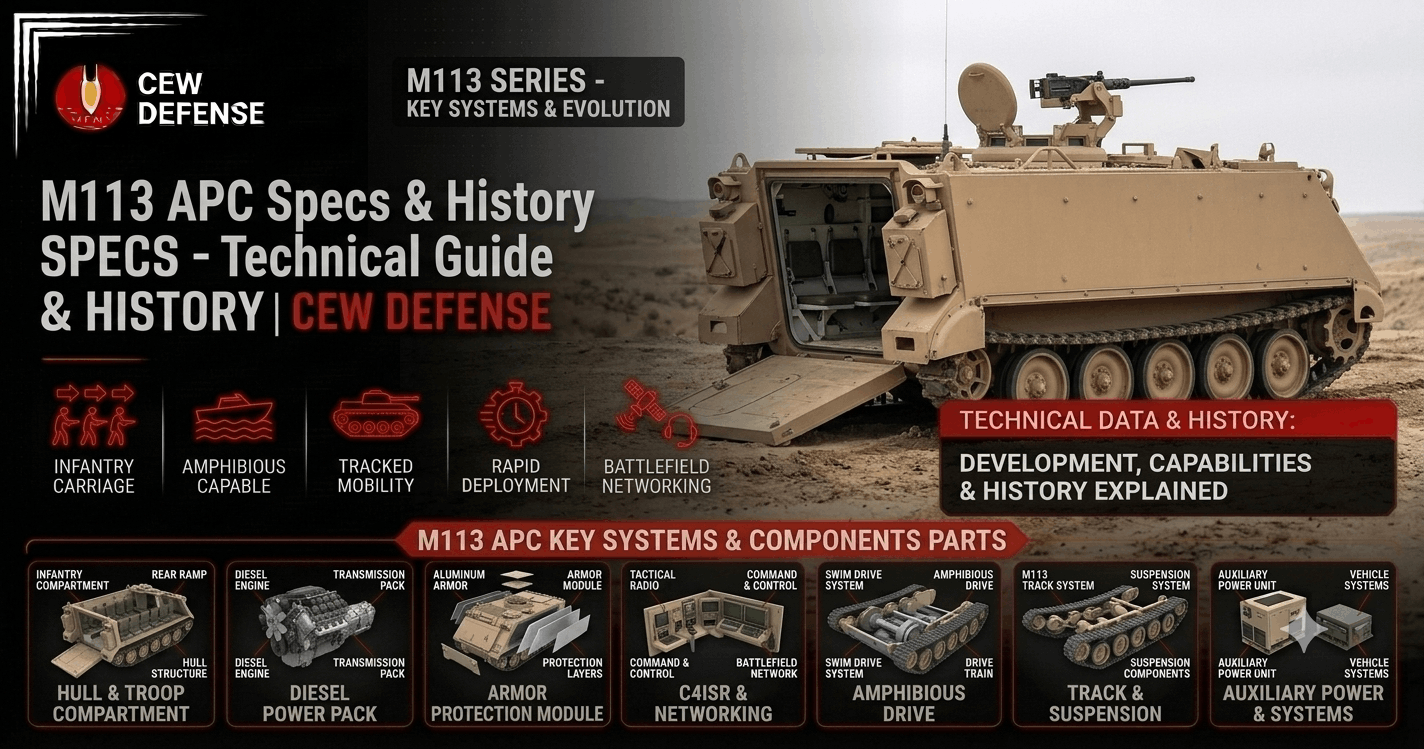
The M113 armored personnel carrier remains a highly successful tracked military vehicle. FMC Corporation originally developed this iconic platform during the late 1950s decade globally. The United States Army officially adopted this specific vehicle in 1960 for global deployment. It serves as a highly versatile armored personnel carrier for global military forces. We analyze the comprehensive technical specifications and historical development of this specific platform. Our engineering team provides detailed data for fleet sustainment and modernization programs.
The M113 APC features a lightweight aluminum hull that ensures high mobility. This specific design allows the vehicle to swim across inland water obstacles safely. Global defense forces continue to rely on this platform for troop transport globally. We explore the detailed mechanical specifications and operational history of the M113. Our comprehensive technical guide supports logistics managers and maintenance crews worldwide right now. The extensive M113 family includes numerous specialized variants for diverse combat roles.
Check our manufacturing of track shoe assemblies.
Historical Development and Evolution
Early Design and Development
FMC Corporation initiated the development of the M113 during the 1950s decade globally. The military required a lightweight vehicle to replace older heavy steel designs. Military engineers selected aluminum alloy armor to achieve an optimal weight ratio globally. The United States military first deployed the M113 in Vietnam during 1962 globally. Early combat operations revealed the immediate need for additional armor and weapons globally.
Variant Progression Timeline
The military introduced the M113A1 variant with a diesel engine in 1964 globally. This specific diesel upgrade significantly improved fuel efficiency and reduced fire hazards globally. The M113A2 variant arrived later with an improved cooling and suspension system globally. The latest M113A3 variant features a more powerful engine and heavier armor. Many global armies are currently upgrading their legacy M113 fleets right now.
Key Development Milestones:
- 1956: Initial design phase begins at FMC Corporation facility
- 1960: United States Army officially adopts the M113 platform
- 1962: First combat deployment in Vietnam War operations
- 1964: M113A1 variant introduces diesel engine technology
- 1979: M113A2 variant improves cooling and suspension systems
- 1987: M113A3 variant adds enhanced armor and powertrain
- 2020s: Modernization programs extend service life globally
These modernization programs will extend the operational life of these vehicles significantly globally. The M113 platform will remain in service for several more decades globally. We track the historical evolution to understand current maintenance requirements accurately globally consistently. The vehicle saw extensive action during the Cold War and subsequent conflicts. Its proven reliability makes it a staple in many modern defense arsenals.
Technical Specifications and Performance Data
Physical Dimensions and Weight
The standard M113 APC weighs approximately 12.3 tons when fully loaded globally. The standard vehicle measures roughly 4.8 meters in overall length for global deployment. It features a width of 2.6 meters and a specific height globally. The ground clearance measures 0.43 meters for effective obstacle negotiation across rough terrain. The original gasoline engine produced 205 horsepower initially during early combat operations globally.
Core Specifications:
- Combat Weight: 12.3 tons fully loaded
- Length: 4.8 meters overall
- Width: 2.6 meters
- Height: 2.5 meters
- Ground Clearance: 0.43 meters
- Crew Capacity: 2 crew plus 11 troops
- Fuel Capacity: 360 liters
Modern variants utilize a Detroit Diesel engine producing 275 horsepower consistently across global fleets. This diesel powerplant delivers a maximum road speed of 64 kilometers per hour. The operational range extends to approximately 480 kilometers on paved roads globally consistently. The vehicle carries a crew of two and up to eleven infantry troops. The aluminum armor protects the crew from small arms fire and shrapnel.
Read our artilce on M109 Paladin Howitzer the self-propelled artillery in modern combat vehicles.
Performance Capabilities
We analyze these performance metrics to optimize fleet operational readiness and logistics. The torsion bar suspension system provides a relatively smooth ride across rough terrain. The track system distributes the vehicle weight evenly to prevent ground sinking. Proper track maintenance ensures maximum mobility and prevents premature undercarriage component failures globally. We supply precision forged track shoes to support these critical undercarriage systems.
Performance Metrics:
- Maximum Road Speed: 64 km/h
- Operational Range: 480 km on roads
- Water Speed: 5.8 km/h swimming
- Gradient Capability: 60 percent
- Side Slope Capability: 30 percent
- Vertical Obstacle: 0.61 meters
- Trench Crossing: 1.68 meters
Major Variants and Specialized Roles
Command and Control Variants
The M113 family encompasses dozens of specialized variants for diverse military roles globally. The M577 command post variant features a raised roof for internal workstations globally. This specific variant serves as a mobile tactical operations center for commanders globally. The M106 mortar carrier mounts a heavy mortar in the rear compartment globally. Crew members operate the mortar system through a large circular roof hatch.
Combat Support Variants
The M163 Vulcan air defense system mounts a 20-millimeter rotary cannon globally consistently. This specific variant provides short-range air defense for armored maneuver units globally. The M901 ITV variant carries a tube-launched optically tracked wire-guided missile system. This anti-tank variant engages heavy armored threats at extended operational ranges globally consistently. The M113AS4 is a modernized variant developed specifically for the Australian Army.
Primary Variant Categories:
- M577: Command post with raised roof
- M106: 107mm mortar carrier
- M163: Vulcan air defense system
- M901: Anti-tank missile launcher
- M113AS4: Australian modernized variant
- M113A3: Latest US Army upgrade
- M548: Cargo carrier variant
It features a new diesel engine and an advanced automatic transmission system globally. We actively support these diverse variants with compatible undercarriage and track components. Our manufacturing processes ensure exact fitment for all M113 family track assemblies. The medical evacuation variant removes troop seats to accommodate stretchers and medical equipment. This configuration saves lives by providing rapid casualty evacuation from combat zones.
Undercarriage and Track System Maintenance
Track System Components
The track system requires rigorous maintenance to ensure optimal vehicle mobility globally. Maintenance crews must inspect track tension and pad condition after every single mission. Improper track tension accelerates wear on the drive sprockets and idler wheels globally. We recommend replacing worn track shoes before they damage the road wheels. The M113 uses a single pin track system with rubber track pads.
Critical Track Components:
- Track shoes with rubber pads
- Drive sprockets
- Idler wheels
- Five road wheels per side
- Three return rollers per side
- Track pins and bushings
- Torsion bar suspension
These rubber pads reduce noise and protect paved roads during road marches globally. We manufacture high-strength steel track shoes with integrated rubber pad interfaces globally. Our precision forging process guarantees superior strength and extended service life consistently globally. The undercarriage system includes five road wheels and three return rollers per side. Heavy-duty torsion bars absorb shock loads to protect the hull and crew.
Maintenance Requirements
We supply replacement undercarriage components that meet original equipment manufacturer specifications globally consistently. Regular lubrication of track pins prevents premature binding and reduces friction heat. Our engineering team provides detailed maintenance schedules to maximize component service life. Fleet managers rely on our technical data to plan predictive maintenance cycles. We ensure full metallurgical traceability for every track assembly we produce globally consistently.
Maintenance Schedule:
- Daily: Visual track inspection
- Weekly: Track tension adjustment
- Monthly: Road wheel bearing check
- Quarterly: Suspension component inspection
- Annually: Complete undercarriage overhaul
This traceability satisfies strict military procurement and quality assurance audit requirements globally consistently. Proper undercarriage maintenance directly determines the overall operational readiness of the M113 globally. Environmental factors like mud and sand significantly accelerate undercarriage component degradation rates. We design our track shoes to shed debris and maintain optimal traction. The drive sprocket teeth must align perfectly with the track shoe pitch.
Modernization and Future Prospects
Current Upgrade Programs
Many defense forces are currently implementing comprehensive upgrades for the M113 globally. These comprehensive upgrades include new engines, transmissions, and enhanced ballistic protection systems. Slat armor and explosive reactive armor protect against modern anti-tank threats globally consistently. The vehicle will continue to serve in secondary and support roles globally. We anticipate sustained demand for replacement undercarriage parts for these upgraded fleets.
Modernization Features:
- New diesel engines
- Automatic transmissions
- Enhanced armor packages
- Digital communication systems
- Improved suspension systems
- Upgraded electrical systems
Our manufacturing capacity scales to meet the urgent requirements of defense contractors globally. Future technological integrations will further enhance the survivability of the M113 platform. We remain committed to supporting the M113 fleet through precision component manufacturing. Our strategic expansion actively targets global defense markets seeking reliable undercarriage solutions globally. We invite procurement officers to evaluate our comprehensive technical capabilities right now.
Future Technology Integration
Digital communication systems integrate seamlessly into the upgraded command post variants globally consistently. Hybrid electric drives are currently under evaluation for future silent watch capabilities. We actively research new materials to further reduce the weight of tracks. Advanced composite materials will eventually replace traditional steel in future track designs globally. Our engineering team leads these material science innovations for next-generation armored vehicles.
Conclusion and Partnership Invitation
The M113 armored personnel carrier remains a cornerstone of global mechanized infantry consistently. Its simple design and robust construction ensure decades of reliable military service. We provide the critical undercarriage components that keep these vehicles moving forward. Our precision track shoe assemblies deliver exceptional performance in demanding combat environments globally. Contact our engineering team via our Contact Us page for detailed technical specifications.
Visit our official website directly at https://cew-defense.com/contact for immediate partnership inquiries. We look forward to supporting your M113 fleet sustainment and modernization programs globally. Our commitment to quality ensures your vehicles maintain peak operational readiness globally. The legacy of the M113 will endure in military history books forever. Our manufacturing excellence guarantees that your undercarriage systems perform flawlessly every time globally.