
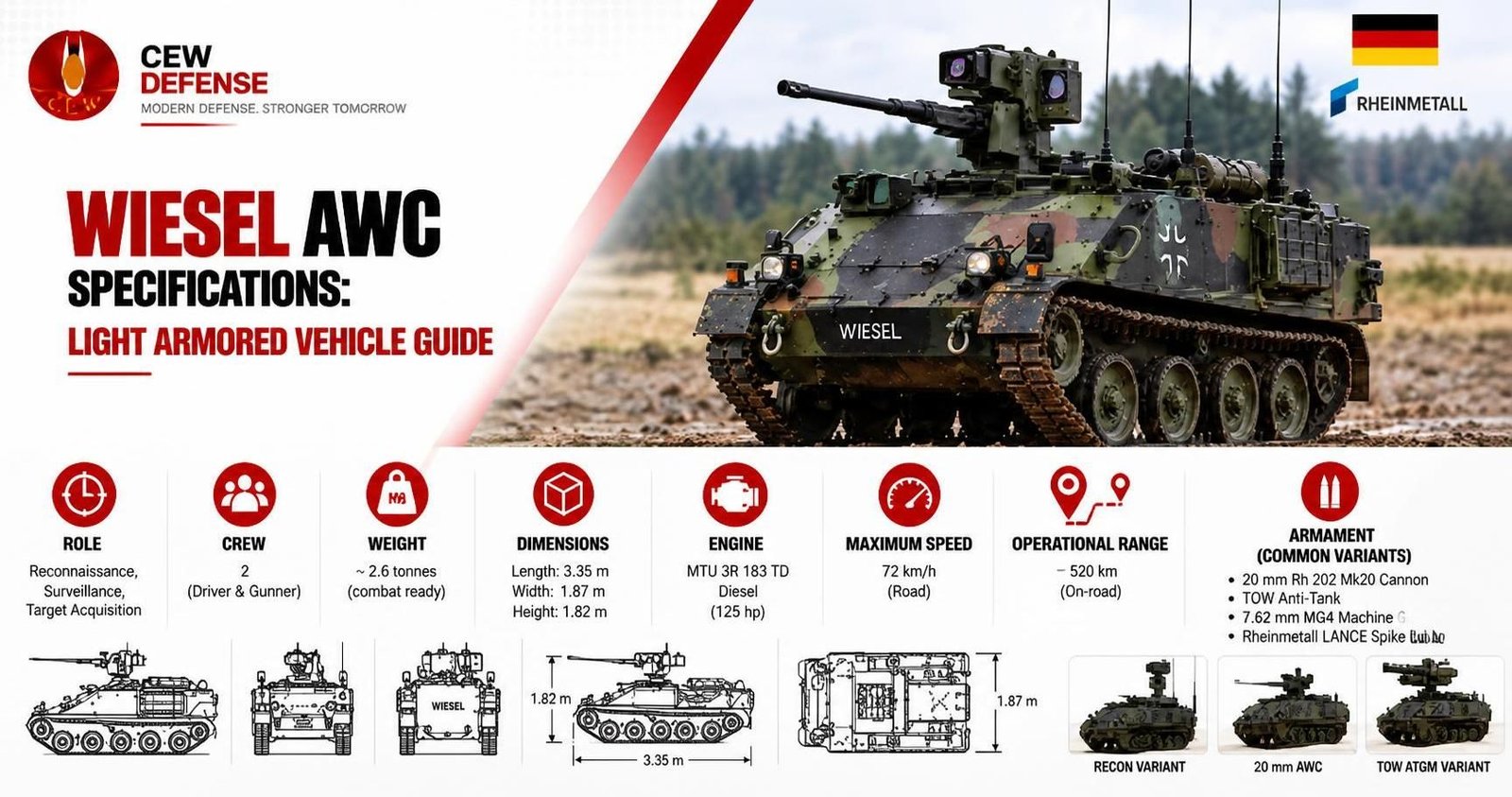
The Wiesel AWC stands as a remarkable light armored weapons carrier for modern forces. This German-engineered vehicle delivers exceptional mobility across difficult and muddy terrain every single day. Military commanders highly value its compact design paired with heavy tactical firepower on the battlefield. Engineers originally designed this platform specifically for airborne operations and rapid deployment missions.
The lightweight chassis allows for strategic airlift using standard military transport aircraft quite easily. Continuous evolution of this armored system ensures modern battlefield operational relevance at all times. Nations across Europe recognize its proven effectiveness in diverse combat environments on a daily basis. This unique capability provides commanders with unprecedented flexibility during complex tactical missions around the world.
History and Development
The Wiesel AWC development began when Porsche conceptualized this lightweight combat vehicle during the 1970s. Germany required a highly mobile platform capable of supporting airborne infantry units in direct combat. Mass production officially commenced in the year 1990 at the MaK manufacturing facilities in Germany.
The German Army quickly integrated these machines into its elite airborne brigades immediately after testing. These German tanks and light armored vehicles set a high standard for the industry.
-
Initial prototypes underwent rigorous testing throughout the late 1970s for complete validation by engineers.
-
The German Army formally accepted the very first production batch in the year 1990.
-
Engineers continuously refined the suspension systems to handle extreme off-road combat conditions perfectly.
-
Early models featured basic optics that were later upgraded to advanced thermal imaging devices.
Design and Engineering
Understanding the precise dimensions reveals why this vehicle excels in demanding tactical scenarios. Designers prioritized a low silhouette to minimize detection by enemy observation posts in the field. The Wiesel AWC weighs approximately 2.75 tons in its standard base configuration. Its compact length measures merely 3.5 meters from the front bumper to the back.
-
The armor thickness provides essential protection against small arms fire and dangerous explosive shrapnel.
-
Its narrow profile enables transport inside standard military cargo helicopters quite easily and safely.
-
The torsion bar suspension guarantees exceptional stability during high-speed tactical maneuvers on rough ground.
-
Weight distribution remains perfectly balanced to prevent tipping on steep inclines and muddy hills.
Armament and Firepower
Military planners developed multiple specialized variants to satisfy diverse combat requirements across different units. The Wiesel 1 primarily serves as an anti-tank platform equipped with advanced TOW missiles. Another version functions as a dedicated air defense system carrying deadly Stinger missiles for protection. The Wiesel AWC later evolved into the larger Wiesel 2 platform for enhanced capacity.
-
The TOW variant specializes in destroying heavily armored enemy vehicles from a safe distance.
-
The air defense model protects forward units against low-flying aerial threats constantly and reliably.
-
The mortar carrier version delivers rapid indirect fire support to advancing infantry troops quickly.
-
Secondary machine guns provide essential suppression against nearby dismounted enemy infantry threats in the area.
Strategic Mobility
Modern reconnaissance demands versatile platforms capable of executing complex battlefield assignments without any delays. Forces often pair the Wiesel AWC with other light armored vehicles for comprehensive coverage.
For instance, units frequently deploy the Fennek alongside it to maximize surveillance capabilities in the field. This strategic combination ensures superior situational awareness across vast operational theaters during active missions.
-
The C-130 Hercules can transport several units internally without requiring any structural modifications.
-
CH-53 helicopters can externally sling-load the vehicle for precise insertion missions behind enemy lines.
-
Rapid loading procedures minimize exposure time in hostile drop zones completely and very safely.
-
Parachute deployment systems ensure safe delivery of the vehicle from high altitudes quite reliably.
Combat Performance
Historical records demonstrate the exceptional reliability of the Wiesel AWC in actual combat action. German forces deployed these units extensively during international peacekeeping missions in the Balkans region. The agile chassis navigated narrow urban streets and dense forest environments with remarkable ease daily. Operators reported minimal mechanical failures even under harsh environmental stress conditions during long deployments.
-
Peacekeeping forces valued its non-threatening appearance combined with lethal defensive capabilities at all times.
-
Urban combat scenarios highlighted its superior maneuverability compared to heavier main battle tanks.
-
Logistics teams appreciated the simplified maintenance procedures requiring fewer specialized tools overall in the field.
-
Cold weather operations proved the engine reliability in freezing temperate climates consistently over time.
Manufacturing and Track Systems
Superior mobility depends entirely on high-quality undercarriage components and durable track assemblies at all times. We manufacture precision-engineered tank undercarriage parts that meet strict military specifications worldwide.
Our track shoe assembly designs prioritize maximum traction and extended operational lifespans for all clients. Rigorous quality control processes guarantee every component withstands extreme battlefield stresses without ever failing.
-
We utilize advanced metallurgy to forge high-strength steel track links for maximum durability.
-
Our custom rubber pads reduce ground pressure and minimize environmental impact significantly during operations.
-
Fast turnaround times ensure military units receive critical replacements without any operational delay whatsoever.
-
Every track shoe undergoes strict stress testing before final shipment to our valued clients.
Operational Tactics and Crew Training
Military instructors currently train 3 crew members to master the Wiesel AWC in simulated combat zones. These German tanks and light carriers will execute complex flanking maneuvers during future battlefield operations. Commanders are developing new tactical doctrines that utilize this 2.75-ton vehicle for rapid strikes. Soldiers practiced these specific 5 core maneuvers extensively before deploying to actual hostile environments.
-
Instructors evaluate 10 different combat scenarios to ensure complete readiness for the crew.
-
The 3 team members will coordinate their 2 primary weapons during intense firefights.
-
Commanders are tracking 4 specific performance metrics to improve overall tactical effectiveness quickly.
- Night Vision and Sensor Integration
Technicians installed 2 advanced thermal cameras to give the Wiesel AWC superior night vision capabilities. These 360-degree sensors detect hidden enemy positions across 5 kilometers of rough terrain. The crew will utilize this 1080p digital display to track moving targets in total darkness.
Engineers tested 4 different lens coatings to prevent glare during intense nighttime combat operations.
- Armor Upgrades and Crew Protection
Mechanics added 3 extra steel plates to the Wiesel AWC to boost its overall survivability. This 50-millimeter composite shield is stopping 7.62mm armor-piercing rounds from penetrating the hull. The 4 occupants will survive direct hits from small explosive devices during urban patrols.
Designers are testing 2 new ceramic materials to reduce the total weight by 15 percent.
Final Thought
The Wiesel AWC represents a true masterpiece of German engineering and tactical innovation currently. Its unique blend of light weight and substantial firepower redefined airborne combat doctrines completely. Military forces will continue relying on this versatile platform for specialized missions worldwide.
Continuous technological upgrades promise even greater operational capabilities in the coming decades ahead