
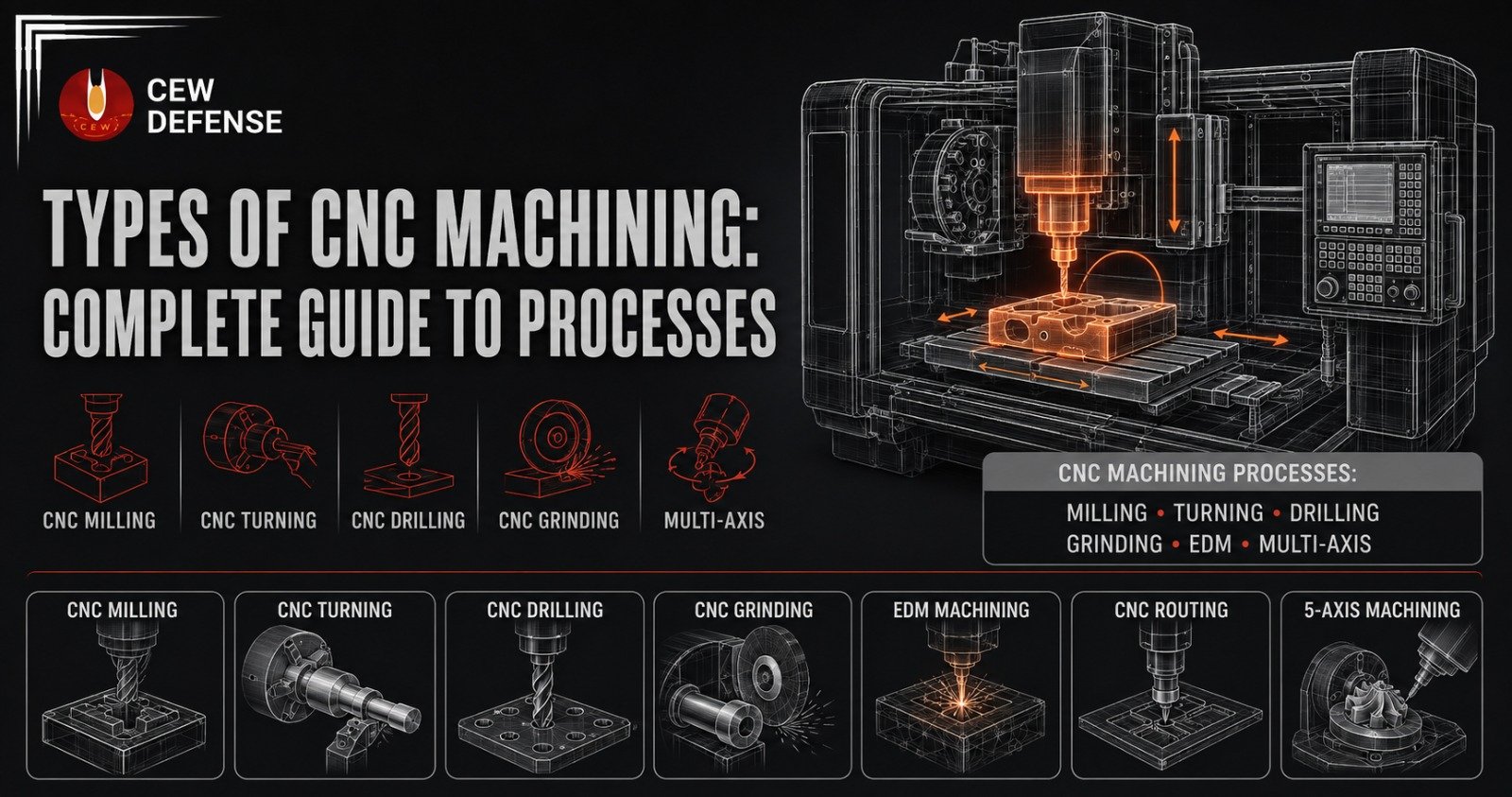
Defense manufacturers require precise components that perform reliably under extreme operational conditions. CNC machining supports this demand through accurate, repeatable, and highly controlled manufacturing processes. Engineers use several machining methods to produce mission-critical components for aerospace, military, naval, and security applications.
Modern defense systems depend on parts with exceptional dimensional accuracy, material strength, and surface quality. CNC equipment converts digital designs into finished components through automated cutting, drilling, shaping, and finishing. This technology helps manufacturers maintain strict tolerances across complex and demanding production programs.
Defense machining often involves advanced alloys, hardened metals, composite materials, and heat-resistant engineering plastics. Each material requires suitable tooling, cutting parameters, workholding systems, and inspection techniques. Selecting appropriate machining processes improves component reliability while reducing waste, delays, and manufacturing risks.
Need dependable CNC machining and milling services for defense or industrial components? Contact us to discuss your project requirements, material specifications, tolerances, and production goals.
Why CNC Machining Matters in Defense Manufacturing
Defense equipment operates in environments involving vibration, impact, pressure, temperature changes, and corrosive exposure. Components must maintain their dimensions and structural strength throughout demanding service conditions. CNC machining creates consistent military-grade parts that support long-term equipment performance.
Manufacturers use computer-controlled machines to produce aerospace brackets, vehicle housings, communication enclosures, and naval components. These machines follow programmed instructions with minimal variation between individual production cycles. Consistent results help defense companies achieve reliable batch production and repeatable component performance.
CNC machining also supports rapid prototyping during defense research, development, and testing programs. Engineers can produce accurate prototypes before approving final designs for larger production runs. This approach reduces development risks and improves design validation during complex engineering projects.
Defense suppliers frequently manage strict documentation, inspection, traceability, and customer approval requirements.
CNC production systems can record tool offsets, machine settings, inspection results, and material information. Detailed records strengthen quality assurance throughout every manufacturing stage.
For an in-depth look at amphibious combat vehicle, read our comprehensive guide covering their features, capabilities and deployment strategies.
How CNC Machining Supports Defense Applications
A typical defense machining project begins with a three-dimensional CAD model and technical drawing. Engineers review dimensions, tolerances, materials, surface finishes, and functional requirements before programming operations. CAM software then generates optimized toolpath strategies for selected CNC machines. Operators secure raw material using fixtures, vises, chucks, vacuum systems, or specialized workholding equipment. The machine establishes its coordinate system before cutting begins. Accurate setup prevents alignment errors and protects component integrity during demanding manufacturing operations.
Advanced CNC machines can coordinate multiple movement axes during a single machining cycle. Three-axis machines handle standard surfaces, while four-axis and five-axis equipment create complex geometries. Multi-axis machining reduces setups and improves geometric accuracy on aerospace and defense components.
Many defense components contain deep cavities, angled surfaces, internal channels, and complex curved profiles.
Traditional equipment may require several repositioning stages for these features. Five-axis machining reaches difficult areas more efficiently while reducing setup-related errors during production.
CEW Defense provides high-precision CNC machining and milling services for defense, aerospace, and heavy industrial manufacturing applications.
Major Types of CNC Machining
CNC Milling
CNC milling removes material through rotating cutting tools and controlled workpiece movements. Machines create pockets, slots, contours, holes, faces, threads, and complex three-dimensional surfaces. Milling remains one of the most versatile defense machining processes available. Defense manufacturers mill aircraft brackets, vehicle housings, mounting plates, sensor supports, and protective enclosures.
They also machine components for communication systems, radar assemblies, propulsion equipment, and unmanned platforms. These applications demand excellent dimensional consistency throughout production.
Vertical milling machines position the spindle above the workpiece during common manufacturing operations. Horizontal mills position the spindle parallel to the workpiece surface. Each machine configuration offers different benefits for chip removal, tooling access, and heavy cutting.
Five-axis milling provides valuable advantages for complex aerospace and defense structures. The machine can approach multiple surfaces without repeated manual repositioning. This capability reduces production time while improving surface continuity across curved and angled components.
Milling tools may include end mills, face mills, ball-nose cutters, drills, reamers, and thread mills. Engineers select tooling according to material hardness, feature size, tolerance, and surface requirements. Appropriate tooling improves cutting efficiency and extends tool service life.
CNC Turning
CNC turning rotates cylindrical stock while cutting tools remove material from its surface. This process produces shafts, pins, bushings, collars, connectors, sleeves, and other rotational components. Defense manufacturers rely on turning for precise cylindrical parts.
Modern turning centers often include live tooling, secondary spindles, automatic tool changers, and bar feeders. These features allow one machine to complete turning, drilling, milling, and threading operations. Integrated capabilities improve production efficiency and reduce handling requirements.
Turning supports numerous defense applications involving propulsion systems, vehicle assemblies, aircraft structures, and electronic equipment. Manufacturers can produce internal bores, external diameters, tapers, grooves, threads, and precision shoulders. Each feature requires careful tool selection and dimensional control.
CNC turning works especially well for medium and high-volume production programs. Automated material feeding allows machines to continue operating with limited operator intervention. This automation supports reliable repeatability across large quantities of similar components.
CNC Drilling
CNC drilling creates accurate holes through rotating drills and programmed feed movements. Defense components often require mounting holes, alignment holes, lubrication passages, and threaded openings. Automated drilling improves hole positioning across complex assemblies. Advanced CNC machines perform drilling, tapping, countersinking, counterboring, reaming, and spot-facing operations. These capabilities allow manufacturers to complete several features within one controlled setup. Fewer setups reduce alignment problems and protect assembly accuracy.
Deep-hole drilling requires specialized tools, coolant delivery systems, and chip evacuation strategies. Operators may use peck cycles to remove chips and prevent excessive heat buildup. Proper drilling methods protect tool performance and maintain consistent internal surfaces.
Aircraft frames, armored vehicle structures, engine components, and naval assemblies commonly require precision drilling. Engineers carefully define hole diameters, depths, spacing, and positional tolerances. Inspection systems verify every important connection feature before assembly begins.
CNC Grinding
CNC grinding uses abrasive wheels to remove small amounts of material accurately. This process creates smooth surfaces, precise dimensions, and consistent cylindrical forms. Manufacturers choose grinding for hardened steel, bearings, shafts, and high-tolerance components. Defense applications often require grinding after heat treatment or hardening operations. Grinding removes minor distortion while restoring critical dimensions and surface quality. This capability supports reliable post-treatment finishing for demanding components.
Cylindrical grinding handles external round surfaces, while internal grinding finishes bores and internal diameters. Surface grinding creates flat, parallel, and exceptionally smooth surfaces. Centerless grinding processes round parts without requiring traditional workpiece centers. Grinding requires careful thermal control because excessive heat can damage component surfaces. Coolant systems reduce temperature while carrying away abrasive particles and machining debris. Proper process control prevents thermal distortion and unwanted material changes.
CNC Electrical Discharge Machining
Electrical discharge machining removes conductive materials through controlled electrical sparks. The process does not require traditional cutting forces between tools and workpieces. This advantage helps manufacturers create delicate complex geometries in hardened metals. Wire EDM cuts profiles using a thin electrically charged wire and dielectric fluid. Sinker EDM creates cavities using shaped electrodes that match required internal features. Both methods support specialized defense tooling and precision component production.
Manufacturers use EDM for hardened steel, carbide, titanium, and heat-treated alloys. The process handles narrow slots, sharp internal corners, deep cavities, and intricate profiles. These capabilities benefit molds, dies, fixtures, and specialized mechanical components. EDM generally operates slower than conventional milling and turning processes. However, its accuracy and geometric flexibility justify its use for difficult components. Engineers select EDM when traditional cutting cannot achieve required feature complexity.
CNC Laser Cutting
CNC laser cutting uses concentrated energy to separate or engrave sheet materials. The machine follows programmed paths while focusing heat across precisely selected areas. Laser cutting creates accurate sheet metal profiles for defense manufacturing.
Manufacturers process aluminum, stainless steel, mild steel, titanium, acrylic, composites, and other materials. Laser systems produce brackets, panels, covers, shields, and structural sections. Narrow kerfs help maintain cutting precision across intricate designs.
Fiber lasers commonly process reflective metals and support fast industrial production. CO₂ lasers remain useful for several nonmetallic materials and specific metal applications. Engineers select laser technology according to thickness, material, speed, and edge quality.
Laser cutting produces minimal mechanical force compared with conventional sawing or milling. This characteristic protects thin materials from clamping distortion and physical deformation. Engineers can create lightweight aerospace panels with reliable dimensional accuracy.
CNC Plasma Cutting
CNC plasma cutting uses a high-temperature electrically charged gas stream. The plasma arc melts conductive material while programmed motion creates the required profile. Manufacturers use this process for thick metal plates and structural components. Plasma systems commonly cut steel, stainless steel, aluminum, and other conductive metals. They support armored vehicle structures, industrial frames, naval components, and heavy fabrication. Plasma offers practical cutting speeds for thicker materials.
Compared with laser cutting, plasma generally creates wider kerfs and rougher cut edges. Secondary machining may improve critical surfaces requiring tighter tolerances. Engineers choose plasma when material thickness and production speed outweigh fine edge requirements. Automatic torch-height controls maintain appropriate distances above the workpiece surface. Correct amperage, gas flow, travel speed, and torch alignment improve cutting results. These settings support consistent fabrication quality across demanding projects.
CNC Waterjet Cutting
CNC waterjet cutting uses high-pressure water to separate materials without substantial heat. Abrasive particles increase cutting power for metals, stone, ceramics, and composite materials. This method suits heat-sensitive materials and thick industrial stock. Waterjet cutting prevents heat-affected zones, thermal distortion, and material hardening near edges. Manufacturers use it for aircraft panels, armor components, gaskets, ceramics, and composite structures. This process protects material properties during cutting operations.
Waterjet equipment can process metals, rubber, glass, foam, plastic, and specialized laminates. It offers broad material flexibility for prototype and low-volume defense production. Engineers value its ability to create intricate profiles without damaging sensitive surfaces. Waterjet systems require water management, abrasive handling, pump maintenance, and proper nozzle replacement. Cutting speeds may remain slower than laser systems for thin materials. However, the process provides valuable cold-cutting capabilities for specialized applications.
Defense Materials Used With CNC Machines
Defense manufacturers select materials according to strength, weight, corrosion resistance, heat performance, and service conditions. CNC machines process a wide range of advanced metals, alloys, plastics, and composites. Material selection directly influences machining parameters and tool requirements.
Common defense materials include:
- Aluminum alloys for lightweight structures, housings, brackets, and aircraft components.
- Titanium alloys for high-strength aerospace parts requiring corrosion and temperature resistance.
- Hardened steel for durable shafts, fixtures, vehicle components, and protective structures.
- Inconel alloys for heat-resistant propulsion and engine-related applications.
- Carbon-fiber composites for lightweight panels, covers, and specialized structural assemblies.
- Engineering plastics for electrical insulation, seals, guides, and communication equipment.
Titanium provides excellent strength-to-weight performance but generates significant cutting heat during machining. Its low thermal conductivity concentrates heat near cutting edges and tool surfaces. Specialized tooling supports reliable titanium component manufacturing. Inconel resists heat and corrosion but presents difficult machining characteristics. Engineers use rigid setups, sharp tools, controlled speeds, and effective coolant systems. These practices improve nickel-alloy machining performance and reduce premature tool failure.
Composite materials require careful cutting because fibers can delaminate, splinter, or separate. Specialized cutters and controlled feeds protect edges and maintain structural performance. Proper techniques improve composite machining quality for aerospace applications.
CNC Machining Requirements for Defense Suppliers
Defense suppliers must maintain repeatable processes throughout production and inspection activities. Machines require calibration, preventive maintenance, documented setups, and controlled operating procedures. These practices strengthen manufacturing traceability and support customer confidence. Inspection systems verify dimensions, surface finishes, hole locations, angles, and geometric relationships. Coordinate measuring machines provide detailed data for complex and high-value components. Digital inspection records support quality documentation throughout manufacturing programs.
Material certificates confirm alloy grades, heat treatments, and supplier information before production begins. Manufacturers maintain these records alongside inspection results and production documentation. Strong traceability helps organizations manage material verification and customer audits. Environmental control can influence precision when components require extremely tight tolerances. Temperature changes may affect machines, tools, fixtures, and workpiece dimensions. Controlled environments improve measurement reliability during critical inspection stages.
Skilled programmers and machinists remain essential despite increasing automation across defense manufacturing. Experienced personnel understand tooling behavior, material response, setup stability, and process limitations. Their expertise supports technical problem-solving during complex production challenges.
Benefits of CNC Machining for Defense Applications
CNC machining provides consistent results across prototypes, replacement parts, and production quantities. Automated processes reduce variation while supporting repeatable component dimensions. This consistency improves mission reliability for equipment operating under demanding conditions. Manufacturers can produce complex shapes that traditional manual equipment cannot easily create. Multi-axis machines reach angled surfaces, cavities, channels, and curved profiles efficiently. These capabilities support advanced defense designs and compact system architectures.
Digital programming allows engineers to modify designs without creating new physical templates. Manufacturers can update toolpaths, adjust features, and produce revised prototypes quickly. This flexibility improves engineering responsiveness during testing and development. CNC systems also reduce repetitive manual tasks and improve workplace safety. Operators supervise machines instead of performing every cutting movement manually. Automated handling and inspection further improve production control and operational efficiency.
Key Benefits for Defense Manufacturers
- Consistent dimensions across prototypes, small batches, and high-volume programs.
- Accurate production for complex aerospace, naval, vehicle, and electronic components.
- Flexible material processing across metals, composites, plastics, ceramics, and alloys.
- Faster prototype development with direct digital design-to-production workflows.
- Reliable documentation for inspection, traceability, calibration, and customer approvals.
- Reduced waste through optimized toolpaths, nesting strategies, and controlled cutting parameters.
Limitations and Production Challenges
CNC machining requires considerable investment in machines, software, tooling, fixtures, inspection equipment, and training. Defense suppliers must plan these costs before accepting complex production programs. Proper planning supports sustainable manufacturing investment and operational growth. Programming errors can cause defective parts, tool crashes, material waste, or equipment damage. Operators must verify coordinates, offsets, tooling, fixtures, and cutting paths carefully. Simulation software helps reduce programming-related risks before production begins.
Subtractive machining removes unwanted material from larger stock, which creates unavoidable material waste. Recycling chips can recover value from aluminum, copper, steel, and certain specialized alloys. Responsible scrap management reduces environmental impact and operating costs. CNC machines require scheduled maintenance to preserve accuracy, reliability, and production availability. Technicians inspect lubrication systems, spindles, coolant systems, electrical components, and cutting tools. Preventive maintenance reduces unplanned downtime across defense manufacturing facilities.
Improving CNC Defense Manufacturing Results
Engineers should design components with tool access, workholding stability, and inspection requirements. Rounded internal corners often simplify cutting and reduce stress concentration. Practical designs improve design for manufacturability and reduce production costs. Tool selection influences cutting speed, surface finish, accuracy, heat generation, and tool life. Carbide tools support demanding materials, while coated tools reduce friction and wear. Correct tooling improves machining productivity across difficult defense applications.
Strong fixtures prevent vibration, movement, and dimensional errors during cutting operations. Fixtures must support thin walls while exposing important surfaces for tool access. Stable workholding protects component accuracy throughout every machining cycle. Coolant systems control heat, remove chips, and protect cutting edges during production. Manufacturers choose flood coolant, mist, air, or minimum-quantity lubrication according to requirements. Effective coolant management improves tool performance and surface quality.
Inspection should occur during setup, production, and final approval stages. Probes can measure workpieces inside machines before operators remove them. In-process inspection reduces errors and supports real-time quality control during critical operations.
Future of CNC Machining in Defense Manufacturing
Defense manufacturers increasingly connect CNC machines with sensors, production software, and factory networks. These systems monitor vibration, temperature, energy consumption, spindle loads, and tool conditions. Connected equipment supports smart manufacturing and better production visibility.
Predictive maintenance software analyzes machine information before failures interrupt production. Engineers can schedule maintenance according to actual machine conditions rather than fixed intervals. This approach reduces maintenance costs and improves equipment availability.
Robotic loading systems allow machines to process materials with limited human intervention. Automated systems support extended operating hours and consistent material handling. Defense suppliers can increase production capacity while reducing repetitive manual work.
Artificial intelligence may optimize cutting parameters, predict tool failure, and identify quality trends. These systems can analyze historical production data and recommend improved operating conditions. Intelligent automation supports process optimization and reduced manufacturing waste.
Hybrid manufacturing combines additive material deposition with conventional CNC machining. Engineers build near-net shapes before machining important surfaces accurately. This approach reduces waste and supports complex component development for advanced defense systems.
Final Thoughts
Understanding different CNC machining types helps defense manufacturers select suitable processes for every component. Milling, turning, drilling, grinding, EDM, laser, plasma, and waterjet cutting offer unique capabilities. Each method supports specific defense manufacturing requirements and production objectives.
Successful production depends on accurate programming, suitable materials, reliable tooling, stable fixtures, and detailed inspection. Manufacturers must also maintain traceability, calibration, documentation, and consistent process control. These practices support dependable mission-critical components for demanding defense environments.
CNC machining will continue supporting aerospace, military, naval, vehicle, communications, and security technology development. Advanced automation and multi-axis equipment will expand manufacturing possibilities across specialized applications. Companies that invest in precision machining can deliver stronger defense engineering solutions with greater efficiency and confidence.