
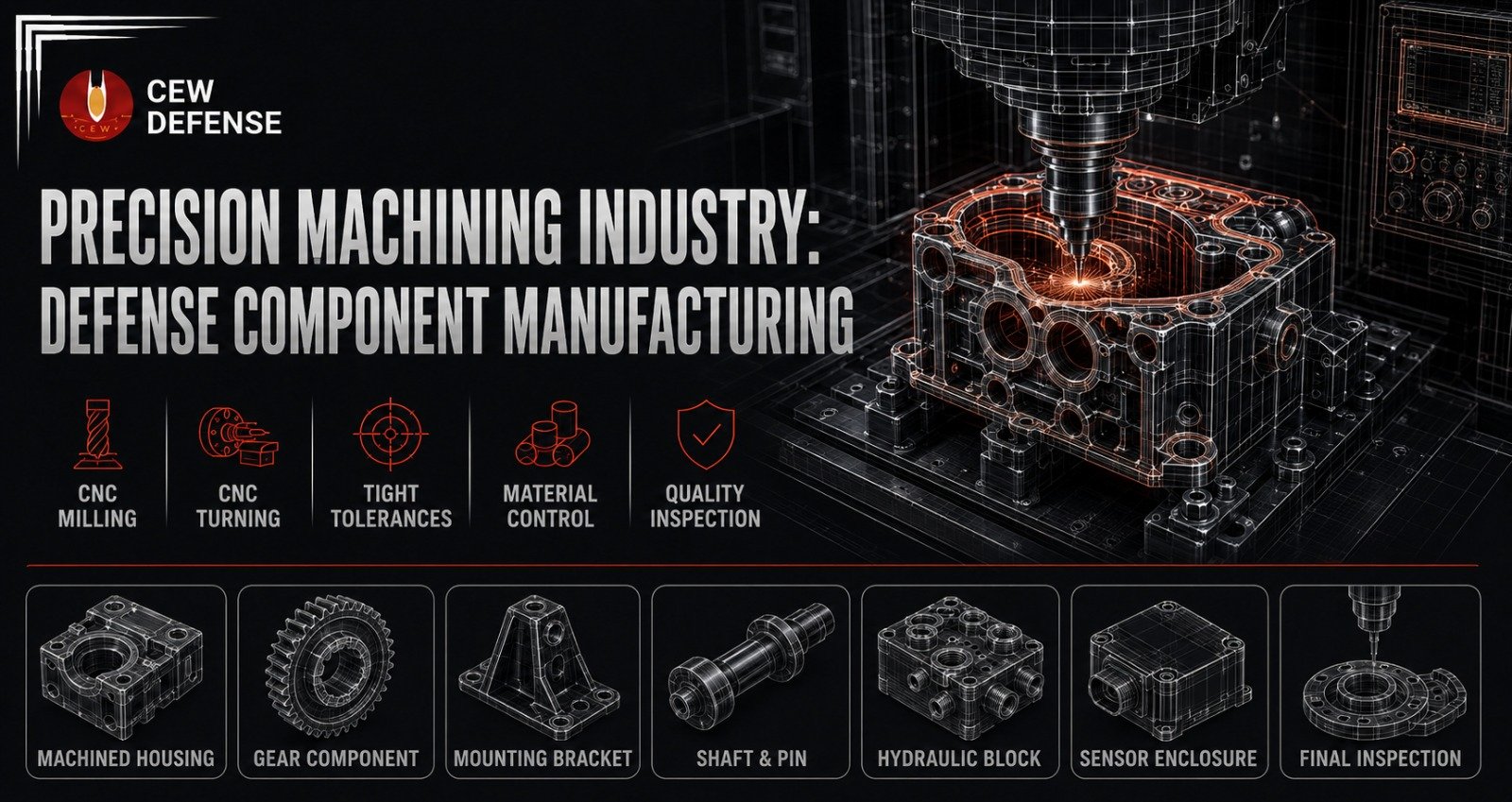
The precision machining industry plays a vital role in modern defense manufacturing. From aircraft structures and missile systems to armored vehicles and communication equipment, defense applications depend on components produced with exceptional accuracy, durability, and consistency.
Even the smallest deviation in a machined part can affect the performance, safety, and reliability of an entire defense system.
As defense technologies become more advanced, manufacturers are required to produce complex parts from tough materials while meeting strict quality standards. This has increased the importance of CNC machining, multi-axis manufacturing, advanced inspection systems, and highly controlled production processes.
Companies such as CEW Defense support demanding defense manufacturing requirements through precision-engineered components and reliable production capabilities under ISO 9001:2015 and TÜV Austria-certified quality standards.
What Is Precision Machining?
Precision machining is the process of manufacturing components to extremely tight dimensional tolerances. It uses computer-controlled equipment such as CNC mills, CNC lathes, Swiss-type machines, wire EDM systems, and multi-axis machining centers.
Unlike conventional machining, precision manufacturing focuses on:
-
High-dimensional accuracy
-
Repeatable production
-
Complex geometries
-
Tight surface-finish requirements
-
Material consistency
-
Detailed quality documentation
In the defense sector, precision machining is used to manufacture components that must function reliably under extreme conditions, including high vibration, pressure, temperature changes, and heavy mechanical loads.
Why Precision Machining Matters in Defense Manufacturing
Defense systems operate in environments where component failure can create serious safety and operational risks. A poorly manufactured connector, housing, bracket, or mechanical interface may reduce the effectiveness of an aircraft, vehicle, weapon platform, or surveillance system.
The precision machining industry supports defense manufacturing in several important ways.
Reliable Component Performance
Defense components must perform consistently during long operating cycles. Precision machining ensures that parts meet exact specifications and maintain proper alignment during assembly.
For example, a machined housing may need to protect sensitive electronics from moisture, dust, and vibration. If the housing is not manufactured accurately, seals may fail, or internal components may become damaged.
Tight Tolerance Control
Many defense components require tolerances measured in thousandths of an inch or even smaller. CNC machines can produce repeated parts with a high level of accuracy, reducing variation between components.
Tight tolerance control is especially important for:
-
Hydraulic and pneumatic components
-
Weapon system interfaces
-
Aircraft fittings
-
Optical equipment mounts
-
Electronic enclosures
-
Guidance system parts
-
Engine and transmission components
Reduced Assembly Problems
Accurately machined parts fit together more efficiently. This reduces rework, manual adjustment, and assembly delays. It also helps manufacturers maintain consistent production schedules.
A component that meets its drawing requirements the first time can improve the efficiency of the entire supply chain.
Common Defense Components Produced Through Precision Machining
The defense sector requires a wide range of machined components. These parts may be small and intricate or large and structurally demanding.
Common examples include:
-
Aircraft brackets and structural fittings
-
Missile and rocket components
-
Radar and communication housings
-
Armored vehicle parts
-
Weapon system components
-
Naval equipment fittings
-
Thermal management components
-
Actuator and valve bodies
-
Engine mounts
-
Custom fasteners and threaded parts
-
Sensor housings
-
Optical instrument components
Many of these parts are produced in low or medium volumes. This makes flexible CNC machining especially valuable because manufacturers can produce prototypes, replacement parts, and specialized components without investing in large-scale tooling.
Materials Used in Defense Component Manufacturing
Defense components must often be lightweight, strong, corrosion-resistant, and capable of withstanding harsh environments. The choice of material depends on the application, operating conditions, and required performance.
Aluminum Alloys
Aluminum alloys are widely used because they offer a useful combination of low weight, strength, and machinability. They are commonly selected for aircraft brackets, electronic housings, structural supports, and equipment panels.
Titanium
Titanium provides high strength-to-weight performance and excellent resistance to corrosion and heat. It is frequently used in aerospace and defense applications, although it requires carefully controlled machining parameters.
Stainless Steel
Stainless steel is valued for its strength, durability, and corrosion resistance. It is suitable for fittings, shafts, housings, valves, and components exposed to moisture or chemicals.
Inconel and Other Nickel Alloys
Inconel and other nickel-based superalloys can withstand high temperatures and mechanical stress. They are used in demanding engine, exhaust, and thermal-management applications. These materials are more difficult to machine and require advanced tools and production expertise.
Engineering Plastics and Composites
Certain defense systems use engineering plastics and composite materials for insulation, lightweight structures, and electronic protection. Machining these materials requires control over heat, vibration, and cutting pressure.
CNC Machining Technologies for Defense Applications
Modern defense manufacturing relies on several advanced machining technologies.
Multi-Axis CNC Machining
Three-axis, four-axis, and five-axis machining systems allow manufacturers to produce complex parts with fewer setups. This can improve accuracy and reduce the risk of errors caused by repositioning the workpiece.
Five-axis machining is particularly useful for:
-
Curved aerospace components
-
Complex housings
-
Turbine-related parts
-
Angled surfaces
-
Lightweight structural components
CNC Turning
CNC turning is used to manufacture cylindrical and rotational parts such as shafts, pins, bushings, collars, and threaded components. As one of the common types of CNC machining, CNC turning can also use live tooling to add milling, drilling, and tapping operations within the same machine cycle.
Swiss-Type Machining
Swiss machining is suitable for small, intricate components requiring high accuracy. It is often used for pins, connectors, miniature shafts, and components with multiple detailed features.
Electrical Discharge Machining
Electrical discharge machining, including wire EDM and sinker EDM, can produce complex shapes in hardened materials. EDM is useful when traditional cutting tools cannot easily create narrow slots, intricate profiles, or precise internal features.
Automated Inspection
Automated inspection systems such as coordinate measuring machines, optical measurement systems, laser scanners, and in-process probing help verify that components meet design specifications.
Inspection data can also support process improvement, quality documentation, and product traceability.
Quality Requirements in the Defense Supply Chain
Quality control is one of the most important parts of defense component manufacturing. A reliable supplier must demonstrate that its production processes are controlled, repeatable, and properly documented.
Important quality practices may include:
-
Inspection planning
-
Material certification
-
First article inspection
-
In-process measurement
-
Final dimensional inspection
-
Surface-finish verification
-
Non-destructive testing
-
Lot and batch traceability
-
Calibration of measurement equipment
-
Controlled documentation
Manufacturers may also work under quality management standards such as AS9100 or ISO 9001, depending on the customer and application. These systems help establish consistent procedures for design review, purchasing, production, inspection, corrective action, and continuous improvement.
Challenges Facing the Precision Machining Industry
The defense machining sector offers significant opportunities, but it also presents several challenges.
Complex Part Designs
Modern defense systems use lightweight and compact designs with complicated internal channels, curved surfaces, and difficult-to-machine features. Producing these parts requires advanced CAD/CAM software and experienced programmers.
Difficult Materials
Titanium, hardened steel, and nickel alloys can cause tool wear, heat generation, and slower machining speeds. Manufacturers must select the right cutting tools, coolant strategies, and feeds and speeds.
Low-Volume Production
Defense programs may require specialized components in small quantities. Suppliers must remain profitable while managing setup time, programming, inspection, and documentation costs.
Supply Chain Pressure
Delays in raw materials, tooling, electronics, or subcontracted processes can affect delivery schedules. Strong supplier relationships and production planning are essential for meeting defense deadlines.
Cybersecurity and Data Protection
Defense manufacturers often handle sensitive engineering files and technical information. Protecting CAD data, customer specifications, and production records is an important part of modern manufacturing operations.
How Technology Is Improving Defense Machining
Digital manufacturing is transforming the precision machining industry. Advanced software and connected equipment allow manufacturers to monitor processes, identify problems, and improve production efficiency.
Some important developments include:
-
Digital twins for process simulation
-
AI-assisted tool wear monitoring
-
Automated production scheduling
-
Robotic loading and unloading
-
Cloud-based quality records
-
Real-time machine data collection
-
Additive manufacturing combined with CNC finishing
-
Advanced simulation to reduce programming errors
Automation can improve consistency and reduce repetitive manual work. However, skilled machinists, engineers, and inspectors remain essential for interpreting technical requirements and solving complex production problems.
Selecting a Precision Machining Partner
Defense companies should carefully evaluate machining suppliers before beginning a project. Important factors include:
-
Experience with defense or aerospace components
-
Available CNC equipment
-
Material and size capabilities
-
Quality certifications
-
Inspection technology
-
Engineering and DFM support
-
Production capacity
-
Lead times
-
Traceability systems
-
Data security practices
-
Experience with prototypes and low-volume production
A capable supplier should be able to review a design, identify manufacturing risks, recommend practical improvements, and provide a clear production plan.
Design-for-manufacturing support can reduce unnecessary features, improve tool access, simplify setups, and lower production costs without affecting part performance.
The Future of Precision Defense Manufacturing
The future of precision defense manufacturing will depend on speed, accuracy, flexibility, and innovation. Military platforms are becoming more advanced, while production programs increasingly require customized parts, rapid prototyping, and shorter development cycles.
Manufacturers that invest in five-axis machining, automation, inspection systems, digital production tools, and employee training will be better prepared for changing industry requirements.
Sustainability is also becoming more important. Efficient toolpaths, optimized material usage, coolant recycling, and reduced energy consumption can lower the environmental impact of machining operations while improving production efficiency.
Conclusion
The precision machining industry is a critical part of defense component manufacturing. It enables the production of strong, accurate, and reliable parts for aircraft, vehicles, weapons, communication systems, naval equipment, and advanced defense technologies.
By combining CNC machining, skilled engineering, strict quality control, advanced inspection, and secure production systems, manufacturers can meet the demanding requirements of the defense sector. As defense technologies continue to evolve, precision machining will remain essential for developing safer, lighter, stronger, and more dependable systems.
With advanced manufacturing capabilities and a focus on quality, CEW Defense is positioned to support the changing needs of the defense machining industry and help customers develop dependable precision components for specialized applications.