
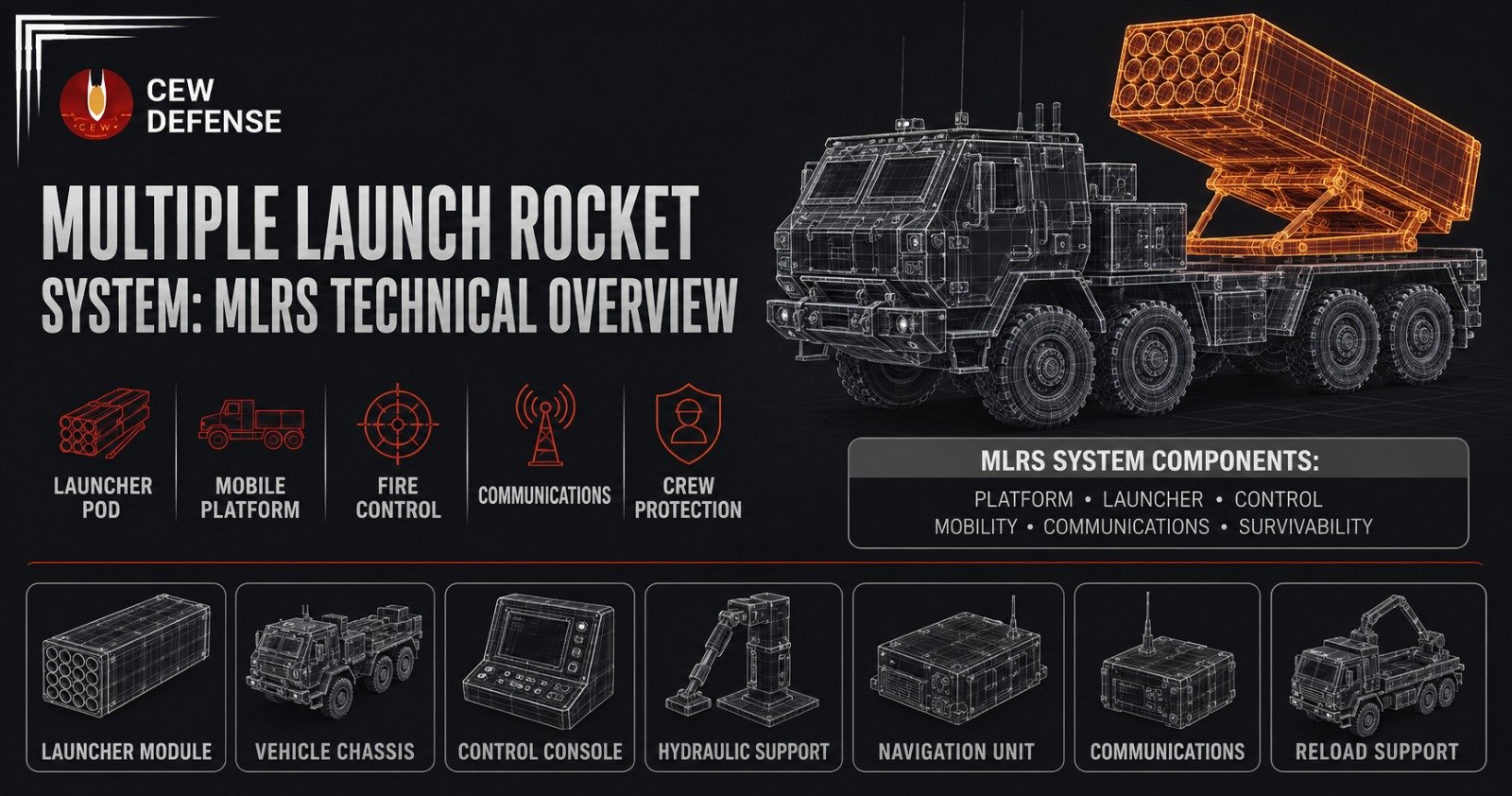
Multiple Launch Rocket System: MLRS Technical Overview
A Multiple Launch Rocket System (MLRS) is a mobile artillery platform designed to launch several rockets in rapid succession against targets at medium or long ranges. Unlike traditional tube artillery, which fires individual shells through a barrel, an MLRS uses a launcher fitted with multiple rocket tubes or containerized launch pods. This allows it to deliver a large volume of fire across a target area within a short period.
Modern multiple launch rocket systems combine mobility, digital fire-control technology, precision-guided munitions, advanced communications, and rapid relocation capabilities. These systems are used by armed forces for battlefield support, counter-battery missions, suppression of enemy positions, and attacks against high-value targets.
The term MLRS can refer to a specific weapon system, such as the M270 MLRS, or to the broader category of rocket artillery platforms. Today, many countries operate their own versions, ranging from lightweight truck-mounted launchers to heavy tracked systems capable of firing guided rockets and tactical missiles.
What Is a Multiple Launch Rocket System?
A multiple launch rocket system is a self-propelled rocket artillery vehicle that can fire multiple rockets from a single launcher. The rockets may be unguided, guided, or designed for specialized missions. Most systems are mounted on wheeled or tracked vehicles, allowing them to move quickly between firing positions.
An MLRS generally includes:
- A mobile launcher vehicle
- Multiple rocket tubes or launch pods
- A fire-control computer
- Navigation and positioning equipment
- Communication systems
- Hydraulic or electronic elevation mechanisms
- Ammunition support vehicles
- Maintenance and reload equipment
The main purpose of an MLRS is to provide concentrated firepower over a wide area. A launcher may fire a complete salvo in seconds, creating a powerful effect against dispersed enemy formations, logistics areas, artillery positions, air-defense sites, and other military targets.
Also read our article on Armored Multi Purpose Vehicle.
How Does an MLRS Work?
The operation of an MLRS follows a coordinated process involving target detection, mission planning, launcher positioning, firing, and relocation. Modern systems use digital networks to receive target information from command centers, surveillance aircraft, unmanned aerial vehicles, ground observers, radar units, and other sensors.
A simplified firing sequence includes:
- Target identification: A target is detected and classified by reconnaissance or intelligence assets.
- Data transmission: Target coordinates and mission details are sent to the artillery command network.
- Fire-control calculation: The system calculates the required trajectory, launch direction, and elevation.
- Launcher positioning: The vehicle moves into a suitable firing location.
- Rocket launch: One or more rockets are fired in a programmed sequence.
- Immediate relocation: The launcher moves away to reduce the risk of counter-battery fire.
- Reloading: A dedicated reload vehicle replenishes the launcher’s ammunition.
This “fire-and-move” approach is one of the most important advantages of modern rocket artillery. It allows crews to deliver fire rapidly and then leave the area before opposing forces can accurately respond.
Main Components of an MLRS
Launcher Vehicle
The launcher vehicle provides mobility and supports the rocket launch assembly. It may be based on tracked armor, a tactical truck, or a highly mobile commercial-style heavy vehicle.
Tracked launchers usually offer:
- Better off-road mobility
- Greater protection
- Improved operation in difficult terrain
- Stronger cross-country performance
Wheeled launchers commonly provide:
- Lower operating costs
- Higher road speed
- Longer road range
- Easier maintenance
- Faster strategic transportation
The choice between tracked and wheeled designs depends on military doctrine, terrain, logistics, and the desired balance between protection and mobility.
Rocket Pods or Launch Tubes
The launcher carries rockets inside individual tubes or sealed launch pods. Older systems often use fixed tubular launchers, while newer platforms frequently use modular pods. Containerized pods make it easier to store, transport, and reload ammunition. A modular design can also allow one launcher to fire different rocket families. For example, the same platform may use short-range guided rockets for tactical targets and longer-range missiles for deeper strikes.
Fire-Control System
The fire-control system is the electronic center of the MLRS. It receives target information, calculates firing solutions, controls launcher alignment, and monitors system status.
Typical fire-control features include:
- Digital map displays
- Automated ballistic calculations
- Satellite or inertial navigation
- Secure communications
- Target coordinate processing
- Ammunition selection
- Launch sequencing
- System health monitoring
Automation reduces crew workload and shortens the time between receiving a mission and firing the rockets.
Navigation and Positioning Equipment
Accurate positioning is essential for rocket artillery. Modern launchers may use a combination of satellite navigation, inertial navigation systems, digital compasses, and vehicle sensors.
These systems help determine:
- The launcher’s exact location
- Vehicle heading
- Terrain position
- Launch direction
- Changes in position after movement
Reliable navigation allows an MLRS to operate more efficiently, especially when it must fire without lengthy manual surveying.
Reload and Support Vehicles
MLRS units depend on ammunition carriers and maintenance vehicles. A launcher’s combat effectiveness is determined not only by its firing range but also by how quickly it can be resupplied.
Support vehicles may transport:
- Rocket pods
- Individual rockets
- Fuel
- Spare parts
- Repair equipment
- Crew supplies
- Specialized loading machinery
Fast reload capability enables the launcher to return to action quickly after firing a salvo.
Types of Multiple Launch Rocket Systems
Tracked MLRS
Tracked systems use armored or semi-armored chassis with continuous tracks. They are designed to accompany mechanized formations and operate across rough terrain.
Advantages include:
- Strong cross-country mobility
- Better protection for crew and equipment
- Ability to operate alongside armored units
- Stability on uneven ground
However, tracked systems are generally heavier and more demanding to maintain than wheeled launchers.
Wheeled MLRS
Wheeled systems are mounted on tactical trucks or specialized heavy vehicles. They are increasingly popular because of their lower cost, high road speed, and operational flexibility.
Wheeled launchers are well suited for:
- Long-distance road movement
- Rapid redeployment
- Large-area territorial defense
- Operations where highways and prepared roads are available
- Reduced maintenance requirements
Their protection level varies significantly. Some use armored cabins, while others rely mainly on mobility and concealment.
Lightweight and Air-Mobile Systems
Some MLRS platforms are designed for airborne or expeditionary operations. They use smaller rockets and compact launchers that can be transported by helicopters, transport aircraft, or smaller ships.
These systems are useful for:
- Mountain operations
- Island defense
- Special operations support
- Rapid deployment forces
- Light infantry formations
Their main limitation is reduced ammunition capacity and shorter range compared with heavy systems.
Modular MLRS Platforms
Modular launchers use interchangeable rocket pods or containers. This approach allows operators to select ammunition based on the mission.
A modular platform may support:
- Short-range rockets
- Precision-guided rockets
- Extended-range rockets
- Tactical missiles
- Training rounds
- Specialized payloads
Modularity simplifies logistics and gives commanders greater flexibility without requiring several different launcher vehicles.
MLRS Range and Firepower
The range of a multiple launch rocket system depends on the rocket type, propulsion system, guidance package, payload, and launcher design. Older unguided rockets may have relatively limited ranges, while modern guided rockets and tactical missiles can reach much farther.
MLRS ammunition can generally be divided into several categories:
- Short-range rockets for close battlefield support
- Medium-range rockets for operational targets
- Extended-range guided rockets
- Tactical missiles for deep-strike missions
- Specialized rockets for training or mission-specific effects
Firepower is not measured by range alone. Important performance factors include:
- Number of rockets carried
- Time required to fire a full salvo
- Reload speed
- Accuracy
- Warhead size
- Navigation precision
- Ability to engage multiple targets
- Resistance to electronic disruption
A system with slightly shorter range may still be highly effective if it offers better accuracy, faster reaction time, and superior mobility.
Guided and Unguided Rockets
Unguided Rockets
Unguided rockets follow a ballistic trajectory after launch. They are usually less expensive and can be carried in large quantities. Their effectiveness depends on salvo size and the ability to saturate a target area.
Common characteristics include:
- Lower cost per round
- Simple construction
- Large-volume fire capability
- Wider impact dispersion
- Reduced precision compared with guided munitions
Unguided rockets are often used when the target covers a broad area or when massed fire is more important than pinpoint accuracy.
Guided Rockets
Guided rockets use satellite navigation, inertial guidance, or other control methods to improve accuracy. They can engage smaller or more precisely located targets while reducing ammunition expenditure.
Benefits include:
- Improved accuracy
- Lower collateral damage risk
- More efficient use of ammunition
- Ability to attack point targets
- Better performance at extended ranges
Guided rockets are more expensive and may be affected by signal disruption, navigation interference, or adverse battlefield conditions. For this reason, many armies maintain a mix of guided and unguided ammunition.
MLRS Warhead Options
The warhead determines the rocket’s intended effect. Different ammunition types are designed for different target categories and battlefield requirements.
Potential warhead categories include:
- High-explosive warheads
- Fragmentation warheads
- Penetration-oriented warheads
- Smoke-producing payloads
- Illumination payloads
- Training warheads
- Specialized area-effect payloads
High-explosive and fragmentation warheads are commonly associated with attacks against exposed personnel, vehicles, field positions, and infrastructure. Smoke and illumination rockets may support movement, concealment, observation, or battlefield coordination.
The use of any warhead depends on military doctrine, national law, international humanitarian law, and the specific operational environment.
Tactical Role of an MLRS
A multiple launch rocket system can perform several battlefield roles. Its primary value is the ability to deliver rapid and concentrated fire beyond the range of many conventional direct-fire weapons.
Area Suppression
MLRS units can suppress enemy positions across a broad area. The purpose may be to disrupt movement, reduce combat effectiveness, or force opposing forces to abandon exposed positions.
Counter-Battery Operations
Rocket artillery can be used against opposing artillery and rocket launchers. Detection systems such as counter-battery radars may help locate the launch point of hostile fire, after which an MLRS unit can respond quickly.
Attacks on Logistics
Supply depots, ammunition storage areas, fuel facilities, repair sites, and transportation hubs may be targeted because they support military operations. Long-range rockets allow these targets to be engaged without placing the launcher close to the forward line.
Support for Ground Forces
MLRS units can support advancing or defending ground forces by engaging obstacles, defensive positions, assembly areas, and other battlefield targets. Their mobility allows them to shift support between different sectors.
Deep Fires
Long-range rockets and tactical missiles extend the reach of ground forces beyond the immediate battlefield. These systems may be integrated into broader operational plans involving surveillance, electronic warfare, aviation, and conventional artillery.
Advantages of Multiple Launch Rocket Systems
MLRS platforms offer several major benefits compared with traditional artillery systems.
High Volume of Fire
A single launcher can release many rockets in a short period. This makes it possible to affect a large target area rapidly.
Mobility
Self-propelled launchers can move after firing, improving survivability and reducing exposure to return fire.
Extended Reach
Many MLRS platforms can engage targets beyond the effective range of ordinary field guns, especially when equipped with extended-range rockets.
Operational Flexibility
A launcher may carry different ammunition types, allowing it to perform several missions.
Digital Integration
Modern MLRS units can connect with command networks, surveillance platforms, navigation systems, and battlefield management software.
Rapid Reaction
Automated fire-control technology reduces the time required to process target information and prepare for launch.
Limitations and Challenges
Despite their capabilities, MLRS platforms also face several limitations.
Ammunition Consumption
Rocket artillery can use large quantities of ammunition during intense operations. Maintaining a reliable supply chain is essential.
Reload Requirements
After firing, launchers may need to withdraw to a protected location for reloading. The time required depends on the vehicle design and loading equipment.
Logistics Burden
Rockets are heavy, bulky, and expensive to transport. Large-scale MLRS operations require substantial fuel, maintenance, and ammunition support.
Detection Risk
Rocket launches create visible, thermal, acoustic, and electronic signatures. Opposing forces may detect the firing location using radar, aerial surveillance, drones, or other sensors.
Weather and Terrain
Heavy rain, dust, snow, rough terrain, and poor visibility can affect mobility, communication, maintenance, and target acquisition.
Electronic Warfare
Navigation and communications systems may be exposed to jamming or interference. Modern crews therefore rely on multiple navigation and communication methods.
MLRS Survivability Features
Survivability is a major design priority. Modern launchers use several methods to reduce the risk of detection and attack.
Important survivability features include:
- Shoot-and-scoot mobility
- Armored crew cabins
- Reduced setup time
- Digital mission planning
- Low exposure during firing
- Camouflage and concealment
- Dispersed deployment
- Secure communications
- Alternative navigation methods
- Decoy and deception techniques
Some systems use automated launch procedures that allow the crew to remain inside an armored cabin. Others prioritize speed and distance, relying on rapid relocation rather than heavy armor.
Crew and Operational Requirements
An MLRS crew typically includes personnel responsible for driving, navigation, communications, fire control, launcher operation, and maintenance. The exact crew size varies by platform and level of automation.
Crew responsibilities may include:
- Receiving mission data
- Confirming ammunition type
- Checking launcher status
- Positioning the vehicle
- Operating the fire-control system
- Monitoring communications
- Conducting safety checks
- Managing reload procedures
- Performing routine maintenance
Training focuses on technical operation, navigation, communications, ammunition handling, safety, and coordination with command and reconnaissance units.
MLRS Compared With Traditional Artillery
Traditional tube artillery fires shells through a gun barrel, while an MLRS launches rockets from multiple tubes or pods. Both systems are important, but they offer different advantages.
| Feature | MLRS | Tube Artillery |
|---|---|---|
| Main ammunition | Rockets and missiles | Artillery shells |
| Fire pattern | Large salvo or multiple launches | Individual or rapid shell fire |
| Area coverage | Generally very high | Moderate to high |
| Precision options | Available with guided rockets | Available with guided shells |
| Reload process | Pod or rocket replenishment | Shell and propellant loading |
| Mobility | Wheeled or tracked | Towed, wheeled, or tracked |
| Best suited for | Deep fires and area suppression | Sustained fire and flexible support |
| Cost per round | Often higher | Usually lower for conventional ammunition |
MLRS platforms are especially valuable when commanders need rapid, concentrated, long-range fire. Tube artillery often has advantages in sustained firing, ammunition availability, and lower cost per shot.
Future Development of MLRS Technology
The future of multiple launch rocket systems is likely to focus on greater precision, improved networking, longer range, and better survivability.
Key development trends include:
- More accurate guidance systems
- Modular ammunition families
- Improved satellite and inertial navigation
- Artificial intelligence-assisted mission planning
- Faster reload mechanisms
- Better counter-jamming technology
- Reduced crew requirements
- Enhanced armored protection
- Greater launcher mobility
- Integration with unmanned systems
- Improved real-time battlefield connectivity
Future systems may also use advanced sensors to automatically share target data across artillery, aviation, naval, and ground units. This networked approach can shorten the time between target detection and engagement.
Maintenance and Logistics
Maintaining an MLRS requires specialized technical personnel and a steady supply of spare parts. Key maintenance areas include the vehicle engine, suspension, launch mechanism, hydraulic systems, electronics, navigation equipment, communications hardware, and fire-control computer.
Regular maintenance helps ensure:
- Reliable startup and movement
- Safe rocket loading
- Accurate launcher alignment
- Stable communications
- Reduced mechanical failures
- Longer service life
- Faster response during operations
Logistics planners must also consider the storage, transportation, inspection, and handling of rocket ammunition. Climate-controlled storage may be required in some environments, while strict safety procedures are necessary during transport and reload operations.
Conclusion
A Multiple Launch Rocket System is a highly mobile and flexible form of modern rocket artillery. Its ability to launch several rockets quickly, engage targets at extended ranges, and relocate after firing makes it an important component of contemporary land warfare. The effectiveness of an MLRS depends on more than the launcher itself. Accurate intelligence, reliable communications, trained crews, ammunition availability, navigation systems, maintenance support, and battlefield coordination all contribute to operational performance.
Modern MLRS platforms increasingly combine guided rockets, modular launch pods, digital fire control, networked sensors, and rapid mobility. As military technology continues to evolve, these systems are likely to become more precise, more automated, and more closely integrated with wider battlefield networks. Their central purpose remains the same: delivering fast, concentrated, and flexible firepower where it is needed most.