
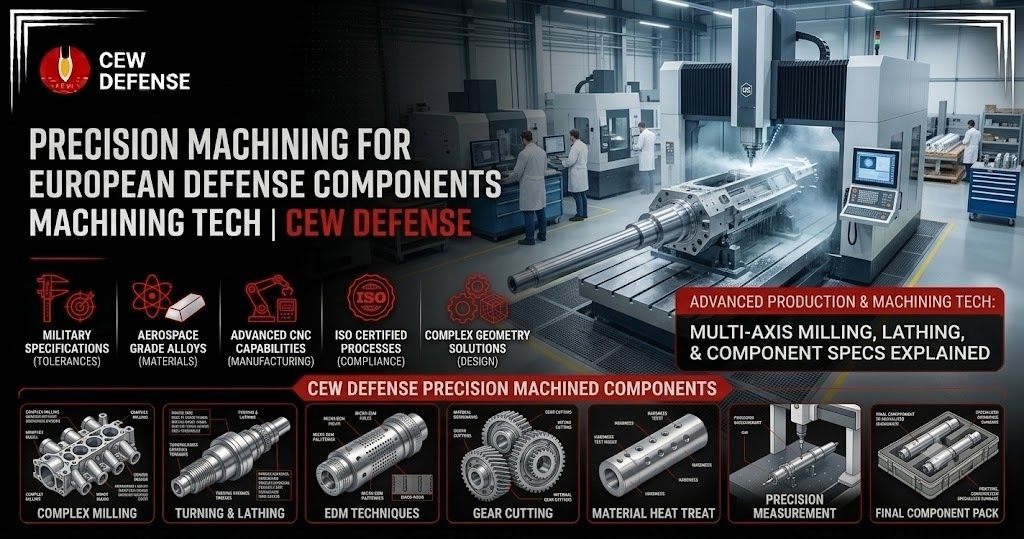
European defense systems require machined components that meet strict military specifications and performance standards. The production of these defense parts relies heavily on advanced heat treatment processes for durability. Manufacturers must follow ISO 9001:2015 standards to ensure total quality across every single production phase. The factory is also TÜV Austria-certified to guarantee full compliance with international defense manufacturing rules.
Machining in European Defense Manufacturing
- Defense Component Requirements
Defense vehicles need strong parts that survive extreme conditions during active military operations in harsh environments. Machining facilities apply specific heat treatment processes to increase the structural strength of these critical parts. Military engineers demand high fatigue resistance to prevent sudden failures during intense combat maneuvers and transport. Reliable component production ensures that armored platforms remain fully operational when facing severe battlefield stress levels.
- Precision and Repeatability
Machined parts must fit perfectly into larger defense assemblies without requiring any manual adjustment during installation. Repeatable manufacturing processes ensure that every single produced component matches the exact original engineering design specifications. High precision prevents dangerous gaps between mating surfaces inside sensitive hydraulic systems and weapon guidance mechanisms. Automated measurement systems verify the accuracy of each part before it leaves the secure machining facility. Machining for European Defense requires this level of precision and consistency to ensure reliable performance in demanding defense applications.
Machined Components for Defense Systems
- Structural Components
Structural parts form the main frame of armored vehicles and provide essential protection for military personnel. These heavy steel structures require precise machining to maintain exact weight limits and dimensional accuracy. Thick armor plates undergo careful milling to create mounting points for external communication arrays and sensors. The structural integrity of the vehicle hull depends entirely on the quality of these machined interfaces.
- Mechanical Components
Mechanical components include gears and shafts that transfer power from the engine to the vehicle tracks. Read our detailed guide on armored vehicle suspension components to understand these mechanical systems much better. Precision-ground bearings reduce friction inside the drivetrain and extend the service life of moving assemblies. Complex gearboxes require exact tooth profiles to deliver smooth power delivery across uneven and rocky terrain.
- Replacement Parts
Military units frequently need replacement parts to repair damaged vehicles and restore full operational combat capabilities. Machining replacement components ensures that older defense platforms remain fully functional and ready for active deployment. Facilities produce spare parts on demand to support legacy fleets that lack active original production lines. Rapid replacement part manufacturing minimizes vehicle downtime and keeps critical defense assets available for immediate missions.
Materials Used in Defense Machining
- Alloy Steel
Alloy steel provides excellent tensile strength and high resistance to wear during demanding military field operations. Facilities use controlled heat treatment processes to harden the surface of alloy steel for maximum durability. Manganese and chromium additives improve the hardenability of the metal during intense industrial cutting and shaping. These specific steel grades resist deformation when subjected to high explosive impacts and heavy dynamic loads.
- Stainless Steel
Stainless steel prevents rust and maintains structural integrity when defense vehicles operate in wet coastal regions. Machining stainless steel requires specialized cutting tools to achieve the required surface finish and dimensional accuracy. The high nickel content prevents corrosion inside cooling systems that circulate harsh liquids near the engine. Naval defense applications rely heavily on stainless components to survive prolonged exposure to aggressive saltwater environments. Machining for European Defense also uses stainless steel components where corrosion resistance and dimensional accuracy are required.
- Aluminum Alloys
Aluminum alloys reduce the total weight of defense vehicles while maintaining adequate protection for the crew. Lightweight aluminum components allow military transport aircraft to carry more vehicles across long distances very efficiently. Aerospace-grade aluminum provides excellent stiffness for radar housings that require precise alignment during active tracking. Machining aluminum alloys demands careful heat management to prevent material distortion and maintain strict dimensional tolerances.
CNC Machining for Defense Production
- CNC Milling
CNC milling removes material from solid metal blocks to create complex flat surfaces and deep pockets. Operators apply specific heat treatment processes before milling to stabilize the metal and prevent future warping. High-speed spindles cut intricate cooling channels into engine blocks to manage extreme thermal loads safely. Adaptive tool path control maintains constant cutting forces to protect fragile thin walls inside complex housings.
- CNC Turning
CNC turning rotates metal stock while a stationary cutting tool shapes the exterior into cylindrical defense parts. This process creates precise shafts and pins that connect different mechanical systems inside military combat vehicles. Live tooling capabilities allow machinists to mill flat spots and drill cross holes during single setups. Automated bar feeders supply continuous material to the lathe to support uninterrupted production runs over multiple shifts.
- Multi-Axis Machining
Multi-axis machines cut metal from multiple angles simultaneously to produce highly complex defense components much faster. This advanced capability reduces the total setup time and improves the overall accuracy of finished parts. Five-axis centers produce aerodynamic turbine blades that power auxiliary generators for onboard military electronic systems. Complex contouring creates smooth transitional surfaces that reduce stress concentrations in heavily loaded structural mounting brackets. Machining for European Defense also uses multi-axis machining to produce complex defense components with the required accuracy.
Machining Requirements for European Defense
- Tight Tolerances
European defense contracts demand extremely tight tolerances to ensure perfect fitment inside sensitive guidance and targeting systems. Machinists apply specialized heat treatment processes to relieve internal stresses and maintain these strict dimensional limits. Microscopic deviations can cause catastrophic failures inside high-pressure fuel injection systems used in modern tanks. Temperature-controlled machining environments prevent thermal expansion errors when measuring critical dimensions against strict military specification sheets.
- Material Traceability
Material traceability requires manufacturers to track every batch of metal from the original supplier to final delivery. This strict tracking system ensures that defective materials never enter the final defense production assembly line. Unique laser-etched codes link each finished component back to its original metallurgical certification and chemical analysis. Auditors review these traceability records regularly to verify full compliance with demanding European military procurement regulations. Machining for European Defense also requires proper material traceability to maintain quality and compliance.
- Consistent Production
Consistent production means that the first machined part and the last machined part share identical physical properties. Manufacturing facilities achieve this high consistency by strictly monitoring machine parameters and cutting tool wear rates. Automated tool breakage detection systems stop the machine immediately to prevent scrap parts from leaving the work zone. Standardized work instructions ensure that every operator follows the exact same procedure for loading and unloading parts.
Defense Manufacturing Quality Control
- Dimensional Inspection
Dimensional inspection uses coordinate measuring machines to verify that all physical dimensions match the approved engineering drawings. Quality inspectors reject any component that falls outside the acceptable tolerance range specified by the military client. Optical comparators project magnified shadows of small pins to check complex geometric profiles against digital master overlays. Surface roughness testers measure the microscopic peaks and valleys to guarantee proper sealing in hydraulic applications. Machining for European Defense also requires dimensional inspection to ensure that every component meets the required specifications.
- Material Testing
Material testing verifies the internal structure and chemical composition of the metal used in defense applications. Technicians verify the results of applied heat treatment processes to confirm the hardness of finished metal parts. Ultrasonic testing reveals hidden internal voids that could compromise the structural strength of heavy load-bearing brackets. Magnetic particle inspection detects microscopic surface cracks that develop during aggressive grinding and finishing operations. The following table summarizes the hardness requirements and primary applications for common military vehicle materials.
- Production Verification
Production verification involves testing a random sample of machined components under simulated battlefield conditions and heavy loads. This final testing phase guarantees that the manufactured defense parts will survive actual combat operational environments safely. Vibration tables shake the assembled components to identify potential resonance issues before the parts reach the field. Thermal shock chambers expose the machined metal to extreme temperature cycles to validate long-term material stability.
European Defense Supply Chain Support
- OEM Component Supply
Original equipment manufacturers rely on external machining facilities to supply critical sub-assemblies for new military vehicle programs. These external suppliers must apply rigorous heat treatment processes to meet the strict demands of military primes. Just-in-time delivery schedules ensure that main assembly plants receive components exactly when production requires them. Strategic partnerships between prime contractors and machine shops stabilize the entire European defense industrial supply network. Machining for European Defense also depends on reliable external machining facilities to support military production.
- Replacement Component Production
Replacement component production supports legacy defense platforms that require new parts long after the original production ended. Machining facilities reverse-engineer obsolete parts to supply the military with reliable replacements for aging combat vehicles. Three-dimensional scanning captures the exact geometry of worn samples to recreate accurate digital manufacturing models quickly. This reverse engineering capability keeps older artillery systems operational without waiting years for new tooling development.
- Long-Term Manufacturing Support
Long-term manufacturing support ensures that defense contractors have a stable supply chain for future vehicle maintenance needs. This reliable support structure allows European militaries to maintain high operational readiness levels over several decades continuously. Facilities store original digital tool paths securely to guarantee identical reproduction of parts twenty years later. Dedicated account managers coordinate directly with military logistics officers to forecast future spare parts demand accurately. Machining for European Defense also provides long-term manufacturing support for defense contractors.
CEW Defense Machining Capabilities
Advanced manufacturing facilities equipped with modern multi-axis machines produce high-quality military components reliably for defense contractors. Strict security protocols protect sensitive military data while the engineering team develops optimized production strategies.
- Precision CNC Manufacturing
Precision CNC manufacturing allows the facility to produce complex defense parts with extremely tight dimensional accuracy limits. The engineering team programs tool paths carefully to maximize material removal rates while maintaining excellent surface finishes. Advanced simulation software predicts cutting forces to prevent tool deflection during the machining of thin walls. Closed-loop feedback systems adjust the cutting depth automatically to compensate for minor thermal growth accurately.
- Defense Component Production
Defense component production requires strict adherence to military security protocols and specialized quality assurance standards at all times. The manufacturing floor isolates sensitive military projects to prevent unauthorized access and protect critical intellectual property data. Background-checked personnel handle classified blueprints to ensure that sensitive vehicle designs remain completely secure internally. Dedicated clean rooms assemble delicate optical sights that require absolute freedom from dust and airborne contamination.
- Custom Machining Solutions
Custom machining solutions provide military engineers with specialized parts that address unique operational challenges in the field. The technical staff collaborates directly with defense designers to optimize part geometry for better manufacturing and performance. Rapid prototyping services allow engineers to test physical design iterations quickly before committing to mass production. Flexible manufacturing cells adapt to low-volume production runs for highly specialized experimental military vehicles.
Future of Defense Machining in Europe
- Production Modernization
Production modernization introduces automated loading systems and advanced robotics to increase the overall efficiency of machining operations. Automated facilities integrate controlled heat treatment processes directly into the production line to reduce manual handling errors. Artificial intelligence monitors machine health data to predict equipment failures before they disrupt critical defense production schedules. Digital twin technology creates virtual replicas of the factory floor to optimize workflow and material routing.
- Local Manufacturing Capacity
Local manufacturing capacity reduces the reliance on foreign supply chains and protects European defense industrial sovereignty effectively. Investing in domestic machining infrastructure ensures that European nations can produce critical military equipment during global crises. Regional production hubs shorten transport distance and lower the carbon footprint associated with heavy metal logistics. Government funding supports the modernization of local machine shops to maintain a strong strategic industrial base. Machining for European Defense also supports local manufacturing capacity and helps maintain a strong European defense industrial base.
Final Thought
The European defense sector requires reliable partners that deliver precision-machined components on time and within budget. CEW Defense continues to invest in advanced manufacturing technologies to support the long-term security needs of Europe. Visit Cew Defense to explore our full range of industrial manufacturing capabilities and precision machining services. Precision machining remains the foundation of a strong and independent European defense manufacturing industry.