
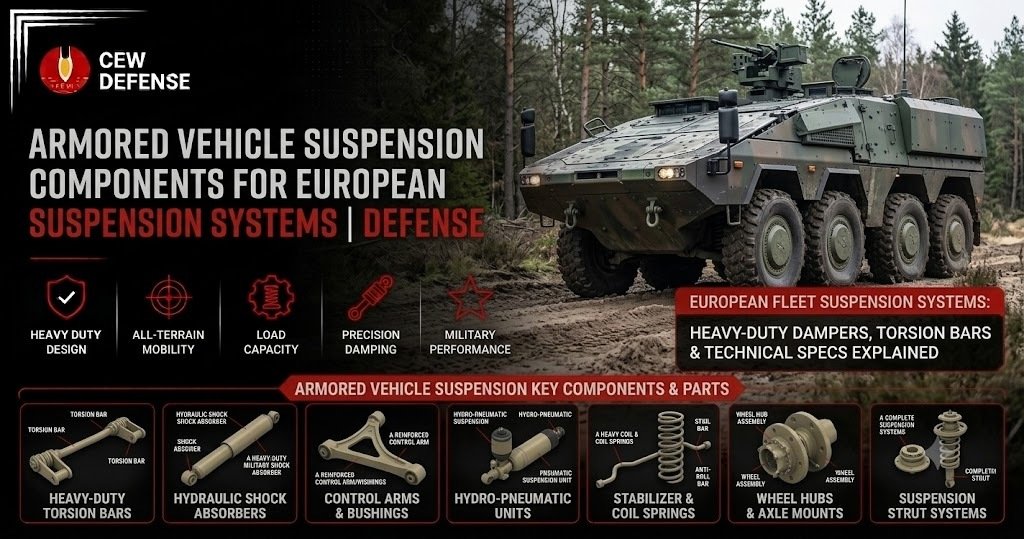
Modern mechanized warfare demands exceptional mobility across unpredictable Central European landscapes. Heavy combat machines rely on robust undercarriage systems to survive these harsh environments. The armored vehicle suspension components absorb immense kinetic shocks during rapid tactical maneuvers. Czech and Slovak military forces demand absolute reliability from their mechanized fleets. Understanding how armored vehicle suspension components function helps logistics teams maintain peak operational readiness. Strict adherence to TÜV Austria and ISO 9001:2015 standards guarantees uncompromising manufacturing excellence. Advanced metallurgical science forms the backbone of successful defense production processes. These systems must endure relentless stress while providing a stable firing base. Without reliable undercarriage parts, even the most advanced combat vehicles become immobilized liabilities.
Armored Vehicle Suspension Components Explained
- Suspension Load Requirements
Modern combat vehicles carry heavy armor plating and advanced weapon systems daily. The suspension must support this massive weight without compromising structural integrity. Engineers calculate dynamic loads meticulously to prevent premature metal fatigue over extended service periods. Proper load management ensures the chassis remains intact during aggressive maneuvers. Ignoring these calculations often results in catastrophic structural failures during intense field operations. Furthermore, dynamic forces multiply exponentially when the vehicle traverses rough terrain at high speeds.
- Component Durability
Harsh environmental conditions rapidly degrade standard automotive parts used in warfare. Military-grade materials resist extreme temperatures, mud, and abrasive desert sand perfectly. High-quality armored vehicle suspension components prevent catastrophic mechanical failures during critical missions. Sustained durability ensures the chassis remains intact during aggressive maneuvers. Regular maintenance protocols further extend the functional lifespan of these critical mechanical assemblies. Operators rely on this resilience to complete prolonged deployments without unexpected breakdowns.
Core Suspension Components
- Heavy-Duty Springs
Torsion bars or coil springs provide the primary lifting force for the chassis. These elements store kinetic energy to smooth out rough terrain impacts. High-tensile steel alloys ensure these springs resist permanent deformation under severe operational stress. Over time, repeated compression cycles can weaken inferior metals significantly. Therefore, manufacturers utilize specialized heat treatments to maximize the elastic limit of the steel.
- Shock Absorbers
Hydraulic dampers control the oscillation of the springs after a heavy impact. They convert kinetic energy into heat, which then dissipates safely into the surrounding air. This mechanism prevents the vehicle from bouncing uncontrollably across uneven ground. Without effective damping, the crew would experience severe physical discomfort and equipment damage. Modern designs incorporate adjustable valving to adapt to varying payload weights dynamically.
- Control Arms and Bushings
Control arms guide the vertical movement of the road wheels precisely. Rubber or polyurethane bushings isolate vibrations from the main vehicle hull. Worn bushings cause excessive noise and degrade the overall ride quality significantly over time. Replacing these isolators regularly prevents metal-on-metal contact within the suspension geometry. This proactive maintenance preserves the alignment of the entire wheel assembly effectively.
- Stabilizer Systems
Anti-roll bars connect the left and right sides of the suspension assembly. They minimize body roll during sharp, high-speed cornering maneuvers on paved roads. This stability allows gunners to maintain accurate aim while the vehicle moves. Enhanced lateral control also reduces the risk of rollover accidents on steep inclines. Consequently, these systems are vital for both safety and combat effectiveness.
Suspension Performance in Armored Vehicles
- Load Distribution
Even weight distribution prevents localized stress fractures within the vehicle chassis. Multiple road wheels share the total mass of the heavy combat machine. This intelligent design protects the hull from cracking under extreme dynamic loads. Uneven loading can cause premature wear on specific suspension arms. Engineers design the geometry to ensure balanced force transfer across all contact points.
- Ride Stability
A smooth ride reduces crew fatigue during prolonged cross-country travel missions. Stable vehicles enable accurate firing of onboard weapon systems while moving. Operators can navigate steep embankments without losing control of the heavy machinery. Consistent stability also protects sensitive internal electronics from vibration-induced damage. This reliability is crucial for maintaining combat effectiveness during extended engagements.
- Off-Road Mobility
Independent wheel articulation allows each tire to maintain ground contact constantly. This traction prevents the machine from getting stuck in deep mud or snow. Superior mobility ensures rapid combat repositioning during active conflict scenarios internationally. Vehicles with restricted articulation often become stranded in challenging topographical features. Thus, flexible suspension designs are paramount for tactical success in diverse environments.
Suspension Requirements for European Platforms
- Czech Defense Vehicles
The Czech Republic operates several modernized wheeled and tracked combat vehicles. Machines navigating the dense Bohemian forests require highly durable undercarriage parts for longevity. Local defense industries prioritize sourcing robust parts to maintain fleet readiness. Reliable armored vehicle suspension components are essential for maintaining the operational readiness of these platforms. Continuous upgrades ensure these vehicles meet contemporary battlefield demands effectively.
- Slovak Defense Vehicles
Slovak armed forces utilize similar mechanized vehicles for national security missions. Their combat fleets face demanding operational conditions across the rugged Carpathian Mountains. Sustaining these demanding military deployments requires uncompromising quality in every set of armored vehicle suspension components. The mountainous terrain places exceptional stress on shock absorbers and torsion bars. Therefore, sourcing premium replacement parts is a critical logistical priority.
- NATO Compatibility
Both nations adhere to strict NATO interoperability standards for military hardware. Components must meet rigorous testing protocols to ensure seamless joint missions. Standardized parts simplify logistics and maintenance across allied military supply chains. This harmonization allows for rapid sharing of spare parts during multinational exercises. Consequently, manufacturers must align their production specifications with these international requirements.
Engineering Factors for Suspension Systems
- Weight and Load Capacity
Engineers must balance the sheer mass of the armored chassis with mobility. Excessive weight can overwhelm standard suspension geometries, leading to rapid mechanical failure. Optimized load capacity ensures the vehicle handles maximum payload without bottoming out. Adding reactive armor or extra equipment increases the baseline weight significantly. The suspension must accommodate these additions without requiring a complete structural redesign.
- Material Strength
Selecting the correct metallurgical composition is vital for long-term survival. High-yield steel alloys provide the necessary tensile strength to resist bending. Advanced heat treatments further enhance the resistance to fatigue and sudden impact forces. Inferior materials will crack under the relentless punishment of cross-country travel. Rigorous metallurgical analysis guarantees that every batch meets these stringent performance criteria.
- Component Integration
Proper integration of armored vehicle suspension components guarantees smooth articulation and prevents premature wear. Poorly integrated parts create friction points that accelerate overall system degradation. Precise alignment ensures smooth movement and protects adjacent mechanical parts from damage. Engineers utilize advanced computer simulations to verify fitment before physical production begins. This meticulous planning eliminates costly assembly errors during the manufacturing phase.
Testing and Quality Standards
- Dimensional Accuracy
Computer numerical control machining ensures exact measurements for every production batch. Tight tolerances are mandatory for seamless integration with existing vehicle assemblies. Digital modeling verifies all dimensions before any physical production begins safely. Even minor deviations can lead to catastrophic binding within the suspension mechanism. Therefore, automated inspection systems monitor every machining pass continuously.
- Performance Testing
Prototypes undergo rigorous stress simulations to mimic real-world battlefield conditions. Hydraulic test benches apply continuous dynamic loads to verify structural limits. This proactive validation prevents unexpected failures during actual combat deployments. Engineers also conduct environmental testing to assess performance in extreme temperatures. Only components passing these exhaustive trials receive approval for military use.
- Quality Control
Every batch undergoes non-destructive testing, including ultrasonic and magnetic particle inspections. These rigorous checks detect hidden micro-fractures before parts receive final approval. Advanced coordinate measuring machines verify exact measurements against original engineering blueprints. Comprehensive documentation accompanies every shipment to ensure full traceability. This transparency builds trust with defense procurement agencies worldwide.
For insights on legacy mobility systems, review our detailed analysis of the M113 APC specs and guide.
CEW Defense Manufacturing Capabilities
- Precision Engineering
Leading defense manufacturers trust CEW Defense for superior metallurgical engineering solutions. Our facility delivers custom metal pieces meeting exact combat requirements perfectly. We understand the critical nature of durability in all defense applications. Our team utilizes state-of-the-art machinery to achieve flawless surface finishes. This dedication to excellence guarantees optimal performance in the field.
- Defense Component Production
Partnering with CEW Defense ensures your fleets receive the highest quality parts. Our engineering team delivers solutions that exceed stringent international defense standards. We stand behind every product with a commitment to absolute structural integrity. Our scalable production capabilities accommodate both small-batch prototypes and large-scale orders. This flexibility supports the diverse needs of modern armed forces.
- Custom Manufacturing
Specialized military platforms often require bespoke undercarriage solutions for unique missions. Our adaptable production lines accommodate specific dimensional requests without compromising quality. This flexibility allows armed forces to maintain specialized vehicles effectively. We collaborate closely with clients to refine designs for maximum operational efficiency. The result is a tailored component that perfectly matches the vehicle requirements.
Modern Armored Vehicle Suspension Trends
- Advanced Suspension Systems
Next-generation alloys promise lighter weight and significantly greater fatigue resistance overall. Active suspension systems will soon adjust damping rates automatically in real-time. Integrated sensors may monitor structural stress for predictive maintenance alerts directly. These innovations will drastically reduce the logistical burden on maintenance crews. Furthermore, they will enhance the overall survivability of the vehicle crew.
- Vehicle Modernization
Upgrading armored vehicle suspension components requires advanced parts to extend the functional lifespan of legacy fleets. Electric drive systems will demand new designs optimized for different torque profiles. Future designs will prioritize silent movement to enhance stealth capabilities on battlefields. Retrofitting older vehicles with modern suspension parts is a cost-effective modernization strategy. This approach maximizes the return on investment for existing military assets.
Final Thought
Robust undercarriage systems remain indispensable for modern mechanized forces everywhere. Their unique combination of load capacity and durability is completely unmatched. Investing in quality armored vehicle suspension components ensures military fleets remain effective and combat-ready long-term. Continuous maintenance will keep these vital vehicles operational indefinitely across Europe. Strategic partnerships with reliable manufacturers guarantee sustained operational superiority.