
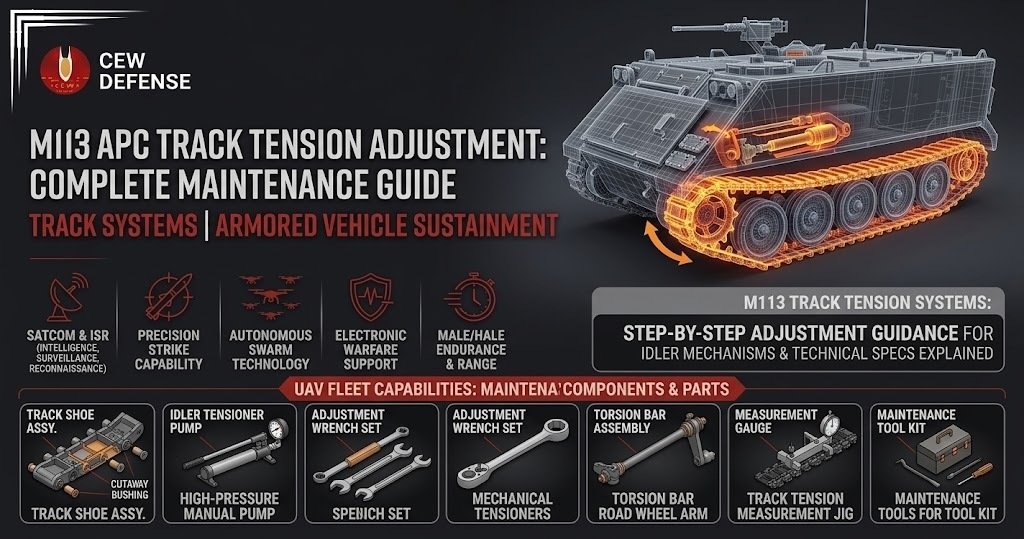
M113 APC require strict maintenance protocols to ensure complete operational readiness during military deployments. Proper M113 APC track tension adjustment prevents sudden derailments when vehicles traverse rough cross-country terrain. Military maintenance depots follow standards to guarantee strict quality control during complex repairs. The production environment is also certified to verify compliance with international industrial safety regulations. Mechanics must understand the exact specifications before attempting any physical adjustments on the heavy steel tracks. Neglecting this critical daily task drastically increases the risk of catastrophic mechanical failures in combat zones.
Historical Background of the M113 Platform
- Initial Design and Aluminum Hull Selection
Initial design work for the platform dates back to nineteen fifty-six for cheaper transport. The military requested an armored personnel carrier that was significantly lighter than previous heavy models. Evaluation studies compared the aluminum T113 prototype against the heavier steel construction T117 prototype carefully. Engineers chose aluminum because it allowed the bulk of military equipment to remain fully air transportable. The aluminum armor required three times the thickness of steel to provide equal ballistic protection. However, the rigid hull eliminated reinforcing structures and created much more usable interior space inside. The welded armored plating has a maximum thickness of thirty-five millimeters for splinter protection.
- Early Production and Engine Upgrades
The T113E1 prototype entered series production in nineteen sixty after extensive military evaluation testing phases. The FMC Corporation delivered the first vehicles less than four years after the initial order. The basic model utilized a two hundred nine horsepower Chrysler petrol engine for primary propulsion. Development continued, and a diesel-powered prototype formed the basis for the new M113A1 model. The newer diesel motor provided significantly improved performance and better fuel efficiency for deployed units. Over fifty thousand units covering one hundred fifty variants were produced during the last decades.
Undercarriage and Track System Specifications
- Torsion Bar Suspension and Road Wheels
The torsion bar suspension system offers definite advantages from a strict vehicle weight reduction aspect. Ten oscillating arms link to separate torsion bars to ensure optimum road-holding capability constantly. Ten pairs of large rubber-rimmed road wheels support the massive hull weight evenly distributed. Hydraulic shock absorbers reinforce the front and rear oscillating arms to dampen severe terrain impacts. The complete absence of top rollers reduces overall weight and simplifies the daily cleaning process.
- Track Link Configuration and Lifespan
The tracks consist of sixty-three and sixty-four links on the left and right sides. Drive sprockets transfer engine power to the simple swivel-type links housed in thick rubber bushings. Each individual link features a rubber pad that improves road holding and reduces overall noise levels. The standard track life reaches forty-five hundred kilometers but can extend to fourteen thousand kilometers. Track tension is regulated by means of a hydraulic adjuster acting on the rear idler wheel. This specific mechanical layout requires precise M113 APC track tension adjustment to maintain optimal mobility performance.
M113 APC Track Tension Adjustment Procedures
- Preparing the Vehicle for Maintenance
The driver must park the armored vehicle on a perfectly flat and solid concrete pad. Crew members thoroughly clean the entire undercarriage using high-pressure water to remove thick mud. Mechanics inspect the torsion bar bump stops to ensure the suspension rests at normal height. The engine remains completely shut off while personnel work underneath the heavy tracks to prevent accidents. Proper preparation guarantees that the M113 APC track tension adjustment process yields highly accurate results.
- Adjusting the Rear Idler Mechanism
The mechanic locates the large grease fitting and lock nut on the rear idler arm assembly. Applying penetrating oil helps dissolve heavy rust that accumulates around the adjustment threads during wet seasons. Releasing the old grease pressure allows the rear idler wheel to move backward and relax tension. Pumping fresh military-grade grease into the adjuster cylinder slowly pushes the idler wheel forward steadily. The mechanic continuously checks the tape measure while the assistant operates the heavy manual grease pump. Achieving the perfect M113 APC track tension adjustment requires patience and constant communication between both mechanics.
- Upgrading from T130E1 to T150F Tracks
Technical bulletins provide specific instructions to convert vehicles equipped with T130E1 track to T150F track. Kit 57K4269 provides the necessary parts and specialized tools to replace the sprocket carrier completely. This modification replaces the existing assembly with the new T150F track on M113A2 and M113A3 carriers. Mechanics must follow all safety warnings detailed in the manual before starting this complex modification process. Completing this upgrade requires a subsequent M113 APC track tension adjustment to seat the new links.
Operational History and Field Modifications
- Combat Experience in Vietnam
Two companies consisting of fifteen vehicles operated in the Mekong Delta during nineteen sixty-two. The vehicles experienced little difficulty covering soft terrain when called upon to leave paved roads. Troops experienced difficulty forming a rapid appreciation of the situation when leaving the vehicle quickly. The commander faced severe risks while acting as gunner with the externally mounted heavy machine gun. Defensive action remained limited to manning the external weapon with consequent risk to the vehicle commander.
- Evolution into Armored Cavalry Assault Vehicles
The military decided to convert the platform into an Armored Cavalry Assault Vehicle in nineteen sixty five. Engineers incorporated side-mounted machine guns and heavy gun shields to improve overall crew protection. These modifications served as temporary palliatives in the absence of a conventional rotating armored turret. Most armies are now considering the installation of turrets to improve direct-fire combat capabilities. The embodiment of a turret frequently resulted in upgunning the original weapon to automatic cannons.
Read our detailed guide on drone technology of pakistan to understand modern aerial surveillance systems.
Preventive Maintenance and Quality Standards
- Routine Inspection Schedules
Maintenance platoons conduct comprehensive undercarriage inspections at the end of every single intensive training month. They visit regularly to download updated technical manuals for heavy armored vehicle maintenance procedures. The following table outlines the standard inspection intervals for critical undercarriage components during monthly services.
They completely wash the tracks and measure the exact pitch elongation of every single steel link. Links that exceed the maximum allowable stretch limit are removed and replaced with new components. This thorough monthly service extends the overall operational lifespan of the entire heavy undercarriage system significantly. Depot mechanics perform a complete M113 APC track tension adjustment after replacing any stretched track links.
- Manufacturing and Quality Certifications
The FMC Corporation mass-produced the vehicles in California and temporarily in West Virginia facilities. SpA OTO Melara also manufactured the platform under license in La Spezia, Italy, for export markets. Modern maintenance facilities follow strict protocols to ensure every repaired vehicle meets original factory specifications. Technicians use calibrated torque wrenches to secure the heavy rear idler lock nuts perfectly tight. A final M113 APC track tension adjustment guarantees the vehicle remains fully prepared for combat deployments.
Amphibious Operations and Variant Development
- Water Propulsion and Bilge Pumps
An outstanding feature is the ability to operate in water without any prior preparation required. The hull construction is completely watertight, and all critical points feature thick rubber seals tightly. The front of the vehicle features a hinged breakwater plate to maintain correct balance afloat. The tracks are provided with rubber blades, which ensure propulsion when amphibious operation becomes necessary. Two electric pumps having a combined capacity of one hundred sixty-six liters keep interiors dry. Supplementary braking is available for controlling the tracks and ensuring improved mobility in aquatic environments.
- Mechanized Infantry Combat Vehicle Prototypes
Designers originally created a battle taxi concept where troops would dismount to complete tactical missions. Infantrymen experienced difficulty observing the military scenario in the combat zone from inside the hull. A modified vehicle carried infantrymen seated back-to-back with firing ports for internal weapons. This concept led to the development of the XM734 prototype with a centrally mounted cupola. Later prototypes incorporated twenty-millimeter gun turrets and rifle ports to meet exacting army requirements. These continuous improvements ensure that the M113 APC track tension adjustment procedures remain highly relevant globally.
Final Thoughts
Proper undercarriage maintenance remains the absolute foundation of tactical mobility for modern mechanized infantry units globally. Commanders rely on well-trained crews to keep their heavy vehicles fully operational during deployments. Strict adherence to technical manuals prevents costly mistakes and ensures maximum operational readiness for military forces. Continuous investment in mechanic training programs guarantees that armored fleets remain highly capable and fully deployable. Mastering these fundamental mechanical skills ensures that armored formations can project power effectively across any terrain.