
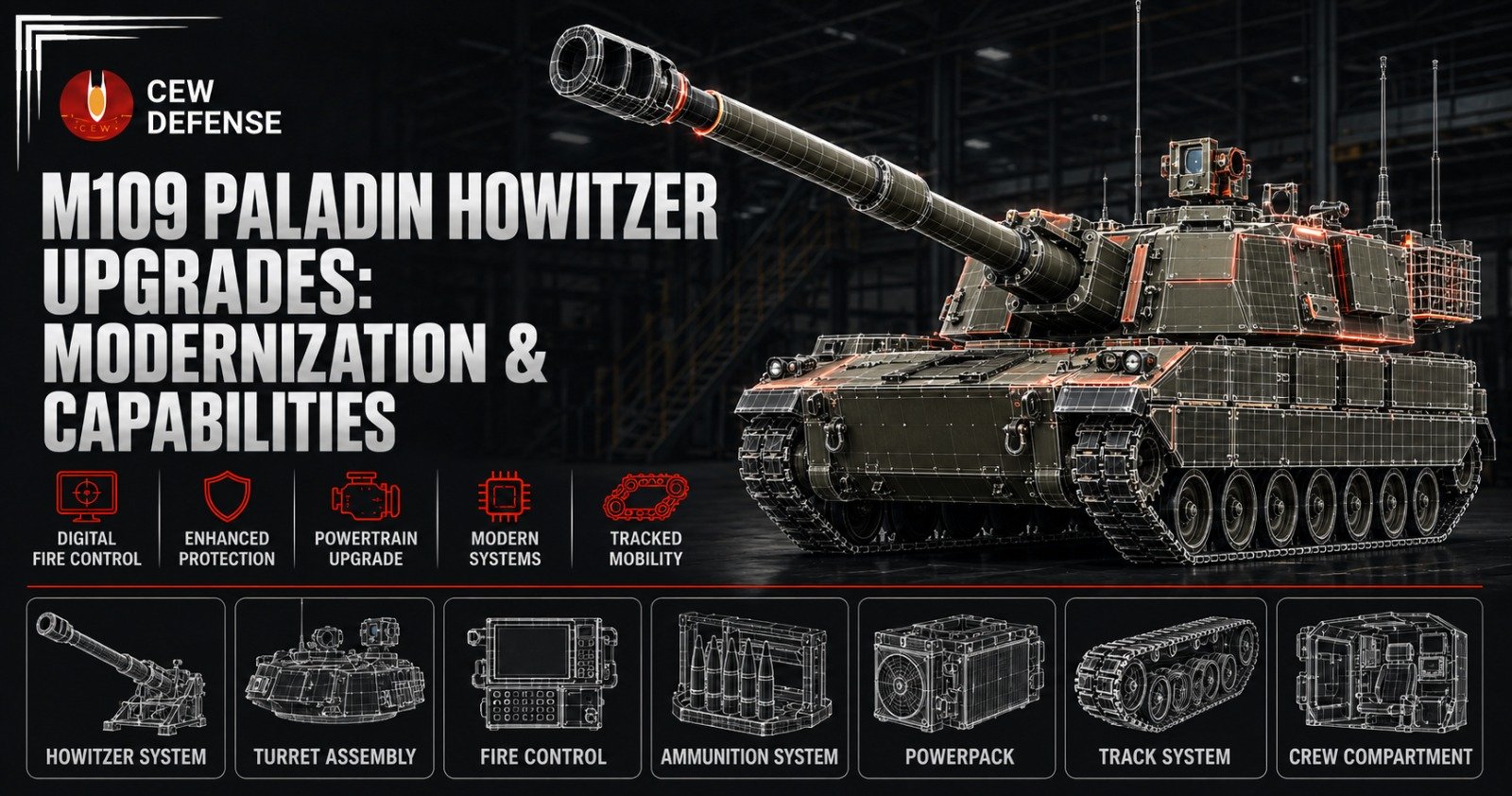
The M109 has served as the backbone of American mobile artillery for over sixty years. First rolling off production lines in 1963, this self-propelled howitzer was never meant to be a static relic. Its true strength lies in a remarkable capacity for continuous transformation. Through a continuous series of M109 Paladin howitzer upgrades, it evolved from a basic Cold War platform.
Today, it remains a sophisticated, networked, and lethal system central to U.S. Army doctrine. We will explore the key milestones and technological leaps in this journey. These strategic pivots have kept the Paladin relevant against ever-changing modern threats.
The Long Road of M109 Paladin Howitzer Upgrades
The story of this howitzer is not about a single revolutionary leap forward. Instead, it represents a testament to persistent and incremental improvement over time. Each new variant directly addressed the specific shortcomings of its immediate predecessor. Engineers constantly pushed the boundaries of range, survivability, and overall battlefield speed.
This relentless modernization ensured the platform’s longevity far beyond original design expectations.
- From Humble Beginnings to Global Workhorse
The original M109 entered active service with a modest 23-caliber barrel. It offered a maximum firing range of just 14.6 kilometers during initial deployment. It was strictly a product of its specific time. Engineers designed it primarily for nuclear-era battlefield support roles.
Throughout the 1970s and 1980s, the army systematically enhanced its core capabilities. The A1, A2, and A3 models introduced a longer 39-caliber gun. They also featured significantly improved engines for better cross-country mobility. The A5 upgrade in the 1980s further extended its reach and reliability.
These early changes proved the platform’s inherent adaptability to new combat demands. When discussing M109 Paladin howitzer upgrades, these early models set the foundation.
-
Original M109 (1963): Featured a short 23-caliber barrel with limited initial range.
-
A1-A3 Series (1970s): Upgraded to a 39-caliber gun, significantly boosting overall firepower.
-
A4 & A5 Models (1980s): Focused heavily on reliability, engine improvements, and extended firing range.
- The Digital Leap: The M109A6 Paladin
The arrival of the M109A6 "Paladin" in 1994 marked a major shift. This was no longer just a simple artillery piece on tracks. It officially became a digital node on the modern battlefield. The M109 Paladin howitzer upgrades in the A6 model changed everything. The A6 integrated an advanced fire control system with GPS and inertial navigation.
This allowed it to stop, fire three rounds in under a minute, and relocate. Enemy counter-battery radar could not lock on before the vehicle moved away. Its larger turret, improved armor, and NBC protection made it far more survivable.
-
Digital Fire Control: Enabled rapid, accurate targeting without traditional manual surveying methods.
-
Shoot-and-Scoot Doctrine: Revolutionized crew survivability against modern enemy counter-fire systems.
-
Enhanced Protection: Added Kevlar spall liners and climate-controlled NBC protection systems.
- Building the Future: The M109A7 PIM
The latest major iteration, the M109A7, emerged from the Paladin Integrated Management program. Instead of a complete redesign, engineers built it on a new chassis. This chassis is shared directly with the Bradley Fighting Vehicle. This commonality simplifies logistics and routine maintenance across the armored fleet. The A7 is heavier but noticeably faster than older models.
It features a more powerful engine and a massive increase in electrical power generation. Power jumped from 18.5 kW in the A6 to a robust 70 kW. This powers its advanced digital architecture and accommodates future technological upgrades.
-
Bradley Common Chassis: Streamlined parts and maintenance across the entire armored fleet.
-
Massive Power Boost: A 70 kW electrical system now supports next-generation electronics.
-
Future Growth Capacity: Designed with weight and power margins for upcoming new tech.
Anatomy of a Modernized Beast: Key Features of the Latest Upgrades
The modern M109A7 is a formidable fusion of legacy reliability and cutting-edge technology. Its upgrades are not superficial cosmetic changes. They touch every critical system, from its mobility to its brain and its punch.
- Mobility and Power: The New Heart of the Paladin
Gone is the sluggish performance of older, aging models. The M109A7’s new powertrain gives it a top speed of 38 mph. This allows it to keep pace with Abrams tanks and Bradleys. They can now operate together during high-tempo combat maneuvers.
The shift to a common chassis was not just about simple convenience. It was a strategic decision to create a more agile artillery force. This force can now operate seamlessly within combined arms teams.
-
Increased Speed: Reaches 38 mph, perfectly matching the pace of main battle tanks.
-
Common Powertrain: Shares vital components with the Bradley for logistical efficiency.
-
Enhanced Suspension: Provides a smoother ride and much better cross-country mobility.
- Brains of the Operation: Fire Control & Network Integration
The true power of the modern Paladin lies in its digital brain. Its automated fire control system receives target data directly from networked sensors. Command posts send this data instantly to the vehicle. The gun lays itself automatically based on these digital commands.
The crew can now execute missions with unprecedented speed and accuracy. This seamless integration into the army's networked battlefield ecosystem is vital. It makes the M109A7 a force multiplier, not just a cannon on tracks. Future M109 Paladin howitzer upgrades will likely focus heavily on this automation.
-
Automated Laying: The gun aims itself accurately based on digital fire commands.
-
Network-Centric Warfare: Fully integrated with the Army’s tactical data networks.
-
Reduced Crew Workload: Automation allows a smaller crew to operate at peak efficiency.
- Delivering the Payload: Lethality and Rate of Fire
The base gun remains a 39-caliber 155mm weapon. However, the M109A7 can unleash its payload with devastating effect. It maintains a sustained rate of fire of one round per minute. It can also burst up to four rounds in a single minute when needed. Crucially, it is fully compatible with precision-guided munitions.
It fires rounds like the Excalibur shell with extreme precision. This turns a single shot into a surgical strike. It can hit targets over 30 kilometers away with pinpoint accuracy.
-
High Burst Rate: Can fire four rounds in under 60 seconds for immediate effect.
-
Precision Munitions: Fires GPS-guided shells for pinpoint accuracy at long range.
-
Increased Ammunition Stowage: Carries more rounds than its predecessors for sustained operations.
Pushing the Envelope: The ERCA Program and Beyond
Even as the M109A7 entered active service, the Army was looking further ahead. The goal was simple yet audacious. Engineers wanted to dramatically extend the cannon’s range. They needed it to match or exceed the range of rocket artillery.
- The Quest for Extreme Range
The Extended Range Cannon Artillery program launched in 2018. It aimed to push the M109’s range from 30 km to a staggering 70 km. The centrepiece was a massive 58-caliber gun tube. This was mounted on the existing M109A7 chassis. It created the prototype vehicle known as the XM1299.
This effort sought to give ground forces a long-range precision strike capability. It needed to be both responsive and cost-effective compared to expensive missiles.
-
58-Caliber Super Gun: The core of the ERCA effort designed for extreme range.
-
70 km Target: Intended to close the range gap with enemy rocket systems.
-
XM1299 Prototype: The primary tested vehicle built directly on the M109A7 platform.
- From ERCA to SPH-M: A Strategic Pivot
In April 2024, the Army encountered significant technical hurdles and delays. Consequently, they made the difficult decision to cancel the ERCA prototyping effort. The quest for a new self-propelled howitzer did not end there, however. It transitioned into the Self-Propelled Howitzer Modernization program.
This new program is now evaluating a much broader range of solutions. It includes potentially wheeled platforms for greater strategic mobility.
-
ERCA Cancellation: The program officially ended in April 2024 due to technical challenges.
-
Birth of SPH-M: A new, more flexible program to find the Army’s future artillery.
-
Broader Evaluation: SPH-M is open to various designs, not just tracked upgrades.
- The M109-52: A Pragmatic Path Forward
The Army continues to search for its ultimate successor. Meanwhile, BAE Systems has proposed a smart, low-risk alternative. They call it the M109-52. This upgrade swaps the standard 39-caliber gun for a proven 52-caliber cannon. It offers a significant range boost without the complexity of the 58-caliber system. It leverages the existing, reliable M109A7 platform. This delivers enhanced capability quickly and affordably to the troops.
-
52-Caliber Upgrade: A balanced solution between extended range and technical risk.
-
Low-Risk, High-Reward: Uses existing, mature technology for much faster fielding.
-
Bridge to the Future: Keeps the Paladin relevant while SPH-M develops.
The Enduring Legacy and Future of the Paladin
Despite the ongoing search for a replacement, the M109’s story is far from over. Its unique blend of power, protection, and digital sophistication ensures its relevance. It will remain a key player on the battlefield for years to come. The success of these M109 Paladin howitzer upgrades is evident globally.
- A Platform Built to Last
The U.S. Army plans to keep the M109A7 in active service well into the 2030s. Some estimates suggest its core architecture could support operations until 2050. The PIM program focused heavily on reliability and growth capacity. This means the platform can easily absorb new technologies as they emerge. It can accept better ammunition and more powerful sensors in the future.
-
Service Until 2030s+: Officially planned to remain in the active inventory for over a decade.
-
Growth Architecture: Designed from the very start to accept future technological upgrades.
-
Proven Reliability: Decades of operational use have thoroughly validated its core design.
- Global Relevance and Allied Use
The M109 is not just an American icon. It is truly a standard for modern artillery worldwide. Dozens of allied nations operate various versions of the Paladin today. You will find them operating from Europe all the way to Asia. This widespread adoption creates a vast ecosystem of support and training. It reinforces the vehicle's value as a cornerstone of allied artillery forces.
-
NATO Standard: Forms the reliable backbone of many allied artillery brigades.
-
Global Support Network: A vast, established logistics chain exists worldwide.
-
Interoperability: Ensures seamless joint operations with international partner nations.
- Design Philosophy: Learning from the Past
The success of the tracked M109 platform is part of a broader philosophy. It reflects a specific American philosophy of armored vehicle design. Its layout, internal organization, and emphasis on crew protection share a lineage. It shares this lineage with other iconic military vehicles. Understanding this design heritage provides valuable context for its evolution.
For instance, the principles of internal space management are very similar. The crew workflow seen in the M113 APC interior is echoed here. It appears in the thoughtful, albeit more complex, arrangement of the Paladin’s fighting compartment.
-
Tracked Vehicle Heritage: Shares core design DNA with other U.S. armored workhorses.
-
Crew-Centric Layout: Internal design prioritizes crew efficiency and overall safety.
-
Evolutionary, Not Revolutionary: Builds on proven concepts rather than starting from scratch.
Final Thoughts
The journey of the M109 Paladin howitzer upgrades is a masterclass in military modernization. It demonstrates how a well-conceived platform can defy obsolescence for generations. A clear vision for incremental improvement makes this possible. From its analog origins to its current role as a digital fires node, the Paladin has continuously adapted.
It adapts to meet the ever-changing demands of the modern battlefield. While the army rightly looks to the future with programs like SPH-M, the M109A7 stands tall. It serves as a powerful reminder about building upon a proven foundation. Its legacy of mobile, precise, and responsive firepower remains a critical pillar of defense.