
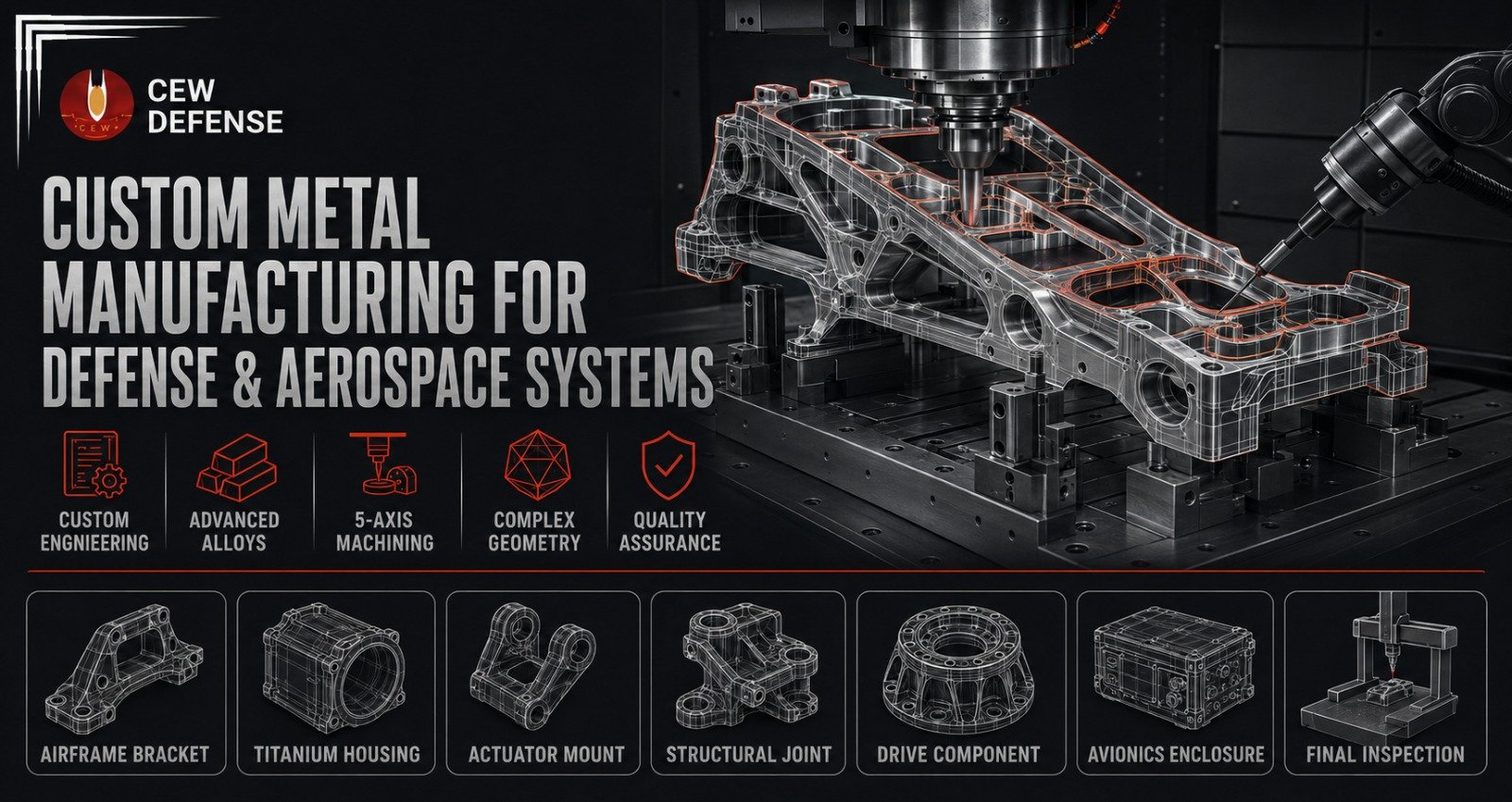
Choosing the right custom metal manufacturing partner protects product quality, project timelines, performance standards, and long-term procurement confidence. CEW Defense maintains TÜV Austria and ISO 9001:2015 certifications, supporting consistent production, documented quality procedures, and dependable manufacturing control.
These certifications provide customers with greater confidence when selecting suppliers for demanding defense, aerospace, industrial, and security-related components. A qualified manufacturing partner also manages material selection, technical specifications, precision machining, surface finishing, inspection requirements, and delivery schedules.
Reliable Manufacturing for Defense and Aerospace Requirements
- Precision Components for Demanding Applications
Defense and aerospace projects require precision-made components that perform reliably under challenging operational conditions. Custom production allows engineers to specify exact dimensions, materials, finishes, tolerances, and performance requirements. These components may support protective equipment, aerospace assemblies, communication systems, vehicle structures, industrial machinery, and specialized defense platforms.
Every part must match approved specifications while maintaining dependable performance during demanding operations.
A suitable supplier understands that small dimensional errors can affect assembly, reliability, and overall system performance. Therefore, manufacturers should use controlled processes, calibrated equipment, and qualified personnel throughout production.
- From Technical Drawings to Finished Parts
A qualified manufacturer transforms technical drawings into production-ready components using controlled processes and specialized equipment. This approach supports prototypes, low-volume orders, replacement parts, and repeat production programs. The production process may include design review, material sourcing, CNC machining, fabrication, finishing, inspection, packaging, and delivery.
Managing these stages through one coordinated supplier can simplify communication and reduce procurement delays.
Buyers should select a supplier capable of managing the complete manufacturing cycle. Design review, material sourcing, machining, inspection, finishing, and delivery should follow one coordinated process.
Complete Production Support
A complete manufacturing service can reduce the need for multiple suppliers and separate project contacts. This creates simpler procurement while improving communication between engineering, purchasing, and production teams.
When one supplier manages several production stages, customers can receive clearer quotations and more consistent delivery updates. This approach also makes it easier to resolve technical questions before production begins.
What Makes a Manufacturing Partner Commercially Valuable?
Technical Guidance and Communication
The best supplier offers more than fabrication capacity or competitive pricing. A valuable partner provides technical guidance, transparent communication, and dependable production control. Before requesting a quotation, confirm whether the supplier can support your specific requirements. These requirements may include complex geometries, tight tolerances, special alloys, protective coatings, or inspection documentation.
A strong supplier should explain production limitations clearly instead of accepting specifications that create unnecessary cost or risk. This guidance helps customers make practical decisions without compromising important performance requirements.
Consistent Production Quality
You should evaluate the supplier’s ability to maintain consistent quality across multiple production batches. Stable processes reduce rework, avoid unexpected delays, and protect your overall project budget. Repeat orders require reliable programming, material control, inspection procedures, and production planning. Consistency becomes especially important when replacement components must match previously supplied parts.
Suppliers with controlled quality systems can identify production issues earlier and correct them before final delivery. This supports repeatable results and stronger long-term purchasing relationships.
Commercial Evaluation Factors
Buyers should compare suppliers according to technical capabilities, certifications, production capacity, inspection procedures, and delivery records. A lower quotation may not provide better value if it creates delays, quality problems, or additional inspection costs.
The following factors help customers evaluate a supplier before ordering prototypes, small batches, or larger production quantities. These considerations support more informed purchasing decisions and reduce avoidable procurement risks.
Materials, Capabilities, and Production Services
Materials Used for Mission-Critical Components
Material selection strongly influences component strength, weight, corrosion resistance, and performance. Experienced manufacturers recommend materials based on application needs, environmental conditions, production quantities, and budget.
Aluminum alloys offer lightweight construction and good corrosion resistance for aerospace and defense components. Stainless steel provides durability, corrosion resistance, and strength for demanding applications. Titanium delivers high strength with low weight but requires controlled machining. Carbon and alloy steel support applications requiring strength, impact resistance, and load-bearing capability.
Material decisions should consider operating conditions, weight, production needs, and budget. A technical review helps prevent unsuitable material choices before manufacturing begins.
CNC Milling and Turning Services
A capable manufacturer should support different production methods according to component geometry and order volume. CNC milling, turning, drilling, tapping, cutting, and finishing can address diverse component requirements. CNC milling creates precise pockets, slots, contours, holes, and complex three-dimensional features.
It works effectively for housings, brackets, mounting plates, fixtures, structural components, and specialized mechanical assemblies. CNC turning produces cylindrical parts, shafts, pins, bushings, adapters, and threaded components. Modern turning equipment supports repeatable dimensions, efficient production, and consistent quality across different order quantities.
These machining methods can support prototype development and established production programs. The correct process depends on part geometry, material type, tolerances, quantity, surface finish, and required production speed.
Stainless Steel Machining Considerations
For buyers seeking dependable stainless steel CNC machining services, supplier expertise remains especially important. Stainless steel requires controlled cutting conditions, suitable tooling, and careful heat management during machining. Poorly controlled machining can create excessive heat, tool wear, surface damage, or dimensional inconsistencies. Experienced machinists use suitable speeds, feeds, coolants, and tooling strategies for reliable and accurate results.
The manufacturer should also understand stainless steel finishing requirements, including deburring, cleaning, passivation, polishing, or protective treatment. These processes can improve surface quality and corrosion resistance.
Sheet Metal Fabrication and Finishing
Sheet metal fabrication supports enclosures, covers, panels, guards, and formed assemblies. Cutting, bending, welding, and assembly can create practical solutions for equipment protection and system integration. Finishing services may include anodizing, powder coating, plating, passivation, blasting, or protective painting. The correct finish improves appearance, corrosion resistance, wear resistance, and component performance.
Customers should specify the operating environment before selecting a finish. Outdoor exposure, chemicals, humidity, friction, temperature, and appearance requirements can influence the most suitable finishing option.
Commercial Production Flexibility
Custom metal manufacturing supports many commercial requirements, including prototypes, replacement parts, low-volume production, and repeat manufacturing. This flexibility helps buyers order according to their current project stage. Prototype support allows engineers to evaluate fit, function, and design performance before committing to larger quantities. Low-volume production can support specialized equipment without requiring unnecessary inventory.
Repeat production becomes more efficient when the supplier maintains approved drawings, material records, inspection requirements, and manufacturing programs. This creates long-term efficiency for future orders.
How the Commercial Buying Process Works
Preparing Information for a Quotation
A straightforward purchasing process helps customers obtain accurate quotations and realistic delivery expectations. Begin by providing drawings, three-dimensional models, quantities, materials, tolerances, finishes, and inspection requirements. Include packaging expectations, delivery locations, required documentation, and target completion dates whenever possible.
Complete information helps suppliers calculate costs accurately and identify technical concerns earlier.
The manufacturer should review your files and identify design risks, manufacturing limitations, and cost-saving opportunities. This stage may reveal unnecessary tolerances, difficult features, or practical material alternatives.
Quotation and Technical Review
After technical review, the supplier prepares a quotation based on labor, material, programming, tooling, inspection, finishing, and delivery requirements. Clear quotations reduce misunderstandings during order placement. Customers should review quoted quantities, material grades, tolerances, finishing requirements, inspection documents, lead times, and payment conditions.
Confirming these details protects both parties before production begins. A detailed quotation should explain important assumptions affecting cost and delivery. This transparency allows purchasing teams to compare offers using accurate information rather than headline pricing alone.
Production Planning and Manufacturing
Once you approve the quotation, production planning begins. The manufacturer purchases materials, prepares machining programs, schedules equipment, and confirms the expected completion timeline.
Effective planning helps coordinate machine availability, tooling requirements, inspection resources, finishing schedules, and packaging activities. This coordination supports predictable delivery and fewer avoidable interruptions.
During production, quality personnel inspect important characteristics according to approved requirements. Early checks can identify dimensional problems before additional machining, finishing, or assembly activities occur.
Inspection, Packaging, and Delivery
Final inspection may include dimensional checks, visual examination, material verification, and documentation review. Inspection requirements should follow the customer’s approved drawings, specifications, and purchase order. The completed components are packaged carefully to prevent damage during transportation. Proper packaging is particularly important for precision parts, coated surfaces, and sensitive assemblies.
Customers should receive parts with suitable identification and supporting documents when required. Clear packaging and documentation make receiving inspections faster and improve internal traceability.
Reducing Costs Without Sacrificing Quality
Practical Design Improvements
Commercial buyers often need lower production costs without compromising component performance. The right manufacturing strategy can achieve both objectives through practical design and process improvements. Simplify complex features whenever they do not provide meaningful functional value. Fewer setups, reduced tooling requirements, and easier access can lower machining time.
Use standard material sizes when practical, because common stock dimensions usually reduce waste and purchasing costs. Your manufacturer can recommend efficient material options during design review. Apply realistic tolerances to noncritical features while maintaining tight tolerances where performance requires them. Excessively strict specifications increase inspection time, machining expenses, and production complexity.
Planning for Repeat Orders
Combine related components when assembly reduction improves overall value. However, larger integrated parts must remain practical for machining, inspection, transportation, and maintenance.
Plan repeat orders early to improve production scheduling and reduce setup costs. Long-term purchasing arrangements may also support better pricing and consistent component availability.
Maintaining approved drawings and production records can reduce preparation time during future orders. This creates better cost control and supports more stable purchasing conditions.
Balancing Price and Performance
The lowest price does not always represent the strongest commercial option. Buyers should consider material quality, inspection standards, delivery reliability, finishing performance, and expected component life.
A slightly higher initial investment may reduce replacement costs, rework, field failures, and production interruptions. Total project value should therefore guide purchasing decisions instead of unit price alone.
Why Quality Documentation Matters
Supporting Approvals and Traceability
Quality documentation supports customer approvals, regulatory requirements, internal audits, and future replacement orders. It also creates useful traceability for mission-critical components. Depending on your requirements, documentation may include inspection reports, material certificates, certificates of conformity, dimensional records, and finishing confirmations.
A manufacturer following controlled quality procedures can identify process issues earlier. This reduces the possibility of receiving components that fail assembly, testing, or field-use requirements.
Certifications and Supplier Confidence
Certifications do not replace product inspection, but they demonstrate organized systems, documented procedures, and management commitment. TÜV Austria and ISO 9001:2015 certifications can strengthen supplier evaluation decisions.
Customers can use certification information alongside production capability, inspection procedures, material knowledge, and delivery performance. A complete assessment provides a more accurate view of supplier suitability.
Quality systems also support better internal accountability throughout production. This can improve supplier confidence when customers purchase components for regulated or mission-critical applications.
Choosing the Right Supplier for Your Project
Comparing Technical Capabilities
Compare suppliers according to technical capability, communication quality, certifications, inspection methods, production capacity, and delivery performance. Price should remain important, but it should not become your only evaluation factor. Ask whether the supplier has experience with comparable materials, component sizes, tolerances, and production quantities. Relevant experience can shorten development time and reduce avoidable manufacturing problems.
You should also confirm how the supplier manages engineering changes, urgent requirements, nonconforming parts, and repeat production. Clear procedures provide greater confidence throughout the purchasing relationship.
Building a Dependable Partnership
A dependable supplier communicates clearly before, during, and after production. Timely updates help customers manage engineering decisions, purchasing schedules, approvals, and final assembly planning.
CEW Defense supports customers requiring accurate components, dependable communication, and controlled production services. The company can assist with technical requirements, material selection, machining, finishing, inspection, and delivery planning.
Selecting the right partner creates advantages beyond one purchase order. It can support stable supply, consistent component quality, faster repeat orders, and improved long-term project planning.
Final Thought
The right custom metal manufacturing partner can improve component quality, procurement efficiency, production reliability, and long-term project value. Focus on certifications, technical capability, transparent quotations, inspection documentation, and proven delivery control.
A supplier with complete capabilities can help reduce manufacturing risks while supporting precise, durable, and application-ready components. Contact us today to discuss your drawings, materials, quantities, and mission-critical manufacturing requirements with CEW Defense.