
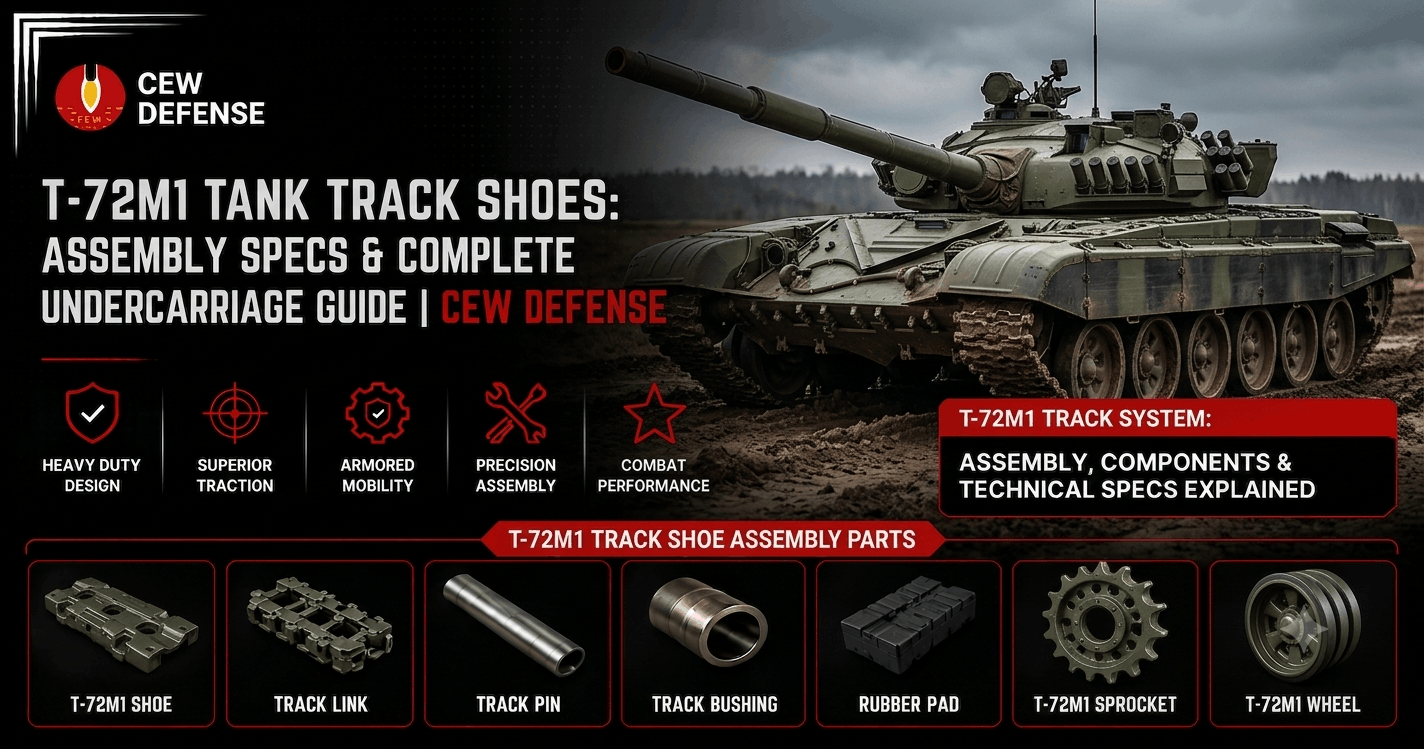
Armored vehicles requires continuous, uninterrupted movement across unpredictable and highly challenging landscapes. The T-72M1 tank track shoe assembly forms the foundational mobility system for this iconic platform. Strict adherence to TÜV Austria and ISO 9001:2015 certifications guarantees every manufactured piece meets rigorous international defense benchmarks. Understanding these mechanical elements allows logistics teams to maintain peak operational readiness. This guide explores the engineering, maintenance, and strategic value of these critical undercarriage elements. Advanced metallurgical science forms the backbone of every successful military manufacturing operation.
What Is a T-72M1 Tank Track Shoe Assembly?
- Primary Function
This mechanical arrangement serves as the direct contact point between the heavy armored chassis and the earth. It distributes massive vehicle weight over a broader surface area, preventing the chassis from bogging down. Proper weight distribution is absolutely vital for maintaining high speeds over rough terrain.
- Importance in Tank Mobility
Without a robust T-72M1 tank track shoe assembly, the vehicle loses its ability to navigate steep inclines. It translates engine torque into forward momentum, ensuring the armored unit reaches its tactical objectives without delay. Commanders depend on this stability to execute complex tactical maneuvers without hesitation.
Main Components of a T-72M1 Tank Track Shoe Assembly
- Track Shoes
These are the individual metal plates featuring aggressive grouser patterns. They bite into loose dirt or snow, providing the necessary friction for forward propulsion. The angled design actively clears mud and debris during continuous rotation.
- Track Links
Acting as the structural backbone, these interlocking segments hold the entire loop together. They must endure immense tensile stress during rapid acceleration or sudden braking maneuvers. High-quality forging prevents stretching under extreme dynamic loads.
- Track Pins and Bushings
These cylindrical connectors join adjacent links securely within the chain. Precision-fitted bushings minimize metal-on-metal friction, reducing internal wear and extending the operational lifespan of the continuous loop. Proper lubrication keeps these joints functioning smoothly.
- End Connectors
Positioned at the extremities of each shoe, these guides keep the track aligned on the road wheels. They prevent lateral slippage and ensure smooth engagement with the drive sprockets. This alignment is crucial for preventing derailment during sharp turns.
Key Features of a T-72M1 Tank Track Shoe Assembly
- High-Strength Steel Construction
Manufacturers utilize specialized armor-grade steel alloys exclusively for these parts. This specific metallurgical composition resists shattering or bending when striking rocks or debris at high speeds. The material balance provides both rigidity and necessary flexibility.
- Heat-Treated Components
Thermal processing hardens the outer surfaces while maintaining a ductile core. This dual-property treatment prevents catastrophic brittle fractures under extreme kinetic shock. Quenching processes achieve optimal Rockwell hardness ratings for maximum durability.
- Precision Manufacturing
Advanced machining techniques ensure every hole and contour matches original blueprints perfectly. Tight tolerances are mandatory for seamless integration with the suspension mechanism. Digital modeling verifies dimensions before any physical production begins.
- High Wear Resistance
A properly engineered T-72M1 tank track shoe assembly resists the abrasive nature of sand, gravel, and mud. Specialized surface treatments significantly delay the thinning of the metal plates. Protective coatings further shield the metal from corrosive environmental exposure.
How Track Shoe Assembly Improves Performance
- Enhanced Traction
The deep, strategically angled grousers dig firmly into unstable ground. This grip allows the armored vehicle to climb steep embankments that would easily immobilize wheeled transport. Operators maintain forward momentum even in deeply saturated soil conditions.
- Better Stability
A wide footprint lowers the ground pressure exerted by the heavy vehicle. This balanced distribution prevents the chassis from tipping or sliding during sharp, high-speed turns. Crews can execute complex flanking maneuvers with complete confidence.
- Reliable Load Distribution
By spreading the multi-ton weight evenly across all road wheels, the mechanism protects the suspension arms from localized stress fractures and fatigue. This even distribution is critical for preserving the structural integrity of the hull.
Manufacturing Process of T-72M1 Tank Track Shoe Assembly
- Material Selection
Sourcing begins with procuring certified, high-tensile steel ingots from trusted suppliers. Raw materials undergo chemical analysis to verify their elemental composition before entering the production line. Only approved batches proceed to the initial shaping phase.
- Casting and Heat Treatment
Molten metal is poured into specialized molds to form the rough shape. Subsequent quenching and tempering cycles refine the internal grain structure, maximizing overall durability. Specialized ovens provide uniform heat distribution to prevent warping.
- CNC Machining
Computer-controlled lathes mill the rough castings to exact, precise dimensions. This step creates the precise mounting holes and smooth mating surfaces required for final assembly. Automated tooling ensures consistency across thousands of produced units.
- Quality Inspection
Every batch undergoes non-destructive testing, including ultrasonic and magnetic particle inspections. These checks detect hidden micro-fractures before the parts are approved for shipment. Advanced coordinate measuring machines verify exact measurements against engineering blueprints.
For comprehensive insights on similar mobility mechanisms, review our detailed analysis of the Leopard 2A4 track shoes assembly. Furthermore, explore our complete catalog of precision track shoe assembly solutions engineered for maximum battlefield endurance.
Common Causes of Track Shoe Assembly Wear
- Rough Terrain Operations
Constant exposure to jagged rocks, concrete rubble, and abrasive sand accelerates surface degradation. The friction physically grinds away the metal over extended missions. Desert environments are particularly harsh on standard steel surfaces.
- Heavy Operational Loads
Carrying additional armor plating or heavy equipment increases the downward force. This extra weight amplifies the stress on every connecting pin and link. Overloading the chassis accelerates the fatigue process significantly.
- Inadequate Maintenance
Neglecting to clean debris or lubricate moving joints leads to accelerated corrosion. Rust weakens the structural integrity, making the pieces prone to sudden failure. Moisture trapped between links causes rapid internal degradation.
Maintenance Tips for Longer Service Life
- Regular Inspection
Crews should visually examine the undercarriage after every single mission. Identifying minor cracks or loose hardware early prevents catastrophic breakdowns in the field. Documenting wear patterns helps predict future replacement needs accurately.
- Correct Track Tension
Maintaining optimal sag is crucial for vehicle longevity and performance. A loop that is too tight accelerates internal wear, while a loose loop risks derailing during sharp maneuvers. Technicians use calibrated gauges for precise adjustments.
- Timely Component Replacement
Worn pins or stretched links must be swapped out immediately. Delaying replacements compromises the entire mechanical loop and endangers the crew. Using original specification parts ensures continued operational safety.
Applications of T-72M1 Tank Track Shoe Assemblies
- Military Vehicles
These elements are essential for keeping legacy armored fleets combat-ready. They restore full mobility to units deployed in active conflict zones. Upgraded parts breathe new life into older, heavily utilized machines.
- Defense Maintenance Programs
Overhaul depots rely on high-quality replacements to refurbish aging chassis. Upgrading with modern, durable parts extends the service life of the entire vehicle. Fleet modernization programs depend on a steady supply of these items.
- Spare Parts Support
Strategic stockpiles ensure that logistics chains remain uninterrupted during crises. Having dependable spares on hand minimizes vehicle downtime during critical operations. Forward operating bases require immediate access to replacement parts.
Factors to Consider When Choosing A Supplier
- Manufacturing Expertise
Choose a partner with a proven history in armored vehicle parts. Experienced engineers understand the unique physical demands placed on these specific items. A strong track record indicates consistent production quality.
- Material Quality
Verify that the supplier uses certified, military-grade alloys exclusively. Substandard metals will fail prematurely under combat conditions. Request material certification documents for every production batch.
- Quality Standards
The facility must adhere to strict international protocols and regulations. Certifications guarantee that every manufacturing step is monitored and documented. Rigorous testing protocols separate premium suppliers from average vendors.
- Global Supply Capability
A dependable vendor can fulfill large orders and deliver them promptly. Steady supply chains are vital for sustaining long-term defense contracts. Logistics networks must support international shipping requirements efficiently.
Leading defense organizations trust CEW Defense for uncompromising quality and precision engineering. Our facility delivers engineered solutions that meet the highest international benchmarks consistently. Partnering with CEW Defense ensures your armored fleets remain fully operational and combat-ready.