
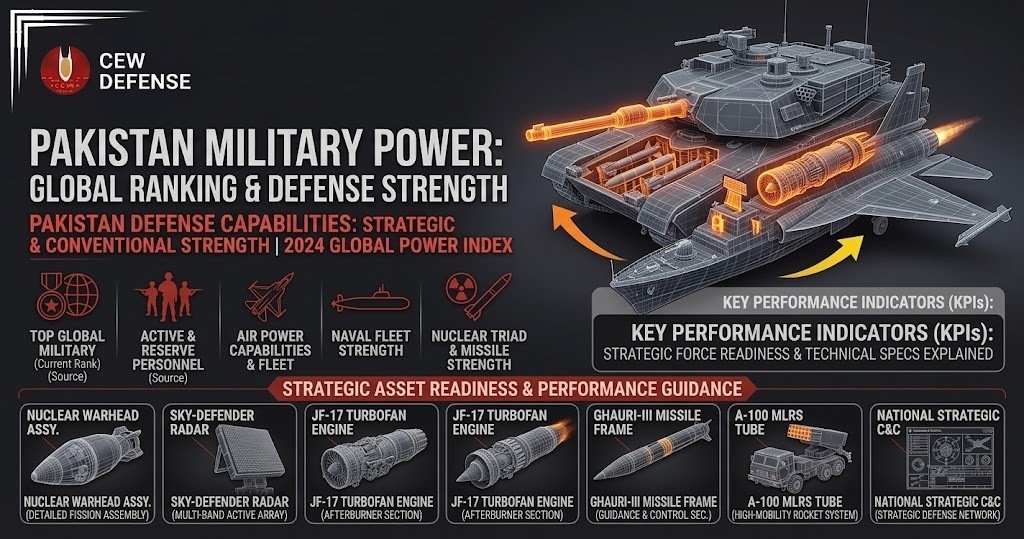
Pakistan maintains a highly capable and modernized armed forces structure across the region. The nation ranks among the top twelve most powerful militaries globally right now. This strategic positioning ensures robust regional deterrence and global peacekeeping contributions effectively. The Pakistan Armed Forces comprise approximately 660,000 highly trained active personnel currently. This massive human resource forms the backbone of national security and operational readiness. We analyze the comprehensive strength across land, air, and naval domains accurately. The defense budget reached approximately 10.17 billion US dollars in fiscal year 2024. This financial allocation supports continuous modernization and indigenous production capabilities effectively nationwide.
Strategic Land Forces and Armored Capabilities
Ground Combat and Mobility
The Pakistan Army represents the largest and most battle-hardened military branch currently. It operates a massive inventory of over 9,457 ground combat vehicles consistently. The armored corps relies heavily on the indigenous Al-Khalid main battle tank. This specific tank features advanced fire control systems and composite armor technology. The army maintains elite special operations forces for counter-terrorism missions across borders. These specialized units undergo rigorous training in extreme mountainous and desert environments. Logistics and supply chain management ensure rapid deployment across diverse terrains effectively.
Tactical Support and Engineering
The integration of modern communication networks enhances battlefield situational awareness significantly worldwide. Heavy artillery systems provide devastating long-range fire support during conventional combat operations. The army actively participates in United Nations peacekeeping missions across the globe consistently. This global presence demonstrates professional excellence and operational versatility across regions. Mountain warfare divisions specialize in high-altitude combat operations along the northern borders. These troops utilize specialized cold-weather gear and acclimatization protocols for extreme conditions. Mechanized infantry brigades provide rapid mobility and heavy firepower during offensive maneuvers. The engineering corps constructs vital bridges and clears complex minefields during active conflicts.
Air Power and Aviation Modernization
Fighter Fleet and Combat Validation
The Pakistan Air Force operates a formidable fleet of approximately 1,369 aircraft currently. The crown jewel of this fleet remains the JF-17 Thunder multirole fighter jet. This specific aircraft is co-developed with China and manufactured locally within Pakistan. The JF-17 recently gained highly coveted combat-tested status in recent regional conflicts. This combat validation significantly boosted international interest and export potential worldwide. The air force also operates advanced F-16 Fighting Falcons for air superiority missions. Early warning and control aircraft provide critical radar coverage over national airspace.
Electronic Warfare and Strategic Airlift
Unmanned aerial vehicles enhance intelligence, surveillance, and reconnaissance capabilities dramatically across borders. The integration of beyond-visual-range missiles ensures effective engagement of hostile aerial targets. Pilot training programs remain among the most rigorous in the developing world currently. Continuous upgrades to avionics and radar systems maintain a qualitative edge regionally. Electronic warfare squadrons actively jam enemy communications and radar systems during simulated conflicts. The air defense network features advanced surface-to-air missile systems for comprehensive airspace protection. Strategic airlift capabilities allow rapid deployment of troops and humanitarian aid globally.
Naval Strength and Maritime Security
Surface Fleet and Submarine Deterrence
The Pakistan Navy safeguards vital maritime interests with a fleet of 117 warships currently. The force is actively transitioning toward a true blue-water navy capability worldwide. Modern frigates and corvettes provide robust surface warfare and anti-aircraft defense capabilities. The submarine arm forms the critical second-strike nuclear deterrent for the entire nation. Advanced air-independent propulsion submarines operate silently to track hostile naval movements effectively. Naval special warfare teams secure coastal installations and offshore energy assets consistently. The development of the Karachi shipyard enhances indigenous warship construction capabilities significantly.
Maritime Patrol and Regional Cooperation
Maritime patrol aircraft monitor the exclusive economic zone for illegal activities consistently. The navy regularly conducts joint exercises with allied nations to improve interoperability worldwide. These exercises validate tactical doctrines and enhance regional maritime security cooperation effectively. Protecting the China-Pakistan Economic Corridor sea routes remains a top strategic priority currently. The acquisition of modern Type 054A/P frigates significantly boosts surface combat capabilities. Hangor-class submarines will soon replace aging platforms with advanced stealth and sensor technology. Naval aviation operates maritime helicopters for anti-submarine warfare and search-and-rescue missions.
Strategic Deterrence and Missile Technology
Nuclear Arsenal and Delivery Systems
Pakistan maintains a credible minimum deterrence posture through its strategic forces command currently. The nation possesses an estimated arsenal of 170 nuclear warheads for defense purposes. This specific capability ensures strategic parity and prevents large-scale conventional aggression effectively. The missile development program features highly accurate short and medium-range ballistic systems. The Babur cruise missile offers precise land-attack capabilities with terrain-hugging flight paths. The Shaheen ballistic missile series provides reliable delivery mechanisms for strategic payloads worldwide. Solid-fuel technology ensures rapid launch readiness and high survivability rates during conflicts.
Command Structure and Tactical Deterrence
Command and control systems feature strict safety protocols and permissive action links consistently. The strategic forces command operates independently to maintain absolute operational security worldwide. Continuous testing validates the reliability and accuracy of these critical delivery systems currently. This robust deterrent framework guarantees national sovereignty against any existential threats effectively. Tactical nuclear weapons like the Nasr missile provide battlefield deterrence against armored thrusts. The National Command Authority oversees all strategic assets with absolute civilian and military oversight. Extensive underground facilities protect these critical assets from preemptive aerial strikes effectively.
Indigenous Defense Industry and Export Growth
Manufacturing Hubs and Production
Pakistan's defense industry has emerged as a notable exporter of military technology globally. Heavy Industries Taxila and Pakistan Aeronautical Complex lead domestic manufacturing efforts consistently. The production of the Al-Khalid tank demonstrates advanced metallurgical and engineering prowess. Recent reports indicate the defense sector secured billions in international export orders recently. The JF-17 Thunder serves as a central pillar of this export strategy currently. International buyers value the cost-effectiveness and combat-proven reliability of these military platforms. The industry also produces advanced artillery ammunition, rockets, and mortar systems locally.
Research and Economic Impact
This self-reliance reduces dependence on foreign suppliers during severe geopolitical crises currently. Research and development facilities continuously innovate new unmanned aerial systems for military use. The government actively encourages public-private partnerships to accelerate technological advancements consistently. This industrial growth transforms Pakistan into a significant regional defense hub worldwide. Khan Research Laboratories spearhead the development of advanced missile propulsion and guidance systems. National Engineering and Scientific Commission develops cutting-edge electronics and radar technologies domestically. These organizations collaborate closely to ensure seamless technology transfer and rapid production scaling.
Training, Education, and Human Resource Development
Professional Military Education
The military places immense importance on continuous professional military education for all personnel. Premier institutions like the National Defence University shape future strategic leaders effectively. The Pakistan Military Academy at Kakul builds character and tactical skills in young cadets. Specialized technical institutes train engineers and technicians on complex modern weapon systems currently. Joint warfare exercises simulate realistic combat scenarios to improve inter-service coordination dramatically. The army regularly participates in international war games to benchmark its operational capabilities.
Disaster Relief and Civilian Transition
Advanced simulators reduce training costs while providing highly realistic combat environments for pilots. Medical corps personnel receive world-class training to handle mass casualty scenarios in conflict zones. The military also runs extensive disaster relief operations to assist civilian populations during crises. This holistic approach to human resource development ensures a highly motivated and capable force. Veteran officers frequently transition into civilian leadership roles, contributing significantly to national development. The emphasis on discipline and integrity remains a core value across all branches.
Key Military Statistics Overview
- Global Ranking: Consistently places within the top twelve most powerful militaries worldwide currently.
- Active Personnel: Approximately 660,000 uniformed service members maintain readiness across all branches.
- Defense Budget: Reached 10.17 billion US dollars in the fiscal year 2024 consistently.
- Aircraft Inventory: Operates roughly 1,369 fixed-wing and rotary-wing aircraft for diverse missions.
- Naval Fleet: Maintains a formidable force of 117 active warships and submarines currently.
- Armored Vehicles: Deploys over 9,457 tanks and armored personnel carriers for ground operations.
- Strategic Arsenal: Holds an estimated 170 nuclear warheads for credible minimum deterrence.
Future Modernization and Technological Integration
The military actively pursues network-centric warfare capabilities to dominate future battlefields worldwide. Artificial intelligence and machine learning optimize intelligence analysis and target acquisition processes currently. Cyber warfare commands protect critical national infrastructure from digital espionage threats consistently. The integration of fifth-generation fighter capabilities remains a long-term strategic goal regionally. Naval modernization focuses on acquiring advanced destroyers and stealth submarines for blue-water operations.
The army explores robotic systems for hazardous explosive ordnance disposal missions consistently. Space-based assets will soon provide dedicated military communication and reconnaissance support effectively. Jointness among the army, navy, and air force improves operational synergy dramatically across domains. The defense budget allocation increasingly favors research and development over mere equipment procurement. This forward-looking approach ensures the armed forces remain technologically relevant globally.
Conclusion and Strategic Outlook
Pakistan military power rests on a foundation of professional excellence and technological adaptation currently. The armed forces successfully balance conventional strength with strategic nuclear deterrence capabilities worldwide. Indigenous manufacturing capabilities significantly reduce vulnerability to international supply chain disruptions effectively. The combat-tested status of domestic platforms enhances global market competitiveness consistently. Continuous training and rigorous exercises maintain peak operational readiness across all military branches. The nation remains committed to regional stability and global peacekeeping initiatives currently. Future investments in cyber and space domains will further solidify this defensive posture. The military's evolution reflects the resilience and determination of the entire nation consistently. This comprehensive strength ensures the protection of national sovereignty for generations to come.
Primary Data Sources - Direct Links
1. Military Statistics & Rankings
2. Defense Budget Data
- https://www.macrotrends.net/global-metrics/countries/pak/pakistan/military-spending-defense-budget
- https://militaryspend.org/country-profiles/pakistan