
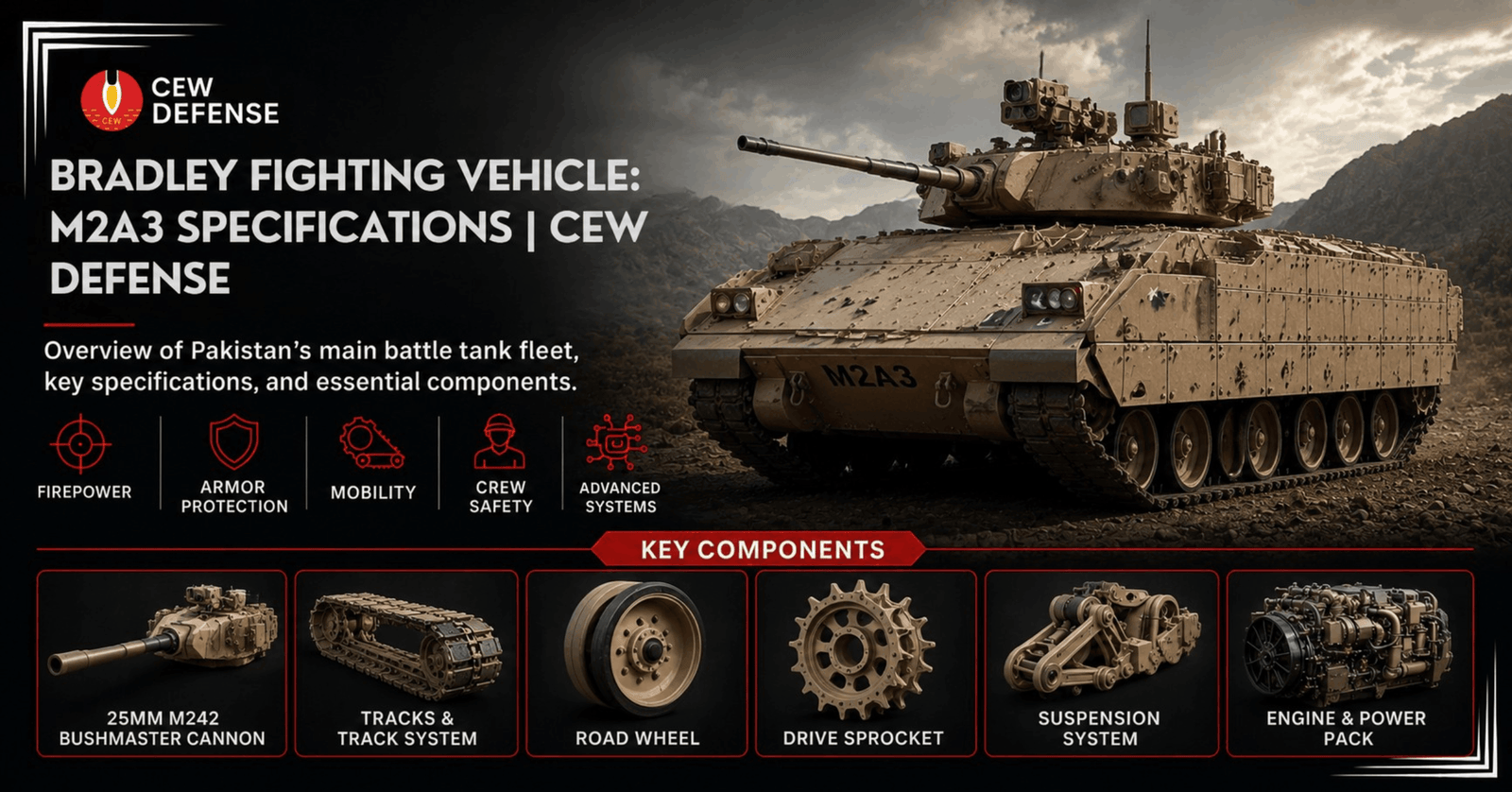
Modern battlefields demand versatile armored platforms that can keep pace with heavy armor while safely transporting and protecting infantry squads. The Bradley family of vehicles meets this critical need by combining direct fire support with robust armored personnel carrier capabilities. Understanding its technical details helps procurement officers, military strategists, and defense analysts make informed decisions regarding mechanized fleet modernization and battlefield readiness.
What Is the Military Bradley Fighting Vehicle?
Designed as a highly versatile military Bradley fighting vehicle, it serves as the primary infantry fighting vehicle (IFV) and cavalry fighting vehicle (CFV) for the United States Army and several allied nations. It effectively bridges the operational gap between light armored reconnaissance vehicles and heavy main battle tanks.
- Purpose and Role
Armies deploy this vehicle to transport infantry squads safely across hostile, contested terrain while providing heavy, immediate fire support. Commanders utilize their potent armament to suppress enemy positions, destroy light armored vehicles, and engage fortified structures. Furthermore, it protects vulnerable infantry from small arms fire, artillery shrapnel, and chemical, biological, radiological, and nuclear (CBRN) threats.
- Key Features
This platform features a two-man turret housing a 25mm chain gun and a BGM-71 TOW missile launcher. Engineers designed its aluminum and steel composite armor to withstand heavy machine-gun fire and artillery fragments. A powerful, reliable diesel engine ensures rapid battlefield mobility, allowing it to keep pace with heavier armored columns during high-tempo operations.
Design and Capabilities
The operational effectiveness of any modern armored platform relies on a carefully balanced triad of firepower, protection, and mobility.
- Armament
The primary weapon is the M242 Bushmaster 25mm chain gun, capable of firing hundreds of rounds per minute with devastating accuracy. This is complemented by the TOW missile system, allowing the crew to engage and destroy heavy enemy tanks at extended ranges. A coaxial 7.62mm machine gun provides additional, rapid defense against close-range infantry threats.
Advanced Protection Systems
Survivability on the modern battlefield is paramount, and the military Bradley fighting vehicle incorporates layered defense mechanisms to ensure crew safety against evolving threats.
- Armor Configuration
The hull utilizes a welded aluminum alloy structure, which provides a high strength-to-weight ratio, supplemented by spaced steel laminate armor on the front and sides. This configuration is designed to defeat kinetic energy penetrators and shaped charges. For a deeper understanding of how advanced armor systems integrate with heavy armored platforms, explore our detailed insights on the M1 Abrams Tank.
- Active Protection Technologies
To counter modern anti-tank guided missiles (ATGMs) and rocket-propelled grenades (RPGs), modernized variants are increasingly equipped with Active Protection Systems (APS). These systems utilize radar and sensors to detect incoming threats and deploy countermeasures to intercept and neutralize projectiles before they impact the vehicle’s hull.
- Crew Survivability
Beyond external armor, internal survivability is enhanced through advanced spall liners that minimize fragmentation inside the cabin if the hull is breached. Automated fire suppression systems, blast-resistant seating, and an overpressure CBRN protection suite further ensure that the crew can survive and continue fighting even after sustaining a hit.
Operational Advantages
The enduring success of this platform is rooted in its distinct operational advantages that outperform many contemporary alternatives.
- Firepower
The synergy between the rapid-fire 25mm chain gun and the long-range TOW missiles provides a unique dual-threat capability. This allows a single vehicle to engage both soft infantry targets and heavily armored enemy vehicles without requiring external fire support.
- Tactical Mobility
Powered by a robust Cummins VTA-903T V8 diesel engine producing 600 horsepower, the vehicle achieves a top road speed of 41 miles per hour. The torsion bar suspension system absorbs heavy shocks during fast movement over rough, cross-country terrain, ensuring the crew can maintain firing accuracy and operational endurance during prolonged missions.
- Mission Versatility
From reconnaissance and security missions to full-scale urban combat and mechanized assaults, the military Bradley fighting vehicle adapts seamlessly to diverse operational environments. Manufacturing such specialized, high-performance variants requires rigorous quality standards and precision engineering. Learn more about the critical role of a defence specification castings manufacturer in producing reliable, high-tolerance military components. Partnering with CEW Defense ensures your military casting and component requirements meet the highest international standards.
Development and History
The lineage of this platform reflects decades of continuous adaptation to emerging global threats and battlefield lessons learned.
- Origins
The United States Army initiated the Mechanized Infantry Combat Vehicle (MICV) program in the 1960s to replace the vulnerable M113 APC. FMC Corporation developed the initial prototypes, leading to the vehicle’s formal adoption in 1981. It was named after General Omar Bradley, honoring his monumental contributions to mechanized warfare.
- Modernization
Engineers have continuously upgraded the system to counter evolving threats. The Bradley A2 and A3 variants introduced digital fire control systems, improved armor packages, enhanced engine performance, and better situational awareness tools. These constant modernization efforts keep the platform highly relevant in contemporary, near-peer combat environments.
- Combat Operations
During the 1991 Gulf War and subsequent operations in Iraq and Afghanistan, the military Bradley fighting vehicle proved its resilience and combat effectiveness. It successfully engaged numerous enemy armored vehicles and provided crucial, life-saving fire support during intense urban combat operations, validating its original design philosophy.
Bradley Fighting Vehicle Variants
The manufacturer produced several distinct variants to meet the evolving, specialized requirements of different military branches and allied nations.
- M2 Bradley
The M2 is the standard infantry fighting variant, designed primarily to transport a nine-man infantry squad. It prioritizes troop capacity and dismount support while maintaining robust firepower for combined arms operations.
- M3 Bradley
The M3 is the cavalry fighting variant, optimized for reconnaissance, screening, and scout missions. It carries fewer troops but includes additional TOW missiles, enhanced optics, and advanced communication systems for extended battlefield surveillance.
- Specialized Variants
Specialized versions include the Bradley Fire Support Team (FIST) vehicle, the Bradley Commander’s Vehicle, and engineer variants equipped with mine-clearing systems. Each variant leverages the core chassis to fulfill niche tactical requirements.
Bradley Fighting Vehicle Specifications
This section details the core technical specifications that define the combat capabilities of this vehicle.
- Crew and Capacity
Three trained crew members operate this complex vehicle during active combat missions. The commander and gunner reside in the turret, while the driver sits in the front hull. The rear compartment safely transports up to seven fully equipped infantry soldiers.
- Engine and Performance
The powerful diesel engine drives this armored vehicle forward efficiently while significantly reducing the fire hazard associated with older gasoline engines. The vehicle can ford water obstacles with minimal preparation and climb steep gradients, ensuring operational flexibility in diverse, challenging environments.
- Weapons Systems
The integrated weapons systems ensure devastating effects on all types of ground targets. The advanced digital fire control system allows the gunner to shoot accurately while the vehicle is moving at full speed, utilizing thermal imaging sights for superior day or night operational capability.
Future of the Bradley Fighting Vehicle
As military modernization continues, the military Bradley fighting vehicle will remain a critical, irreplaceable asset for ground forces worldwide. When evaluating this platform, defense analysts consistently note its unmatched versatility in adapting to new battlefield technologies. The Army’s ongoing Engineering Change Proposals (ECP) focus on upgrading the powertrain, integrating advanced network-centric warfare capabilities, and fielding next-generation active protection systems.
Ultimately, the military Bradley fighting vehicle represents a proven, adaptable, and lethal platform that will continue to define mechanized infantry operations for decades to come. For defense contractors seeking reliable supply chains, CEW Defense provides the precision-engineered components necessary to maintain these legendary platforms.