
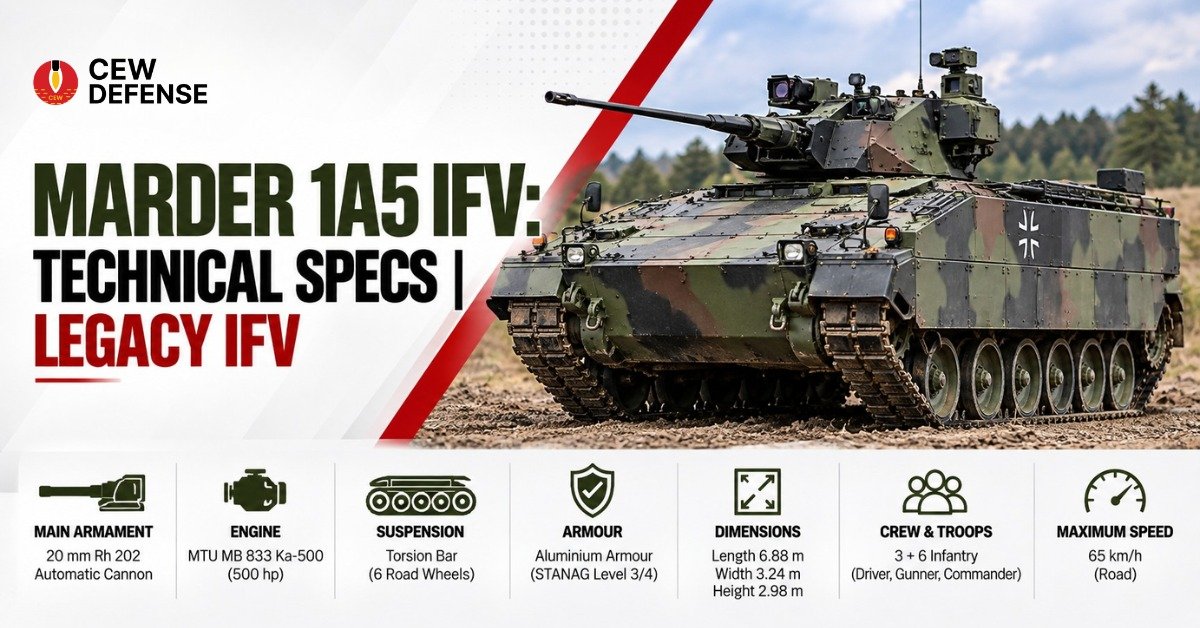
The Marder 1A5 IFV stands as a prominent German legacy infantry fighting vehicle platform. Military engineers originally designed this armored chassis to transport infantry troops safely across hostile terrain. It continues serving various defense forces with its robust mechanical reliability and proven durability.
Operators highly value the upgraded protection systems integrated into this specific historical vehicle variant. Understanding its detailed technical specifications provides crucial insights into the evolution of European armored warfare. We will explore its development, armament, and ongoing operational relevance in modern contexts.
Historical Development
The Marder 1A5 IFV was born out of the tough demands of Cold War-era combat. West German defense contractors kicked off the original Marder project back in the late 1960s. Over the years, engineers kept upgrading the design to stay one step ahead of new anti-tank threats.
-
Initial development focused on creating a highly mobile platform for mechanized infantry units.
-
Early prototypes underwent rigorous testing to validate the suspension system under extreme conditions.
-
Collaborative efforts between military branches ensured the design met all operational requirements.
- Early Design Phases
-
Designers prioritized a low silhouette to minimize the vehicle target profile significantly.
-
The power pack received continuous refinements to sustain adequate speed under heavy armor loads.
-
Initial feedback from training exercises directly influenced the final production specifications.
- Armor Evolution
-
The 1A5 variant specifically introduced significant appliqué armor enhancements for urban combat scenarios.
-
Manufacturers integrated these improvements to ensure crew survival against modern kinetic energy penetrators.
-
This specific iteration represented a major leap forward in infantry fighting vehicle protection standards.
- Production Milestones
-
Historical records indicate that the upgrade program began during the early nineteen nineties.
-
Defense ministries recognized the urgent need to enhance survivability in asymmetric warfare environments.
-
The resulting vehicle successfully balanced its increased weight with acceptable mobility performance metrics.
Core Technical Specifications
The Marder 1A5 IFV features a conventional layout with the engine positioned at the front. This specific arrangement allows rear compartment access for rapid infantry dismount operations during combat. The vehicle accommodates a three-person crew alongside six fully equipped infantry dismounts internally.
-
Its total combat weight reaches approximately thirty-three thousand five hundred kilograms fully loaded.
-
A powerful diesel engine generates sufficient horsepower to maintain excellent cross-country mobility standards.
-
The transmission system provides multiple forward and reverse gears for versatile tactical maneuvering capabilities.
- Mobility and Power
-
The torsion bar suspension gives you a remarkably smooth ride, even when bouncing over rough battlefield terrain.
-
Track tensioners keep the tracks tight to maintain grip, stopping them from derailing during high-speed maneuvers.
-
For stopping, it relies on both regular and parking brakes to give you solid, reliable control whenever you need it.
- Engine and Transmission
-
Substantial fuel capacity supports extended operational ranges without requiring immediate logistical resupply support.
-
The robust electrical system powers advanced communication suites and modern battlefield management networks.
-
Hydraulic systems assist the driver with steering and braking functions during complex maneuvers.
Weight and Dimensions
-
Advanced thermal management systems ensure the engine operates within safe temperature limits continuously.
-
Specialized tracks distribute the vehicle weight evenly to prevent sinking in soft terrain.
-
The steering mechanism allows for precise directional changes during complex tactical engagements.
Armament and Protection Systems
The primary weapon system consists of a fully stabilized twenty-millimeter automatic cannon. This Marder 1A5 IFV variant also carries a coaxial seven point sixty two millimeter machine gun. Gunners utilize advanced optical sights to engage aerial and ground targets with high precision.
-
The turret design allows for rapid traversal and elevation to track fast-moving threats continuously.
-
Applique armor panels protect the frontal arc and turret against heavy machine gun fire.
-
The vehicle also features a comprehensive NBC protection system for contaminated environment operations.
- Weaponry Upgrades
-
The main cannon fires high-explosive, incendiary, and armor-piercing tracer ammunition types.
-
Smoke grenade launchers provide immediate visual concealment during tactical withdrawal maneuvers.
-
The commander operates an independent periscope for enhanced situational awareness during missions.
- Defensive Measures
-
Ballistic protection meets stringent NATO standards for resisting small arms fire and shell fragments.
-
The rear ramp includes firing ports allowing dismounts to engage targets while remaining protected.
-
Integrated smoke grenade launchers provide immediate visual concealment during critical tactical withdrawal maneuvers.
- Survivability Features
-
The armor layout specifically addresses threats from rocket-propelled grenades and improvised explosive devices.
-
Ammunition storage incorporates blow-out panels to protect the crew from catastrophic detonations.
-
Fire suppression systems activate automatically to extinguish internal fires within milliseconds.
Operational Role in Modern Conflicts
Defense forces currently deploy this vehicle in peacekeeping and stability operations worldwide. Its proven reliability makes it an excellent choice for demanding multinational coalition environments. The Marder 1A5 IFV often operates alongside newer platforms like the advanced puma ifv during joint exercises.
-
This combination allows commanders to leverage both legacy durability and modern network-centric capabilities.
-
Troops appreciate the spacious rear compartment, which facilitates rapid deployment under direct enemy fire.
-
Mechanics find the modular design highly serviceable in austere forward operating base conditions.
- Tactical Deployment
-
Infantry squads utilize the rear ramp for rapid dismounting during ambush response scenarios.
-
The vehicle provides crucial fire support during the critical initial phases of an assault.
-
Reconnaissance elements value its cross-country performance when navigating dense forest environments.
- Logistics and Support
-
Logistics units maintain extensive spare parts inventories to ensure continuous operational readiness.
-
Crews conduct regular maintenance checks to prevent mechanical failures during extended missions.
-
The vehicle serves as a mobile command post for platoon leaders during complex operations.
- Joint Operations
-
Convoy operations benefit from the vehicle's robust armor when traversing hostile supply routes.
-
Urban combat scenarios highlight the importance of its thirty-sixty-degree turret elevation capability.
-
The platform continues to prove its worth in diverse climatic and geographical operational theaters.
Comparison with Contemporary European Platforms
The Marder 1A5 IFV holds its own when compared to newer European infantry fighting vehicles. While newer designs offer advanced digital networks, the Marder excels in mechanical simplicity. Countries operating legacy fleets appreciate the lower maintenance costs associated with older designs.
-
The vehicle armor protection remains highly competitive against many modern light armored threats.
-
Its twenty-millimeter cannon remains highly effective against unarmored and lightly armored targets.
-
Future battlefield requirements may eventually necessitate a complete fleet replacement with newer models.
- Platform Advantages
-
Proven mechanical reliability reduces the frequency of unexpected breakdowns during critical missions.
-
Extensive operator experience ensures that training new crews requires minimal additional time.
-
The widespread availability of spare parts simplifies long-term logistical support requirements.
- Modernization Potential
-
Continuous upgrades ensure the platform remains viable for secondary defense roles worldwide.
-
The transition period will likely see mixed fleets operating together for several upcoming decades.
-
Defense analysts note that hybrid fleet compositions offer unique strategic advantages during transitions.
- Cost Effectiveness
-
Budget constraints often dictate the pace at which older platforms receive comprehensive modernization packages.
-
Lower acquisition costs allow defense budgets to allocate funds toward other critical military needs.
-
The modular architecture permits incremental upgrades without requiring complete vehicle replacement.
Maintenance and Lifecycle Management
Sustaining the operational readiness of legacy platforms requires dedicated logistical support frameworks. Regular scheduled maintenance prevents minor mechanical issues from escalating into major system failures. Specialized training programs ensure that mechanics possess the necessary skills for complex repairs.
-
Inventory management systems track the availability of critical spare parts across multiple depots.
-
The Marder 1A5 IFV benefits from decades of accumulated technical knowledge and repair documentation.
-
Field technicians can often diagnose and resolve common issues using standardized troubleshooting procedures.
- Maintenance Best Practices
-
Daily pre-operation inspections identify potential safety hazards before mission deployment begins.
-
Scheduled fluid changes preserve engine health and prevent premature wear of internal components.
-
Track tension adjustments must occur regularly to maintain optimal mobility and prevent derailment.
- Lifecycle Extension
-
Comprehensive annual overhauls restore the vehicle to near original factory performance specifications.
-
Digital record-keeping improves the tracking of component lifespans and maintenance histories.
-
Cross-training personnel ensures that units retain mechanical expertise even during personnel transitions.
- Supply Chain Reliability
-
Lifecycle extension programs focus on replacing worn components before they reach their failure limits.
-
This proactive approach significantly reduces the total cost of ownership for defense ministries.
-
Continuous monitoring of vehicle performance data helps accurately predict future maintenance requirements efficiently.
-
Proactive supply chain management prevents unexpected delays during critical deployment phases worldwide.
-
Strategic stockpiling of high-wear items guarantees uninterrupted operational readiness for all units.
Manufacturing Excellence in Armored Components
Our company specializes in producing high-quality replacement parts for legacy armored vehicles. We manufacture robust tank undercarriage components specifically designed to withstand extreme battlefield stresses. Our precision-engineered track shoe assembly units guarantee optimal traction and extended service life.
-
Clients trust our manufacturing processes because we strictly adhere to rigorous military-grade standards.
-
We continuously invest in advanced metallurgy to improve the durability of our track systems.
-
Future production runs will incorporate even more resilient materials for harsh operational environments.
- Component Advantages
-
Our track shoes feature optimized grouser patterns for superior mud and snow traction.
-
The undercarriage assemblies undergo rigorous stress testing before final delivery to customers.
-
We offer customized solutions tailored to the specific requirements of various armored platforms.
- Quality Assurance
-
Dedicated support teams provide expert technical guidance for seamless component integration processes.
-
Advanced coating technologies protect our components from corrosion and environmental degradation.
-
Rapid manufacturing capabilities ensure minimal downtime for military units requiring urgent replacements.
- Future Innovations
-
Rigorous quality assurance protocols guarantee that every component meets strict military specifications.
-
Our logistics network ensures timely delivery of critical parts to forward operating locations.
-
Continuous research and development drives innovation in heavy-duty armored vehicle mobility systems.
-
Our dedicated engineering teams constantly evaluate new alloy compositions for superior track performance.
-
We understand that reliable mobility directly impacts mission success and crew survival rates significantly.
-
Every manufactured component undergoes strict dimensional checks to guarantee flawless fitment upon installation.
-
Our worldwide distribution network ensures that critical armored vehicle parts reach forward operating bases rapidly.
-
We pride ourselves on delivering unparalleled customer support throughout the entire procurement and installation phases.
Final Thought
The Marder 1A5 IFV remains a solid proof of enduring German armored vehicle engineering excellence. Its continuous evolution demonstrates the vital importance of adaptable design in modern military procurement strategies. Investing in quality undercarriage components maximizes the return on these reliable legacy platforms significantly.
This legendary platform will always be remembered as a cornerstone of European mechanized infantry doctrine.