What Is the M88A2 Hercules?
The M88A2 Hercules is the United States Army’s primary armored recovery vehicle (ARV), officially designated as the Heavy Equipment Recovery Combat Utility Lift and Evacuation System. Its sole battlefield mission is recovering, extracting, and field-repairing disabled or immobilized armored vehicles, most notably the M1 Abrams main battle tank.
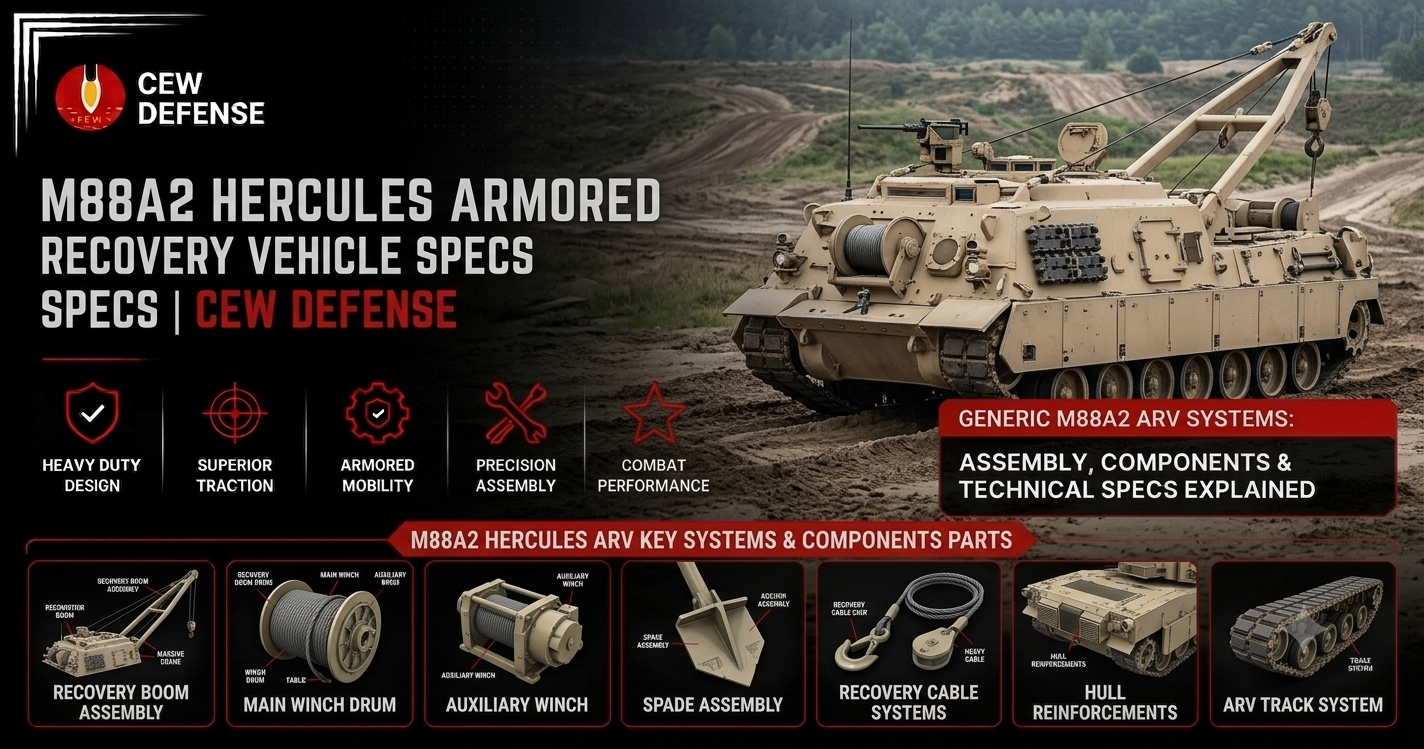
Built on a reinforced chassis derived from the M48 Patton tank, the M88A2 weighs approximately 70 tons and is powered by a 1,050-horsepower Continental diesel engine. Its core recovery systems include a 140,000-pound main winch, a 35-ton hydraulic crane boom, an auxiliary winch, and a rear earth spade that anchors the vehicle during high-force extractions.
The M88A2 is not a combat vehicle in the offensive sense. It carries a .50-caliber machine gun for crew self-defense, but its primary value is logistical and operational: keeping armored formations combat-effective by returning disabled vehicles to service rather than abandoning them on the battlefield.
Key facts for quick reference:
- Full name: Heavy Equipment Recovery Combat Utility Lift and Evacuation System
- Manufacturer: BAE Systems (formerly United Defense)
- In service since: 1997 (M88A2 variant)
- Weight: approximately 70 tons
- Crew: 4 (commander, operator/driver, rigger, assistant rigger)
- Main winch capacity: 140,000 lbs (280,000 lbs with snatch block)
- Crane lift capacity: 35 tons
- Primary recovery subject: M1A1 and M1A2 Abrams main battle tank
- Users: U.S. Army, U.S. Marine Corps, Egypt, Kuwait, Taiwan
The M88A2 remains in active frontline service as of the mid-2020s and is considered one of the most capable armored recovery vehicles operated by any NATO nation.
Historical Origins: From M88 to M88A2
Genesis of the M88 Program
The original M88 Hercules Armored Vehicle emerged in the late 1950s as the U.S. Army’s answer to a pressing logistical problem. The fielding of increasingly heavy main battle tanks that legacy recovery vehicles could not adequately handle. The M32 and M74 tank recovery vehicles, designed to support lighter WWII-era armor, were wholly insufficient against the tonnage of modern combat vehicles.
Bowen-McLaughlin-York (BMY) was awarded the development contract, producing a vehicle that borrowed the hull architecture of the M48 Patton while integrating purpose-built recovery systems. The M88 entered service in 1961 and immediately proved its utility during early Cold War deployments.
The M88A1 Interim Upgrade
As the M60 Patton and later the M1 Abrams entered service, the original M88’s recovery capacity became a limiting factor. The M88A1 introduced incremental enhancements, a more powerful Continental AVDS-1790 diesel engine, and modest improvements to the winch system, yet it still struggled with the 67-ton heft of a fully combat-loaded M1A1 Abrams.
Field commanders during Operation Desert Storm reported recovery incidents where the M88A1 required two vehicles in tandem to extract a stuck or disabled Abrams. This operational deficiency accelerated the development of a more capable successor.
Development of the M88A2
United Defense (later BAE Systems) undertook the M88A2 upgrade program through the 1990s. The program sought to dramatically increase lift, pull, and tow capacity through a combination of structural reinforcement, upgraded powertrain components, and new recovery hardware. The M88A2 entered full production in 1997 and has since become the standard ARV of the U.S. Army and Marine Corps armored formations.
Engineering Architecture: What Makes the Hercules Formidable
Powertrain and Mobility
At the core of the M88A2 is a Continental AVDS-1790-2DR diesel engine producing approximately 1,050 horsepower a significant increase over the M88A1’s powerplant. This engine drives an Allison CD-850-6A cross-drive transmission, enabling the vehicle to achieve road speeds of approximately 26 miles per hour and traverse grades up to 60 percent.
The suspension system employs torsion bars with hydraulic shock absorbers, providing adequate cross-country mobility even when carrying or towing heavy loads. Ground pressure is distributed across its wide tracks, reducing the risk of terrain-induced bogging that has historically plagued heavy recovery operations.
Armor Protection
Unlike the thin-skinned recovery trucks of earlier eras, the M88A2 is encased in rolled homogeneous armor (RHA) sufficient to provide ballistic protection against small arms, artillery fragments, and certain direct-fire threats. The vehicle weighs approximately 70 tons in combat configuration, rendering it one of the heaviest non-combat armored vehicles in service.
A commander’s weapon station mounts a .50-caliber M2 machine gun, providing the four-person crew with a measure of self-defense capability in contested environments. This armament is not incidental; recovery operations routinely occur under fire or in proximity to threat contact.
Communications and Electronics
Modern M88A2 variants incorporate SINCGARS (Single Channel Ground and Airborne Radio System) communications infrastructure, enabling the crew to maintain situational awareness and coordinate with the unit they are supporting. Night-vision-capable optics allow recovery operations to be conducted in conditions of limited visibility, an increasingly common operational requirement.
The Role of an Armored Recovery Vehicle
The fundamental raison d’etre of the M88A2 is battlefield recovery: the extraction and evacuation of disabled, damaged, or immobilized armored vehicles. This mission set is broader and more complex than it superficially appears.
A tank may become inoperable through enemy fire, mechanical failure, or terrain entrapment. In each scenario, the owning unit faces an urgent choice to recover the vehicle and return it to service, deny it to the enemy through destruction, or abandon it as a tactical exigency. The M88A2 enables the first and most preferable option in the vast majority of cases.
Beyond extraction, the Hercules functions as a field maintenance platform. Its crane can lift powerpack assemblies the engine and transmission unit of an Abrams weighs approximately 2.5 tons, enabling roadside replacement in forward areas. This capability dramatically reduces the time between vehicle incapacitation and return to the fighting force.
The Boom, Winch & Spade System Explained
The Main Winch
The M88A2 is equipped with a main winch rated at 140,000 pounds (approximately 63.5 metric tons) of single-line pull. When rigged with a snatch block, effective pull capacity doubles to 280,000 pounds, sufficient to extract a fully combat-loaded M1A2 SEPv3 Abrams from most terrain-induced entrapments.
The winch drum accommodates 200 feet of 1.5-inch-diameter wire rope. Winching operations are controlled from within the vehicle, allowing crew protection during extraction activities under fire.
The Auxiliary Winch
An auxiliary winch rated at 30,000 pounds complements the primary system, used for lighter recovery tasks, self-recovery, and rigging operations. It can be deployed independently of the main winch, expanding operational flexibility during complex multi-vehicle recovery scenarios.
The Hydraulic Crane Boom
The A-frame boom assembly provides a vertical lift capacity of 35 tons. This is sufficient for extracting complete powerpacks from the M1 Abrams and M60 series tanks, as well as a range of other armored and wheeled vehicles. The boom is operated via hydraulic controls from a protected station, and its reach allows the Hercules to work on vehicles positioned laterally or to the front.
The Earth Spade
Perhaps the most underappreciated component of the M88A2 is its rear earth spade, a large hydraulically deployed blade that anchors the vehicle during high-force extraction operations. Without the spade firmly set into the ground, winch or boom operations at maximum capacity would simply drag the Hercules forward rather than moving the target vehicle.
The spade is capable of penetrating a wide range of terrain types, from loose desert sand to frozen ground. Its proper emplacement is a critical crew skill, and its deployment is among the first tasks performed upon arriving at a recovery site.
What Vehicles Can the M88 Recover?
The M88A2 is designed to recover any vehicle in the U.S. Army’s tracked armored inventory. Its primary recovery subject is the M1 Abrams main battle tank family, including the M1A1 and M1A2 in all variants, vehicles that weigh between 60 and 74 tons depending on configuration.
Beyond the Abrams, the Hercules regularly recovers the M2/M3 Bradley Infantry Fighting Vehicle and Cavalry Fighting Vehicle (approximately 33 tons), the M109 Paladin self-propelled howitzer (approximately 32 tons), the M270 Multiple Launch Rocket System (approximately 25 tons), and various variants of the M113 armored personnel carrier.
With appropriate rigging and configuration, the M88A2 can also assist in the recovery of certain wheeled vehicles, though this is secondary to its primary tracked-vehicle mission. Its capacity renders it the most capable ARV in the U.S. inventory and among the most capable in NATO.
What Happened to the M88A2? Current Status
The M88A2 Hercules remains in active service with the United States Army and Marine Corps as of the mid-2020s. Contrary to any suggestion of obsolescence, the platform is actively maintained, upgraded, and fielded with frontline armored units worldwide.
Concerns about its adequacy have arisen periodically, particularly as the M1A2 SEPv3 has added weight through enhanced armor packages and electronic systems, pushing fully loaded combat weights toward 74 tons. This has renewed discussions about the M88’s theoretical ceiling and whether a successor platform is required for high-intensity conflict against near-peer adversaries.
In response, BAE Systems and the U.S. Army have explored the M88A3 upgrade program, discussed below. Simultaneously, existing M88A2 fleets have received incremental improvements through Product Improvement Programs (PIPs) that enhance electronic systems, crew comfort, and certain mechanical components.
The M88A2 has been exported to several allied nations, including Egypt, Kuwait, and Taiwan, further attesting to its enduring operational relevance.
The M88A3: Evolution of the Platform
The M88A3 program represents the next evolutionary step for the Hercules lineage. Conceptually, the upgrade package aims to address the growing weight disparity between current M88A2 capabilities and the increasing mass of next-generation armored vehicles.
Key proposed enhancements include a more powerful engine producing upward of 1,500 horsepower, an upgraded transmission, a reinforced chassis structure to handle greater sustained loads, and an improved winch system exceeding the current 140,000-pound rating. Additionally, the M88A3 is expected to incorporate digital command-and-control systems compatible with the Army’s Integrated Tactical Network (ITN) architecture.
As of the mid-2020s, the M88A3 program has proceeded through various stages of concept development and early prototyping. Budgetary constraints and competing modernization priorities have tempered the pace of progression, though the operational requirement for a more capable ARV is widely acknowledged within Army acquisition circles.
Combat Deployments and Operational History
The M88 family has participated in virtually every major U.S. combat operation since Vietnam. During the Gulf War, M88A1 vehicles proved invaluable in recovering Abrams tanks that succumbed to the treacherous sand of the Kuwait Theater of Operations. The loose, powdery substrate immobilized even otherwise mechanically sound vehicles, creating a persistent and volume-intensive recovery demand.
Operation Iraqi Freedom and Operation Enduring Freedom saw M88A2 crews operating under fire in complex urban and mountainous terrain. Recovery operations in Fallujah, Mosul, and the Korengal Valley demonstrated both the vehicle’s capabilities and the personal courage required of its operators, who frequently performed extractions in direct contact with enemy forces.
The lessons of these engagements directly informed subsequent PIPs, particularly regarding crew survivability, electronic countermeasures integration, and urban mobility enhancements such as obstacle-clearing blade configurations.
The Weakest Tank Ever Fielded
Military historiography offers numerous candidates for the designation of the weakest operational tank. The answer depends substantially on the metric employed, armor protection, firepower, mechanical reliability, or operational effectiveness.
The Renault FT of World War I, while revolutionary for introducing the rotating turret concept, was protected by only 6 to 22 millimeters of armor and armed with either a 37mm cannon or a machine gun. By modern standards, it would be eviscerated by a single rifle-caliber armor-piercing round.
Among more contemporary examples, the Stridsvagn 103 (S-tank) of Sweden is sometimes cited for its unconventional design, though it was in fact a technically sophisticated and capable vehicle for its era. A more legitimate contender for minimal lethality is the Italian CV33 tankette of the interwar period, a two-man vehicle weighing barely 3.5 tons, armed only with machine guns, and protected by armor so thin it was vulnerable to heavy rifle fire.
In terms of modern operational failure, the Argentine TAM medium tank has sometimes been cited, not due to inherent design flaws but due to severe maintenance and funding deficiencies that rendered large portions of Argentina’s fleet non-operational for extended periods.
Most Powerful Military Vehicles in the World
Quantifying ‘most powerful’ requires definitional precision. By raw firepower and protection, the competition for the world’s most formidable military vehicle typically narrows to a handful of candidates.
Armored Ground Vehicles
The M1A2 SEPv3 Abrams is widely regarded as among the most capable main battle tanks in existence, combining 120mm smoothbore firepower, Chobham composite armor, depleted uranium armor inserts, active protection system integration, and advanced fire control systems.
Its competitors for the title include the German Leopard 2A7, the Israeli Merkava Mk. 4, the British Challenger 3, and the Russian T-14 Armata the latter representing a next-generation design whose actual production numbers and operational status remain subjects of considerable uncertainty.
Heavy Firepower Systems
For raw destructive power, the self-propelled howitzer and multiple rocket launcher categories deserve mention. The U.S. M109A7 Paladin fires 155mm artillery rounds with range and precision that can obliterate fortifications kilometers distant. The M270 MLRS and M142 HIMARS can deliver guided munitions to targets over 70 kilometers away, with precision measured in meters.
Naval and Aerial Assets
Expanding beyond ground forces, the Nimitz and Gerald R. Ford-class aircraft carriers arguably represent the most powerful individual military platforms ever constructed, capable of projecting air power across thousands of miles. The B-21 Raider stealth bomber, as of the mid-2020s, entering service, represents the apex of strategic aerial strike capability.
Top 10 Tanks in the World Today
Ranking main battle tanks involves inherently subjective weighting of competing attributes: firepower, protection, mobility, crew ergonomics, logistics footprint, and combat-proven effectiveness. The following represents a broadly accepted hierarchy based on open-source defense analysis as of the mid-2020s.
1. M1A2 SEPv3 Abrams (USA): The benchmark against which most others are measured, combining battlefield-proven performance with continuous modernization.
2. Leopard 2A7+ (Germany): Widely exported and operationally respected, featuring superb fire control and armor integration.
3. Merkava Mk. 4M (Israel): Uniquely optimized for crew survivability with Trophy active protection and innovative hull design.
4. Challenger 3 (United Kingdom): The latest evolution of Britain’s heavily armored main battle tank, incorporating a new 120mm smoothbore cannon.
5. K2 Black Panther (South Korea): A technologically dense platform with an autoloader, advanced fire control, and impressive cross-country mobility.
6. Type 10 (Japan): A highly mobile and modular tank designed for Japan’s specific terrain and logistical constraints.
7. T-90M (Russia): The most capable production variant of Russia’s T-90 family, incorporating improved fire control and the Relikt explosive reactive armor suite.
8. Leclerc XLR (France): A highly automated tank with an autoloader and sophisticated battlefield management systems.
9. Altay (Turkey): A domestically developed MBT reflecting Turkey’s ambition for indigenous defense production.
10. VT-4/MBT-3000 (China): China’s primary export MBT, fielded by Pakistan and other nations, with capabilities competitive within its weight class.
Comparative Analysis: M88A2 vs. Other Recovery Vehicles
The M88A2 operates within an international cohort of armored recovery vehicles, each reflecting the doctrinal priorities and industrial capabilities of its nation of origin.
The German Bergepanzer 3 Büffel, built on the Leopard 2 chassis, provides a direct NATO analog to the Hercules. With a winch capacity of approximately 980 kN (220,000 lbs), the Büffel marginally exceeds the M88A2’s winch rating and is similarly capable of recovering Leopard 2 variants. It is widely considered the M88A2’s closest peer competitor.
The British Challenger Armored Repair and Recovery Vehicle (CRARRV), based on the Challenger 1 hull, provides UK armored formations with ARV capability, though its winch and lift capacity are somewhat below those of the Hercules, a constraint acknowledged in British Army capability assessments.
Russia’s BREM-1, based on the T-72 chassis, represents a significantly lighter recovery solution with correspondingly reduced recovery capacity. Its prevalence throughout Soviet-successor and export customer inventories makes it the most numerically common ARV globally, though its suitability against the heavier T-80 and T-90 platforms is questioned.
Crew, Training & Operational Requirements
The M88A2 is operated by a crew of four: a vehicle commander, an operator/driver, a rigger/mechanic, and an assistant rigger. Each crew member requires specialized training that extends well beyond vehicle operation.
The 91A Military Occupational Specialty (MOS) Abrams Tank System Maintainer and 91H Track Vehicle Repairer form the technical backbone of M88A2 crews. Soldiers must demonstrate proficiency in vehicle recovery techniques, rigging procedures, field maintenance operations, and tactical movement in armored formations.
Recovery operations are physically demanding and cognitively complex. A crew recovering a disabled Abrams in a contested environment must simultaneously manage winch tension, boom positioning, earth spade set, radio communications, and force protection all under time pressure and potentially under fire. The cognitive load is significant, and training pipelines reflect this complexity through progressive scenario-based instruction.
Maintenance and Logistical Footprint
The M88A2’s own maintenance requirements are substantial, reflecting the complexity of the systems it houses. Regular preventive maintenance checks and services (PMCS) encompass engine oil analysis, track tension adjustment, hydraulic system inspections, and winch cable condition assessments.
The vehicle’s 1,050-horsepower engine, while robust, requires the same AVDS-1790 support infrastructure as the M60 tank fleet a logistical commonality that simplifies sustainment for units operating both platforms. However, the transition toward Abrams-exclusive armored formations has gradually reduced the prevalence of AVDS-equipped mechanics, creating niche expertise requirements.
Fuel consumption is significant: the M88A2 consumes approximately 57 gallons per hour under load, placing demands on fuel resupply that must be factored into operational planning. In high-tempo recovery scenarios, fuel management can become a limiting operational constraint.
Future of Armored Recovery in Modern Warfare
The evolving character of warfare raises legitimate questions about the future relevance of the ARV concept. Unmanned ground vehicle (UGV) development, directed energy weapons, and autonomous systems are collectively reshaping the battlefield in ways that may alter the recovery mission profile.
However, as long as heavy armored vehicles remain central to land warfare doctrine, the requirement for recovery assets will persist. The physics of armored combat vehicles immobilized by fire, terrain, or mechanical failure are unlikely to be abolished by technological novelty. What may change is the platform performing the recovery function: future ARVs may incorporate optionally manned designs, improved active protection, and AI-assisted recovery planning tools.
The Army’s Next-Generation Combat Vehicle (NGCV) program, which encompasses the Armored Multi-Purpose Vehicle (AMPV) and the Optionally Manned Fighting Vehicle (OMFV), will likely necessitate a corresponding recovery vehicle upgrade. The weight and technological complexity of future platforms will place even greater demands on whatever succeeds the M88A2.
The Strategic Value of Recovery Vehicles
The strategic significance of the ARV is frequently underestimated in public discourse, which naturally gravitates toward the kinetic dimensions of warfare. Yet in the economics of armored combat, the recovery vehicle exercises outsized influence.
A single M1A2 SEPv3 Abrams costs approximately $10 million. The logistical and operational cost of destroying, rather than recovering, a disabled tank can therefore be enormous, not merely in monetary terms but in combat power and strategic signaling. Nations that can sustain and recover their armored fleets under fire demonstrate a materiel resilience that directly translates into operational staying power.
During the Gulf War, the U.S. Army recovered and returned to service a remarkable proportion of disabled Abrams tanks, including several that absorbed significant direct fire. This recovery efficiency contributed meaningfully to the coalition’s sustained operational tempo and ultimately to the rapid defeat of Iraqi ground forces.
Conclusion
The M88A2 Hercules stands as a testament to the enduring importance of the sustainment dimension of warfare. In an era captivated by precision munitions, stealth technology, and autonomous systems, the Hercules quietly performs the foundational work of keeping armored formations combat-effective.
Its history mirrors the evolution of American armor doctrine: from the early Cold War requirements of the M48/M60 era through the transformative demands imposed by the Abrams. Its current form reflects decades of operational feedback and engineering refinement. Its future, whether in M88A3 guise or an entirely new platform, will be shaped by the relentless upward trajectory of main battle tank weight and capability.
Understanding the M88A2 is not merely an exercise in vehicle appreciation. It illuminates a broader truth about warfare: that the capacity to persist to recover, repair, and return is as decisive a military capability as the capacity to destroy. The Hercules embodies that truth with 70 tons of uncompromising steel.