
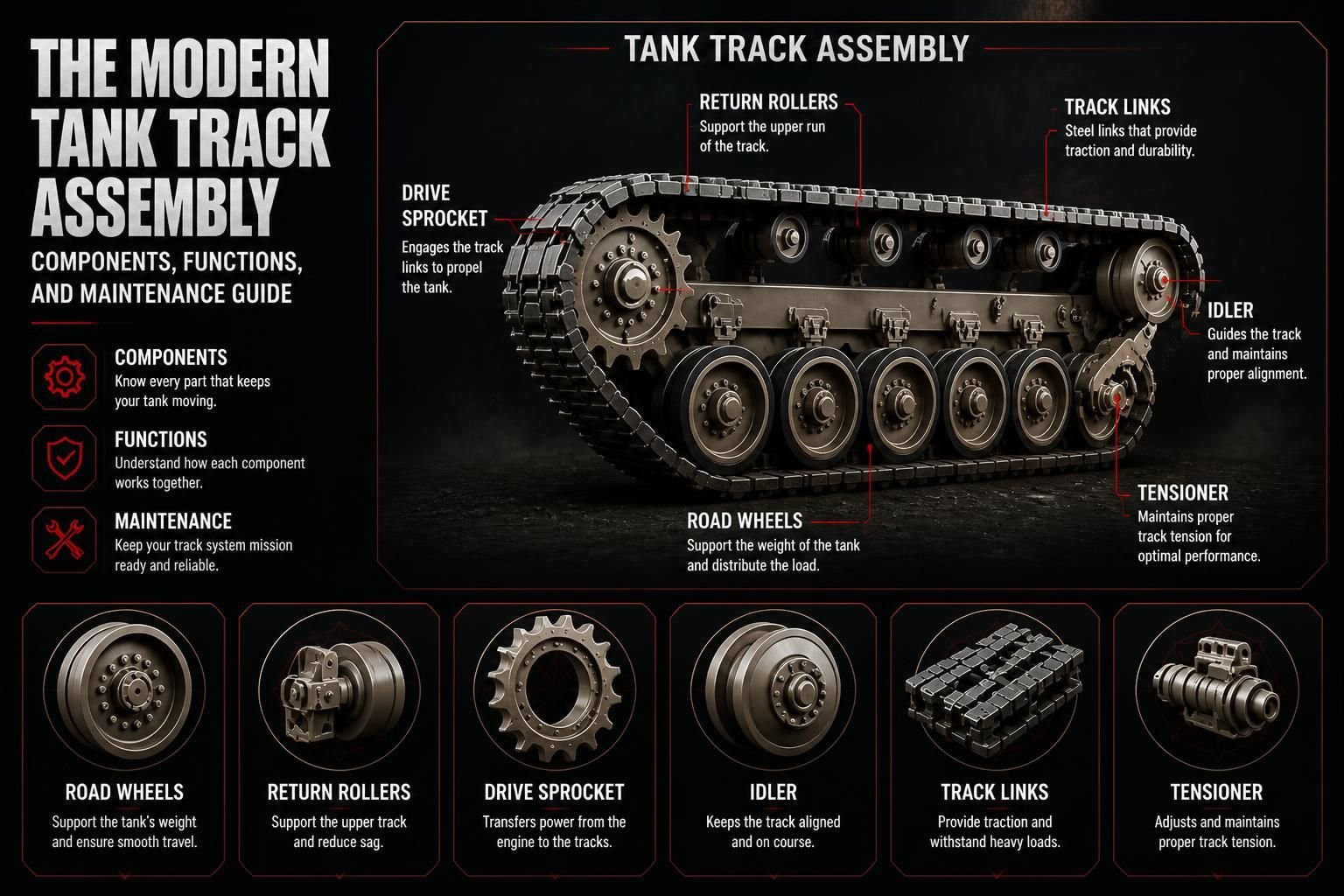
Modern armored warfare demands unmatched mobility and extreme durability across the most hostile terrains. Heavy combat vehicles rely entirely on a robust tank track assembly to maintain tactical superiority. This continuous loop system distributes immense vehicle weight evenly to prevent sinking in soft ground. Unlike wheeled platforms, tracked systems provide exceptional traction and stability during intense cross-country operations. Understanding its complex design and strict maintenance protocols ensures maximum operational readiness for military forces.
What Is a Tank Track Assembly?
- Purpose and Function
A tank track assembly enables heavy armored vehicles to traverse mud, sand, and snow. It provides unmatched traction by wrapping around drive sprockets, idler wheels, and road wheels. This continuous loop converts engine power into forward or reverse motion efficiently and reliably. Without it, main battle tanks would lose their essential cross-country mobility entirely today.
- Key Components
The core elements include track links, pins, bushings, and track shoes working in unison. Each component must withstand extreme stress, abrasion, and shock during high-speed tactical maneuvers. Proper alignment and material integrity ensure smooth operation over thousands of operational miles. Failure in any single part can compromise the entire mobility system instantly today.
Tank Track Assembly Design
- Track Links
Track links form the backbone of the assembly, typically forged from high-strength alloy steel. They interlock to create a flexible yet durable chain that bends around suspension components. Similar design principles are also used in tanks where durability and mobility remain critical operational requirements. Modern designs feature hollow cavities to reduce weight without sacrificing structural integrity significantly. Precision machining ensures consistent geometry for reliable engagement with drive sprockets every time.
- Track Pins and Bushings
Track pins connect adjacent links, while bushings act as wear-resistant sleeves inside each link. These components endure constant rotational friction and compressive loads during continuous vehicle movement. Hardened surfaces and proper lubrication extend service life under harsh battlefield conditions daily. Worn pins or bushings lead to excessive play, noise, and eventual track failure quickly.
- Track Shoes
Track shoes are bolted or integrally cast onto links to enhance grip on various surfaces. Some feature grousers, which are raised ridges that dig into soil for maximum propulsion. Rubber-padded variants protect paved roads while maintaining off-road capability in mixed terrain environments. Shoe width directly affects ground pressure and flotation over soft ground very effectively.
Technical Specifications Overview
How a Tank Track Assembly Works
- Power Transmission
Engine torque transfers through the transmission to the final drive and drive sprocket. The sprocket teeth engage with track link notches, pulling the entire assembly forward smoothly. This mechanical linkage ensures efficient power delivery even during steep climbs or sharp turns. Reverse motion works identically but in the opposite direction through careful gear selection.
- Traction and Stability
The large contact area between tracks and ground minimizes slippage on loose surfaces. Weight distribution across dozens of road wheels enhances stability on slopes and uneven ground. This system allows tanks to climb obstacles that would easily immobilize wheeled vehicles. Lateral forces during turning are absorbed by the track's flexibility and suspension design.
- Terrain Adaptability
From Arctic tundra to desert dunes, the tank track assembly performs reliably everywhere. Modular designs allow quick replacement of damaged sections in field maintenance scenarios easily. Adjustable tension systems compensate for thermal expansion, wear, or different terrain demands effectively. This adaptability makes tracked platforms indispensable in diverse global military operations today.
Types of Tank Track Assemblies
- Steel Track Assemblies
Traditional steel tracks offer maximum durability and resistance to ballistic damage in combat zones. They are standard on main battle tanks like the M1 Abrams and Leopard 2 platforms. Though heavy, their ruggedness justifies the weight penalty in high-threat environments globally today. Regular maintenance prevents cracking and fatigue in high-stress operational cycles consistently over time.
- Rubber-Padded Tracks
These feature rubber blocks bonded to steel links to reduce road surface damage significantly. They are common on lighter armored vehicles during peacetime training and highway deployments. They provide quieter operation and better ride quality on urban infrastructure and paved roads. However, rubber degrades faster under extreme heat or prolonged off-road use regularly today.
- Modular Track Systems
Modern assemblies use bolt-on segments for rapid field replacement without full disassembly requirements. Damaged sections can be swapped in minutes using basic tools at forward operating bases. This design reduces downtime and logistical burden during extended deployments overseas very effectively. Modularity also supports customization for mission-specific terrain or threat profiles accurately and quickly.
Performance and Durability
- Wear Resistance
High-grade steel alloys and surface hardening treatments maximize resistance to abrasion and impact. Tracks operating in sandy or rocky environments experience accelerated wear without proper daily care. Regular inspection identifies early signs of cracking, elongation, or link deformation very reliably. Timely replacement prevents catastrophic failure during critical tactical movements unexpectedly on the battlefield.
- Load-Bearing Capacity
A typical tank track assembly supports fifty to seventy tons of dynamic vehicle weight. Each link and pin must handle immense shear and compressive forces during acceleration. Engineering margins account for shock loads from jumps, drops, or sudden braking events safely. Overloading or poor maintenance drastically reduces safe operational limits over extended time periods.
- Maintenance Requirements
Crews must check track tension daily using manufacturer-specified sag measurements very precisely today. Lubrication of pins and bushings reduces friction and extends component lifespan significantly overall. Debris removal from between links prevents jamming and uneven wear during rotation cycles. Scheduled overhauls at depot facilities restore performance to near-new condition very reliably.
Military Applications
- Main Battle Tanks
The M1 Abrams, Challenger 2, and T-90 all depend on robust tank track assembly systems. These platforms require maximum durability due to their heavy weight and high-speed cross-country demands. Track reliability directly impacts survivability during offensive armored thrusts in contested combat zones. Modernization programs often include upgraded track systems for enhanced mobility and operational longevity.
- Infantry Fighting Vehicles
Vehicles like the Bradley Fighting Vehicle use a lighter but highly durable tank track assembly. They balance troop protection, firepower, and mobility across varied operational theaters globally today. Quick repair capability is essential for maintaining squad transport during extended engagements daily. Track design supports rapid deployment via strategic airlift when configured properly by engineers.
- Armored Recovery Vehicles
Recovery platforms such as the M88 Hercules use reinforced tracks to tow disabled tanks safely. Their assemblies must handle extreme static and dynamic loads during winching operations regularly today. Extra-wide tracks reduce ground pressure when operating on soft or unstable recovery sites. Reliability is non-negotiable when retrieving multi-million-dollar combat assets under heavy enemy fire.
Common Track Assembly Challenges
- Track Wear
Continuous contact with abrasive surfaces causes gradual thinning of link plates and shoes. Uneven wear often signals misalignment, suspension issues, or improper tension settings incorrectly applied. Monitoring wear patterns helps predict remaining service life and schedule proactive replacements timely. Ignoring wear leads to broken links or derailment during high-stress maneuvers very suddenly.
- Pin and Bushing Failure
These components suffer from metal fatigue, corrosion, and loss of lubrication over time. Excessive play between pins and bushings creates loud clattering and uneven power transfer. In severe cases, pins can shear, causing immediate track separation and mission abort. Preventive maintenance includes periodic greasing and ultrasonic inspection for internal structural cracks.
- Track Tension Adjustment
Too loose, and the track may derail; too tight, and it accelerates component wear rapidly. Tension changes with temperature, load, and accumulated wear during extended missions daily today. Modern vehicles use hydraulic or mechanical tensioners for precise, tool-free adjustments very easily. Crews must verify tension after every major operation or transport event consistently today.
Future Advancements in Tank Track Technology
Next-generation materials like nanostructures steel promise lighter weight and greater fatigue resistance. Self-lubricating bushings and composite track shoes could reduce maintenance frequency dramatically over time. Integrated sensors may monitor real-time stress, temperature, and wear for predictive maintenance alerts. Electric and hybrid drive systems will demand new track designs optimized for torque profiles. Autonomous armored vehicles will require ultra-reliable tracks with minimal human intervention needed daily. Manufacturers like CEW Defense are pioneering advanced casting techniques for next-gen track components. Partnering with us ensures your armored vehicles receive the highest quality mobility parts. The future of the tank track assembly remains bright with continuous technological evolution.