When defence procurement professionals evaluate a casting manufacturer, the word “best” rarely appears in their technical briefs. What they look for is something more substantive: evidence of disciplined engineering, verified quality systems, material traceability, and a proven track record of supplying parts that perform under conditions that ordinary industrial components simply were not designed to survive.
So the question is worth examining properly. What does it actually take to be a credible defence specification casting manufacturer? And when you place CEW Defense against those criteria, where does it stand?
What a Defence Specification Castings Manufacturer Actually Does
The role of a defence specification castings manufacturer goes considerably beyond producing shaped metal. These are suppliers responsible for components that may end up in armoured vehicle hulls, turret assemblies, track systems, weapons platforms, and undercarriage structures. Failure in any of these components, whether due to a material defect, dimensional variance, or inadequate surface treatment, can have consequences that extend far beyond a production line.
Producing castings to defence specification means working to controlled material chemistries, tight dimensional tolerances, and recognised international standards. It means being able to demonstrate traceability throughout the production process and subjecting every critical component to rigorous inspection before it leaves the facility. It also means having the engineering depth to support original equipment manufacturers, military procurement agencies, and prime contractors with technical documentation that stands up to scrutiny.
Why Defence-Grade Castings Demand a Higher Standard

Civilian and commercial castings are produced to performance bands that reflect the loads, temperatures, and cycles expected in normal industrial use. Defence-grade castings operate in an entirely different environment. Armoured vehicle components must absorb shock loads, resist ballistic and blast forces, function across extreme temperature ranges, and maintain dimensional integrity after repeated operational stress.
This shifts the entire manufacturing requirement. Material selection moves away from off-the-shelf alloys towards controlled compositions specified against standards such as ASTM, AISI, GOST, and MIL-spec references like MIL-T-11891. Heat treatment is not optional; it is engineered into the production sequence to achieve the hardness, toughness, and tensile properties demanded by the component’s role. Quality inspection cannot rely on sampling alone: critical castings require dimensional verification, non-destructive testing, and documented certification.
Organisations such as the Defence Science and Technology Laboratory (DSTL) and equivalent agencies in allied nations maintain material and manufacturing standards precisely because the consequences of getting this wrong in the field are irreversible.
What Buyers Look for When Selecting a Defence Casting Supplier

Experienced procurement teams assess potential suppliers across several dimensions before placing defence-related casting orders. The evaluation typically covers:
- Certification and compliance: ISO 9001:2015 certification is a baseline requirement, confirming that quality management systems are audited and maintained. Compliance with specific military material specifications is a further indicator of readiness to supply defence-sector work.
- Material capability: A supplier that can work across multiple alloy families, including wear-resisting steel, corrosion-resisting steel, low-alloy steel, carbon steel, and ductile iron, offers the versatility that multi-platform supply contracts demand.
- In-house machining: Castings that leave a foundry in rough form and require external machining introduce risk. Suppliers with integrated CNC machining capability reduce the number of handoffs, maintain dimensional accountability, and shorten lead times.
- Reverse engineering capability: In legacy platform maintenance and overhaul, original drawings are sometimes incomplete or unavailable. A manufacturer able to reverse-engineer worn components and reproduce them to specification is genuinely valuable to organisations keeping older platforms in service.
- Engineering support and documentation: Defence contracts increasingly require full material traceability, conformance certificates, and export-ready documentation. A manufacturer that understands these requirements and routinely produces this paperwork is demonstrably more capable than one that treats documentation as an afterthought.
CEW Defense: Examining the Evidence
CEW Defense is an ISO 9001:2015 certified manufacturer with over 75 years of precision engineering history. The company is a defence specification castings manufacturer and supplier of OEM-grade military vehicle parts, producing aluminium castings for defence applications alongside components in a broad range of steel and iron grades.
On the material side, the company works across grey iron, SG iron, low-alloy steel, corrosion-resisting steel, wear-resisting steel, and carbon steel. The material specifications published on the CEW Defense website align with ASTM, AISI, and GOST standards, and production conforms to MIL-T-11891 US military specifications. This is not a generalised capability claim: the published chemical compositions and mechanical property ranges correspond to recognised international references.
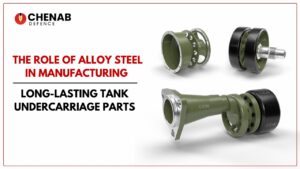
The platform coverage is also notable. CEW Defense supplies components for more than 30 armoured platforms, including the T-54/55/62/72/80/90 family, M60 Patton, M1 Abrams, Leopard 1 and 2, M113 APC, M2/M3 Bradley, and various artillery systems. Across these platforms, the company produces track shoe assemblies, undercarriage parts, hull parts, turret and gun parts, and gun tooling components.
Manufacturing Depth: From Casting to Finished Part

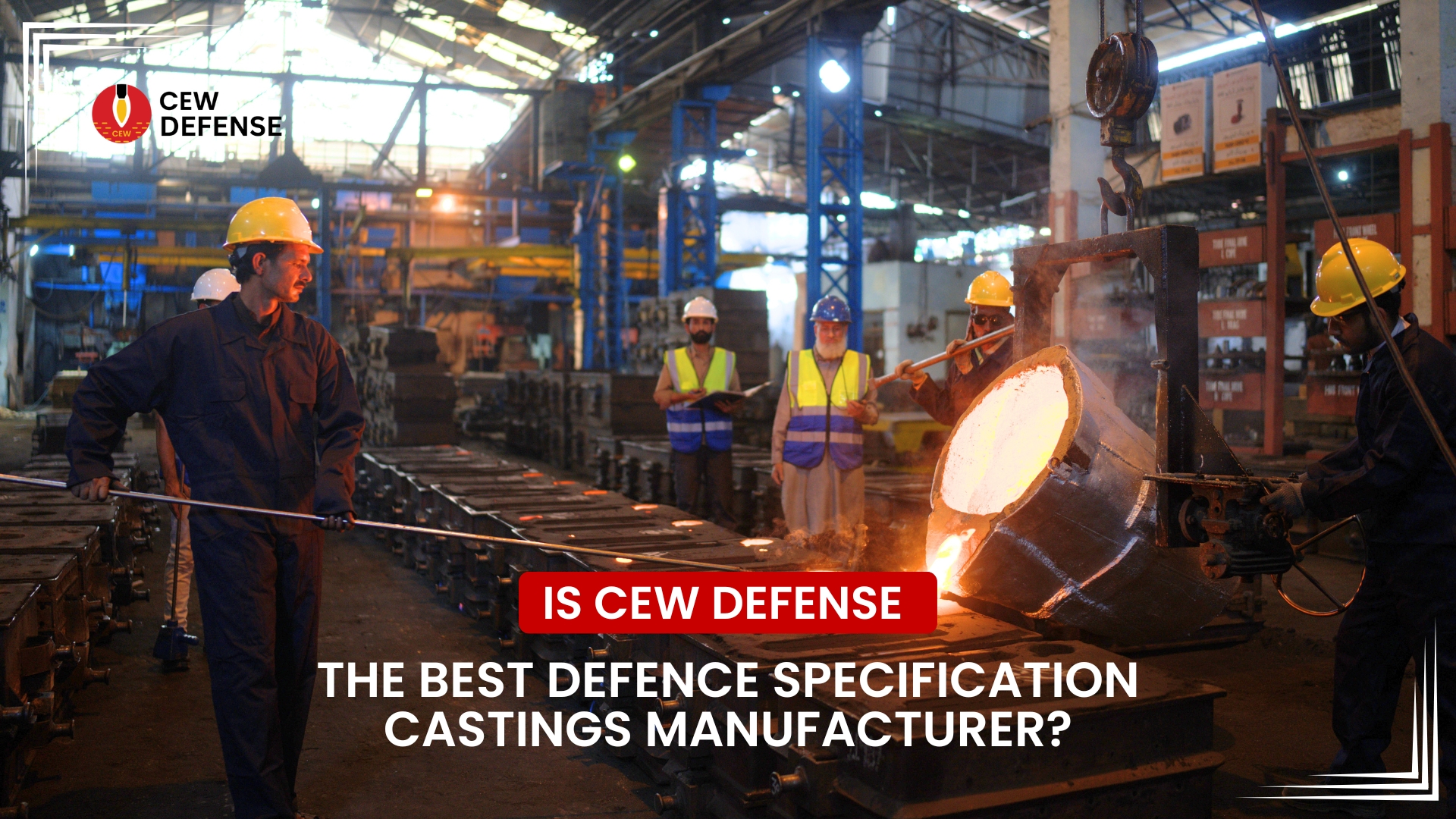
One of the practical indicators of a manufacturer’s credibility in the defence sector is whether it controls the full production sequence or relies on subcontracted steps that introduce variability. CEW Defense’s in-house capabilities, as described on the company’s design and development page, cover investment castings, forging, CNC machining, heat treatment, rubberization, and reverse engineering.
This matters because defence-grade components are not simply cast and shipped. They require post-casting operations to reach dimensional tolerance, achieve the required mechanical properties through thermal processing, and meet surface finish requirements where applicable. Controlling each of these steps internally means the manufacturer takes end-to-end responsibility for conformance, which is precisely what defence contracts demand.
The quality assurance programme and machining services at CEW Defense reflect this integrated approach, reinforcing the company’s position as a manufacturer rather than a distributor or assembler relying on third-party production.
The Compliance Question
The NATO Support and Procurement Agency (NSPA) and equivalent defence procurement bodies expect suppliers to demonstrate not only manufacturing competence but also regulatory compliance and the ability to produce export-ready documentation. For suppliers serving allied nations and international defence customers, this is a non-negotiable element of qualification.
CEW Defense is an authorised supplier to Heavy Industries Taxila (HIT) and a supply partner for defence forces, prime contractors, and procurement agencies across the United States and allied nations. Export-ready documentation and on-time delivery are cited as core commitments, reflecting an understanding of what defence procurement contracts actually require in practice.
This positioning, aligned with formally recognised quality standards and compliance with mil-spec material references, indicates a manufacturer that has taken the administrative and systems infrastructure of defence supply seriously, not simply the engineering side.
Honest Assessment: Where Does CEW Defense Stand?
Declaring any single manufacturer the “best” in a globally competitive sector requires evidence that goes beyond what any article can compile. The defence casting industry includes major Western foundries, state-backed facilities, and specialist manufacturers across several continents, many of which serve different platforms, customer bases, and supply chains.
What can be said with confidence is this: CEW Defense demonstrates the hallmarks of a credible, technically capable, and compliance-aware Defense specification casting manufacturer. The combination of long-standing engineering heritage, ISO 9001:2015 certification, mil-spec material conformance, broad platform coverage, integrated manufacturing capability, and an established position within recognised defence supply chains places it firmly in the category of suppliers that serious procurement teams should evaluate.
For organisations sourcing precision castings for armoured vehicle maintenance, OEM programmes, or military spares replenishment, the question is not whether CEW Defense meets a theoretical standard of excellence, but whether it meets the specific requirements of the task at hand. Based on what the company presents, the answer, for a significant range of defence casting requirements, is that it does. For further information on CEW Defense’s products and manufacturing capabilities, visit the CEW Defense homepage or contact the team directly to discuss your requirements